
ASTANA – Kazakhstan marks the 115th anniversary of the birth of Kassym Amanzholov, one of the most influential Kazakh poets and translators of the 20th century, on Oct. 10. He is remembered for his distinctive poetic voice, powerful wartime poetry and contribution to the development of modern Kazakh literature.
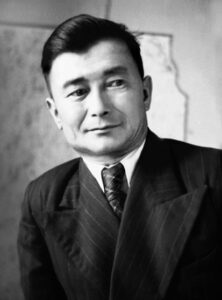
Kassym Amanzholov, one of the most influential Kazakh poets and translators of the 20th century. Photo credit: martebe.kz
Amanzholov was also among the poets who expanded the expressive possibilities of Kazakh verse, including through the use of a 10-syllable line that allowed poetry to more naturally convey conversational intonation.
He was born in 1911 in what is now the Karkaraly district of the Karaganda Region. He lost his parents at an early age and was raised by his older brother for several years. Amanzholov received his first education at a newly established rural school. In 1924, his brother enrolled him in a boarding school in Semipalatinsk, where he studied until 1927. He then spent three years at the Semipalatinsk Veterinary College, where he wrote his first poems.
In 1930, Amanzholov moved to Almaty and worked for the “Leninshil Zhas” newspaper. A year later, he entered the Forestry Institute in Leningrad, now St. Petersburg. However, health problems and a lack of interest in the field led him to return to Kazakhstan several years later.
He joined the “Ekpindi Kurylys” newspaper in Uralsk, now Oral, where the city played an important role in his development as a poet and public figure.
Finding his voice
Amanzholov’s early poems appeared in newspapers including “Leninshil Zhas,” “Kyzyl Asker,” and “Pioner”. In Uralsk, he wrote some of his first poems about love and youth.
In 1935, after completing his military service, Amanzholov organized a theater troupe and became its artistic director. The troupe soon developed into a full-fledged theater, while Amanzholov’s talents as a poet, singer and performer attracted wider public attention.
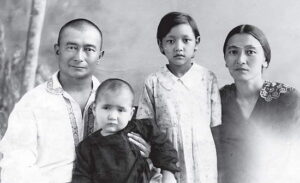
Amanzholov with his wife, Sakypzhamal, and daughters, Zhanna and Dariga in 1947. Photo credit: archive.np.kz
He was a gifted musician who played the dombyra, accordion, violin, and piano. He also composed music for his own poems, including “Dariga” and “Tugan El,” which remain among his best-known songs.
From 1936 to 1941, Amanzholov lived in Almaty and worked for “Socialist Kazakhstan” and the Union of Writers of Kazakhstan. Alongside poetry, he wrote articles, essays and satirical pieces. He published his first collection, “Omir Syry” (the Secret of Life), in 1938.
The following years marked a period of major creative growth. Poems such as “Nar Tauekel,” “Dauyl,” “Kokshetau,” “Oramal,” “Zaula, Zaula Turksib” and “Sultanmakhmut Turaly Ballada” reflected the breadth of his ideas, emotional depth and expressive language.
His work as a translator further expanded his literary horizons. He translated poetry by Alexander Pushkin, Mikhail Lermontov, Taras Shevchenko, Lord Byron and Vladimir Mayakovsky into Kazakh.
In 1940, he translated nearly a dozen of Mayakovsky’s poems. The translations were published in 1941 as a collection titled “Bar Dauyspen” (In Full Voice).
Poetry shaped by war
When the Second World War began, Amanzholov was called up for military service. Although he was eligible for an exemption, he refused it and volunteered for the front.
On his way to the front, his train passed through Uralsk. The journey inspired his famous poems about the Ural River, in which he addressed the river as a symbol of his homeland while preparing to leave for war.
Between 1941 and 1943, Amanzholov served in the Far East before being transferred to the western front. He remained there until the end of the war.
The experience profoundly influenced his poetry. Works such as “Oral,” “Saryarka,” “Baikal” and “Otip Baryp Zhatyrmyn” captured his feelings about his homeland and the long journey across Kazakhstan. Other poems, including “Ustimde Sur Shinelim,” “Martbek” and “Zhenis Dauysy” reflected the realities of military life. Meanwhile, “Elge Khat,” “Dostar Qaida Zhursinder?” and “Agaiyga’ focused on the inner world of a soldier separated from his homeland, family and friends.
One of Amanzholov’s most significant works emerged in 1943. He dedicated his poem “Akyn Olіmi Turaly Anyz” (The Legend of the Poet’s Death) to his friend, young poet Abdulla Zhumagaliyev, who was surrounded by enemy forces and died in battle. The poem brought Amanzholov widespread recognition and became one of the landmark works of Kazakh wartime poetry.
A literary bridge between generations
After the war, Amanzholov continued publishing his wartime poetry while producing new works. His poem “Bizdin Dastan” and the collection “Dauyl” appeared during the postwar years. Other collections, including “Balbobek,” “Nurly Dunie” and “Tandamaly Shygarmalar” (Selected Works), followed between 1949 and 1952.
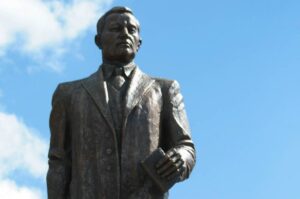
Monument to Amanzholov in Karagandy. Photo credit: yvision.kz
Kazakh writer and Honored Figure of Kazakhstan Sabit Dosanov, who studied Amanzholov’s work and wrote about his life, described him as a “golden bridge” between two generations of Kazakh poets.
According to Dosanov, Amanzholov emerged between the generation of poets who were repressed during the Soviet period and the literary generation that followed. After the deaths and persecution of major figures such as Magzhan Zhumabayev, Shakarim Kudaiberdiuly, Saken Seifullin and Ilyas Zhansugurov, Amanzholov helped fill a major gap in Kazakhstan’s literary development.
“Amanzholov was a poet-innovator who moved away from the didactic traditions of earlier poetry. His war poems were distinguished by their realism and emotional depth, portraying not only heroism and patriotism but also the pain of war and the longing of young soldiers for their homeland and peaceful life,” Dosanov said.
Amanzholov’s health began to deteriorate in 1947, and he was periodically confined to bed. Yet illness did not stop him from writing. His poem “Ozim Turaly” (About Myself) reflects on his life and his calling as a poet.
He took part in the opening of the Third Congress of Writers of Kazakhstan in September-October 1954. His health worsened later that year, and he died on Jan. 18, 1955, at the age of 43.
Despite his relatively short life, Amanzholov left a substantial literary legacy. Some of his poems and songs have been lost, but his surviving works were collected in a four-volume edition published between 1977 and 1980.
