
ASTANA – Chinese and Kazakh archaeologists have launched a joint study of archaeological sites in Kazakhstan that may link to the ancient Yuezhi people, Wang Jianxin, chief professor at Northwest University’s Research Center for Archaeological Cooperation on the Silk Road in Xi’an, said on the sidelines of an international archaeological symposium in Astana.
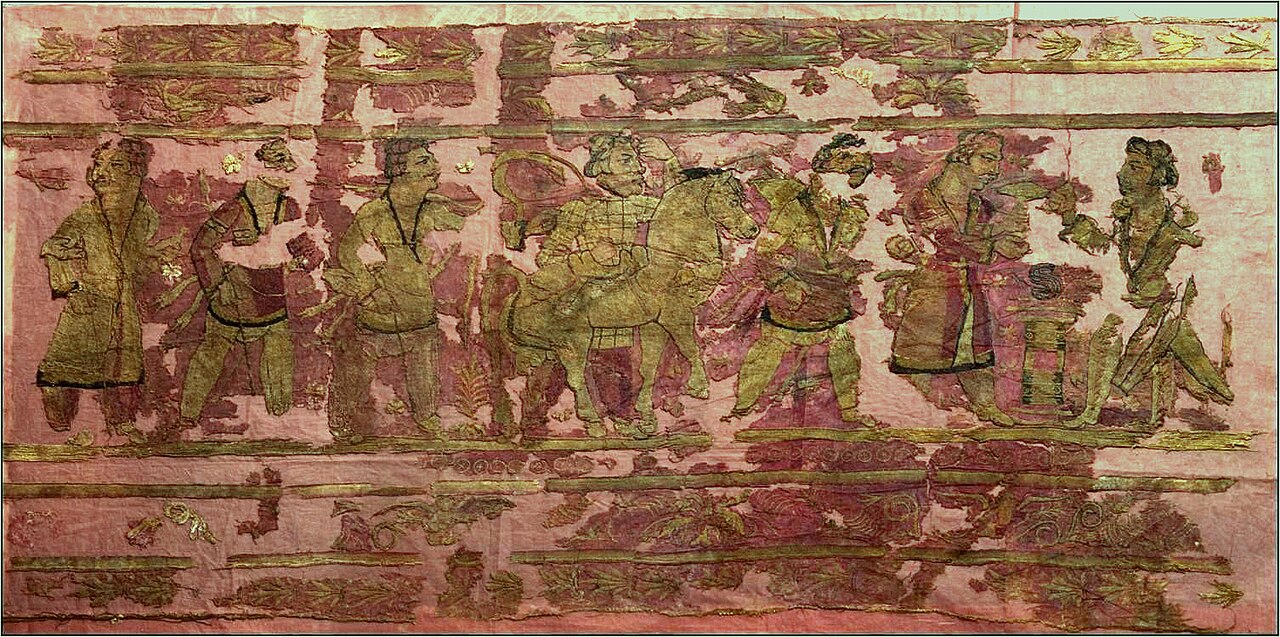
Figures depicted on an embroidered carpet from the Xiongnu Noin-Ula burial site. The figures are thought to represent the Yuezhi. 1st century B.C.–1st century A.D. Photo credit: Wikipedia
The Yuezhi were an ancient people known primarily through Chinese historical records. According to Wang, the Greater Yuezhi are recorded in Chinese literature, while the location of archaeological remains associated with them remained largely unknown.
In 2000, Chinese archaeologists began excavations in northwestern China and identified what they believe was a major Greater Yuezhi settlement on the eastern edge of the Tianshan Mountains. Following conflicts with the Xiongnu, part of the Yuezhi population moved westward from China to Central Asia, passing through Zhetysu toward the Amu Darya basin.

Wang Jianxin, chief professor at Northwest University’s Research Center for Archaeological Cooperation on the Silk Road in Xi’an. Photo credit: inform.kz
“Western sources contain very little information about Yuezhi. That is why I began researching the subject 26 years ago. I initially searched for traces of the Yuezhi in China and later continued my research in Kazakhstan and other parts of Central Asia,” Wang told Kazinform news agency. .
Wang said sites associated with the Yuezhi may have existed in what is now Kazakhstan as early as the Early Iron Age.
The joint research by Chinese and Kazakh scholars is currently focused on two areas, such as the Altai Region in the East Kazakhstan Region and the Kazakh part of Zhetysu.
The first stage will involve archaeological surveys. Researchers will look for similarities between sites in Kazakhstan and previously studied sites in China that have been associated with the Yuezhi.
“First, we will clarify the findings. Then, we may conduct small-scale excavations,” Wang said.
Wang has conducted archaeological research along the Silk Road since 1999, focusing in part on locating traces of the ancient Yuezhi in Central Asia. In 2009, he led a Chinese archaeological team to Uzbekistan to conduct field surveys. The team identified the Sazagan site, associated with Kangju-era noble tombs, and the Rabat site, where researchers found remains believed to be linked to the Yuezhi.
According to Wang, some Yuezhi sites in Kazakhstan may have been discovered and even studied by archaeologists, but their connection to the ancient people has not yet been established.
Archaeologists may have already discovered and studied some Yuezhi sites in Kazakhstan, but their connection to the ancient people has yet to be established.
“These sites may have been excavated, but their identity was not recognized,” Wang said.
He plans to publish annual reports on the joint research results and eventually prepare a monograph.
