
ALMATY – Kazakhstan marks the 80th birthday of prominent Kazakh writer, playwright, translator, publisher and public figure Rollan Seisenbayev on Oct. 11, marking eight decades of a life closely intertwined with Kazakhstan’s literary and cultural history.
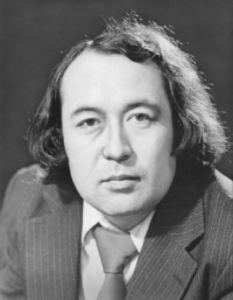
Seisenbayev in his early-career years. Photo credit: adebiportal.kz.
Born in Semei on Oct. 11, 1946, Seisenbayev graduated from the Semei Engineering and Technology Institute in 1970 before moving to Moscow in 1975 at the invitation of writer Georgy Markov. There, he completed the Higher Literary Courses and began a period of literary work that would bring him recognition across the Soviet Union and beyond.
His works include plays such as “Finding Yourself,” “At A Crossroads and Night Dialogue,” as well as collections of stories and novellas, including “The Day The World Collapsed.”
Seisenbayev is a winner of several international literary awards, including the Antoine de Saint-Exupéry International Prize, the Jack London International Literary Prize and an award from Columbia University. For his contribution to world culture, he was awarded the Gold Officer’s Cross of Poland, the Grand Gold Knight’s Cross of Hungary and the Order of Friendship of Cuba, all in 2006.
He is also a member of the Kazakh Writers’ Union and an academician of the World Academy of Art and Culture. Over the years, he has been named an honorary professor of several universities in Kazakhstan.
A writer shaped by life and travel
Between 1976 and 1991, Seisenbayev served as the representative of the Writers’ Union of Kazakhstan in Moscow. During those years, several of his best-known works were published, including “The Last Snow,” “The Road That Meets At The Mountain Top,” and “The Dead Wander In The Sands.”
The books established him as one of the widely read Kazakh authors of his generation and brought the realities of Kazakhstan to a broad Soviet readership. “The Throne Of Satan,” in particular, was translated into several foreign languages and received international literary recognition in Europe.
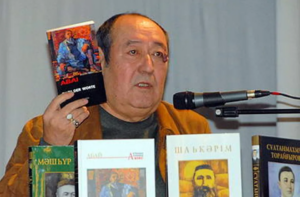
Seisenbayev during a press conference on the collection of books dedicated to Kudaiberdiuly. Photo credit: novayaepoxa.com.
His friend, Abai scholar and candidate of technical and philosophical sciences Asan Omarov, remembers Seisenbayev as a writer who regarded life experience as an essential part of his craft.
During one journey together, Seisenbayev told Omarov that great literature could not emerge from an uneventful life. He spoke of spending decades traveling across Russia, Siberia and Kazakhstan, later extending his journeys to Europe and the United States.
“How many people I met, how many I became acquainted with — I even met unfortunate people who were in prison,” Seisenbayev recalled, according to Omarov.
Those journeys became part of the writer’s literary world. His works are marked by close attention to people, their choices and inner conflicts, alongside a deep attachment to Kazakhstan and its landscape.
“The Kazakh steppe, fragrant with wormwood, is silent. (…) You want to walk freely and peacefully across this boundless steppe. The dormant honour of the Kazakh people and their spirit, unable to flare up to their full strength, live in this vast steppe. Undoubtedly, the golden cradle of Kazakh happiness is here, in this boundless steppe,” Seisenbayev wrote in one of his works.
Omarov sees this combination of intellectual reflection, human experience and national consciousness as one of the defining features of Seisenbayev’s writing.
Preserving the memory of the Semipalatinsk tragedy
Perhaps one of the most powerful examples of Seisenbayev’s literary engagement with Kazakhstan’s history is “The Day The World Collapsed,” written in 1988 about the Semipalatinsk nuclear testing site. The work recalls the first hydrogen bomb test in the region through the eyes and memories of those who witnessed it.
In one passage, Seisenbayev describes the confusion in a village near the Shyngystau mountains:
“The residents of the Shyngystau area encountered this disaster in the summer of 1953. It came suddenly, unexpectedly. (…) We, the children, could not understand what God had disturbed the peace of our quiet village. We stood bewildered, unable to understand anything. Has the war begun?”
The account then moves from confusion to the terrifying moment of the explosion. For Omarov, the importance of the book extends beyond its literary value. It preserves the testimony of a generation that experienced the consequences of nuclear testing first-hand.
“Almost all the witnesses of this terrible tragedy, of these scenes as if the end of the world had come, have passed away,” Omarov writes. “Therefore, we should be immensely grateful to Rollan-aga [a respectful Kazakh form of address] for preserving this tragedy in a book and leaving it for future generations.”
The work was translated into numerous languages and brought Seisenbayev international recognition.
A lifelong commitment to Abai
Seisenbayev’s connection to Abai is another important thread running through his literary and cultural work. During his years in Moscow, he contributed to promoting Abai’s legacy internationally. His wife Klara Seisenbayeva translated Abai’s “Qara Sozder” (Words of Wisdom) into Russian.
His commitment to the great Kazakh thinker later took a more institutional form. In 1995, Seisenbayev helped open the Abai House in London. In 2001, he established the International Abai Club and the Amanat literary magazine. Through the club and the magazine, some 200 volumes of works by classics of world literature were published, creating a platform for cultural exchange between Kazakhstan and the wider literary world.
These efforts reflected Seisenbayev’s understanding of literature not simply as a profession, but as a way of preserving cultural memory and connecting societies.
More than a writer
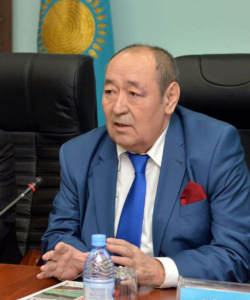
Seisenbayev’s literary work is marked by its strong focus on social issues and human struggles, earning him numerous national and international literary awards. Photo credit: kazpravda.kz.
Seisenbayev’s life has also included a less familiar chapter: sport. Omarov recalls watching the young Seisenbayev compete in a wrestling tournament in Semei in 1968, when he was still a student at the Technological Institute.
“We were a group of schoolchildren watching the final,” Omarov recalls. “Suddenly the hall erupted. One of the young wrestlers lifted his opponent, threw him over his shoulder and, after turning several times, slammed him onto the mat.”
A spectator sitting nearby identified the athlete as Seisenbayev, describing him as a student of the Technological Institute who repeatedly won using the same technique.
Seisenbayev later received the title of master of sport of the Soviet Union in wrestling. For Omarov, however, one of his friend’s most important qualities was not his literary fame or sporting achievements, but his willingness to support the work of others.
Supporting the next generation of scholars
Omarov recalls this personally. In 2008, he completed a research book on the life of Shakarim Kudaiberdiuly ahead of the poet and philosopher’s 150th anniversary. After completing the manuscript, Omarov struggled to find a way to publish it. He eventually learned that Seisenbayev was preparing Shakarim’s collected works in Almaty and sent him the manuscript.
“Two or three days passed, and Rollan-aga called me himself: ‘I read your book and could not put it down until dawn. Even tears came to my eyes. My dear Asan, your work is wonderful. I will immediately include it in the third volume, so don’t worry!’” Omarov recalls.
The study was subsequently published in the third volume of Shakarim’s collected works. Later that year, in an interview with Egemen Kazakhstan, Seisenbayev spoke warmly of Omarov’s research.
“There is a talented young man named Asan Omarov in Semei. He is thoroughly and carefully studying the biography of Kudaiberdiuly, pursuing deep analysis and discoveries that encourage new thinking. His pen is swift, his heart is pure, and he possesses many qualities of a true researcher. I was impressed by him,” Seisenbayev said.
For Omarov, the episode remains an example of his friend’s broader contribution to Kazakhstan’s cultural life, supporting not only his own literary work but also those engaged in preserving the country’s intellectual heritage.
A legacy beyond literature
Looking back at Seisenbayev’s career, Omarov sees a writer whose work has been closely connected with the major questions of his time: the human cost of nuclear testing, national identity, the legacy of Abai, the relationship between generations and the place of Kazakh culture in the wider world.
His literary career has also been accompanied by extensive public and publishing work, from promoting Kazakh literature abroad to bringing works of world literature to Kazakh readers. Now living in Almaty, Seisenbayev continues to share his experience with younger generations through lectures and meetings with students, keeping his connection with readers and aspiring writers alive.
