
ASTANA – President Kassym-Jomart Tokayev has called for coordinated regional action to address the Caspian Sea’s shrinking water levels, proposing a shared digital monitoring platform and an international biodiversity fund. The environmental crisis also poses growing risks to regional economies and communities, he said, speaking at the Caspian Ecological Summit on Oct. 9 in Avaza.
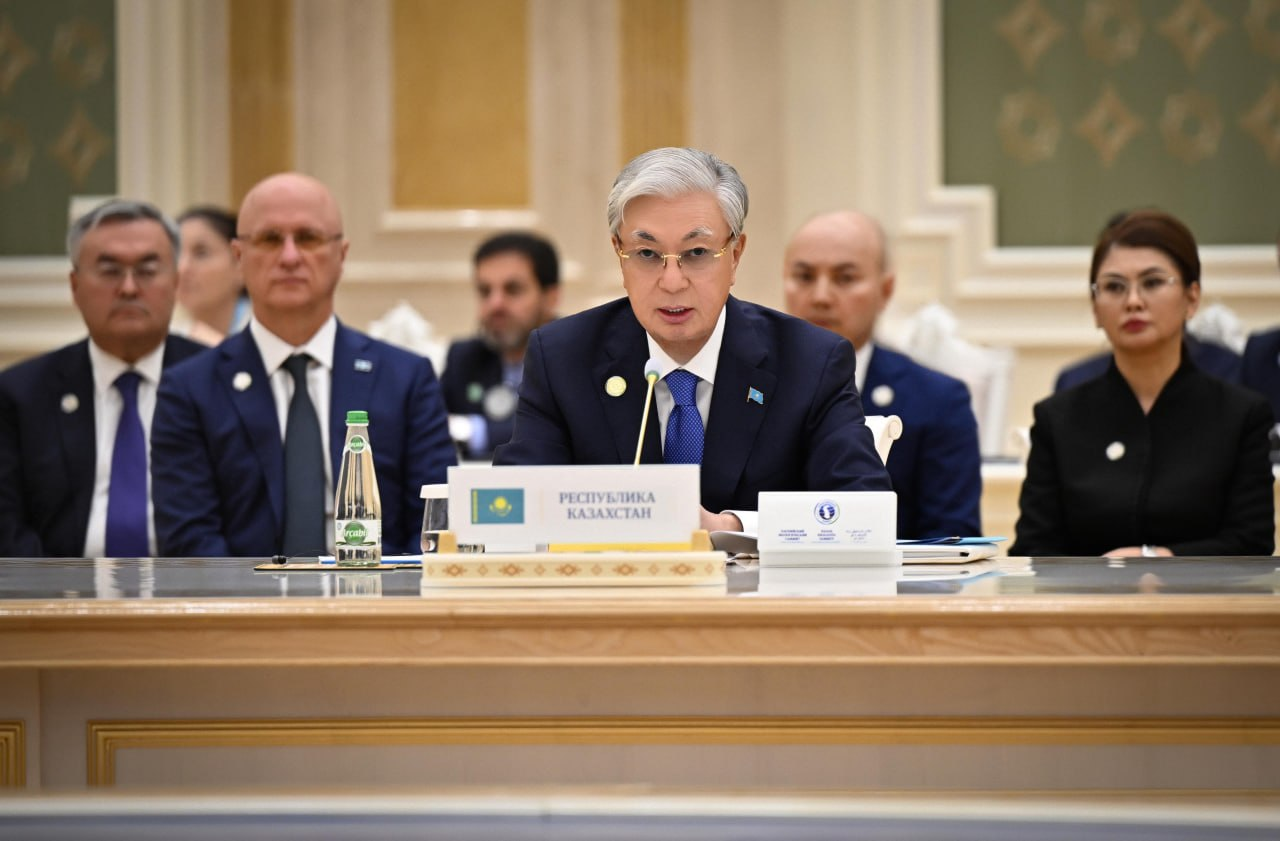
According to Tokayev, Caspian countries must strengthen regional cooperation and take coordinated action to address the sea’s shrinking water levels. Photo credit: Akorda.
According to him, the sea’s surface area had decreased by more than 16,000 square kilometers between 2000 and 2025, while the Caspian seal population had fallen from around one million to 270,000 over the past century.
“The Caspian is a unique natural treasure, a source of well-being for millions of people, and a key transport and energy hub for the entire Eurasian continent. Therefore, preserving the Caspian Sea’s ecosystem requires special attention, primarily from our states,” Tokayev said.
“If urgent and decisive measures are not taken now, the environmental situation will deteriorate rapidly, causing irreparable damage not only to the peoples of the Caspian countries but also to the entire international community,” he added.
Shared monitoring and scientific cooperation
To address the ecological crisis, Tokayev proposed leveraging the Caspian Sea Research Institute, established in Kazakhstan in 2024, and partnering with research centers across the Caspian region to conduct comprehensive studies and develop joint strategies for adapting to environmental changes.
He also proposed creating a shared digital platform to collect and analyze information on water resources, shoreline changes, biodiversity, pollution and river flows.
“Satellite technologies, artificial intelligence and modern forecasting systems will make it possible to conduct real-time monitoring and identify and eliminate environmental risks in a timely manner,” Tokayev said.
Climate risks threaten regional economies
Tokayev said the Caspian’s decline must be considered in the context of wider climate change across the region. According to projections he cited, temperatures in some parts of the region could rise by 5 degrees Celsius by the end of the century, intensifying glacier melt, water shortages, droughts and land degradation.
He also referred to World Bank estimates that nearly 2.5 million people in the region could face the risk of internal displacement due to climate factors by 2050.
“The shrinking of the sea creates threats to shipping and port infrastructure, fisheries, energy, industry and the sustainable development of coastal communities. These are complex challenges that could lead to a large-scale environmental catastrophe,” Tokayev said.
He cited the Aral Sea disaster as a warning of the consequences of unsustainable resource management.
“We must under no circumstances allow such a situation to happen again. Saving the Caspian, which was once rightly called ‘great’ and ‘wise,’ is not simply our responsibility but a matter of honor for the statesmen of our time,” he said.
Kazakhstan highlights restoration efforts
Tokayev pointed to Kazakhstan’s environmental restoration efforts as examples of what sustained action can achieve. He said the area of the North Aral Sea had increased by 36%, accompanied by improved water quality, recovering fish stocks and a gradual revival of economic activity in surrounding areas.
He highlighted that some of the lessons from the North Aral restoration could be applied to the Caspian, particularly by combining engineering measures with scientific and nature-based approaches.
Tokayev highlighted the Caspian seal, whose population has declined substantially, as a particular concern. He also urged countries to intensify efforts against illegal fishing, poaching and the illicit trade in biological resources through information-sharing among law enforcement and environmental agencies, joint operations and digital monitoring.
Tokayev also announced the creation of an International Biodiversity Fund intended to bring together global efforts to protect shared natural heritage. Protecting rare species and the Caspian’s unique ecosystems will be among its priorities, according to Tokayev.
Joint projects and international coordination
Tokayev called on Caspian countries to develop a consolidated portfolio of promising projects covering both the sea itself and the river basins that feed it.
“We must restore water flows, river deltas and wetlands, and bring hydraulic structures into proper condition. Grants, concessional lending and other channels of climate financing can and should support this work,” he said.
Tokayev welcomed Azerbaijan’s proposal to establish an intergovernmental commission on the Caspian’s shrinking water levels at the level of deputy prime ministers. He also noted that Caspian states had approved Kazakhstan’s proposal to develop an interstate program for conserving the sea’s water resources.
“The Caspian is a single ecosystem that does not recognize state borders, so shared success is impossible without coordinated action in international organizations and financial markets,” he said.
Tokayev concluded by calling on regional governments and international partners to use existing political dialogue, legal frameworks, institutions and scientific expertise to preserve the Caspian as a source of life and prosperity for future generations.
