
ALMATY – Kazakhstan and Uzbekistan signed regional and commercial agreements worth more than 80 billion tenge (US$146 million) on July 24 as the two countries advanced cooperation in trade, transport, industry and cross-border development during a series of meetings in Aktau.
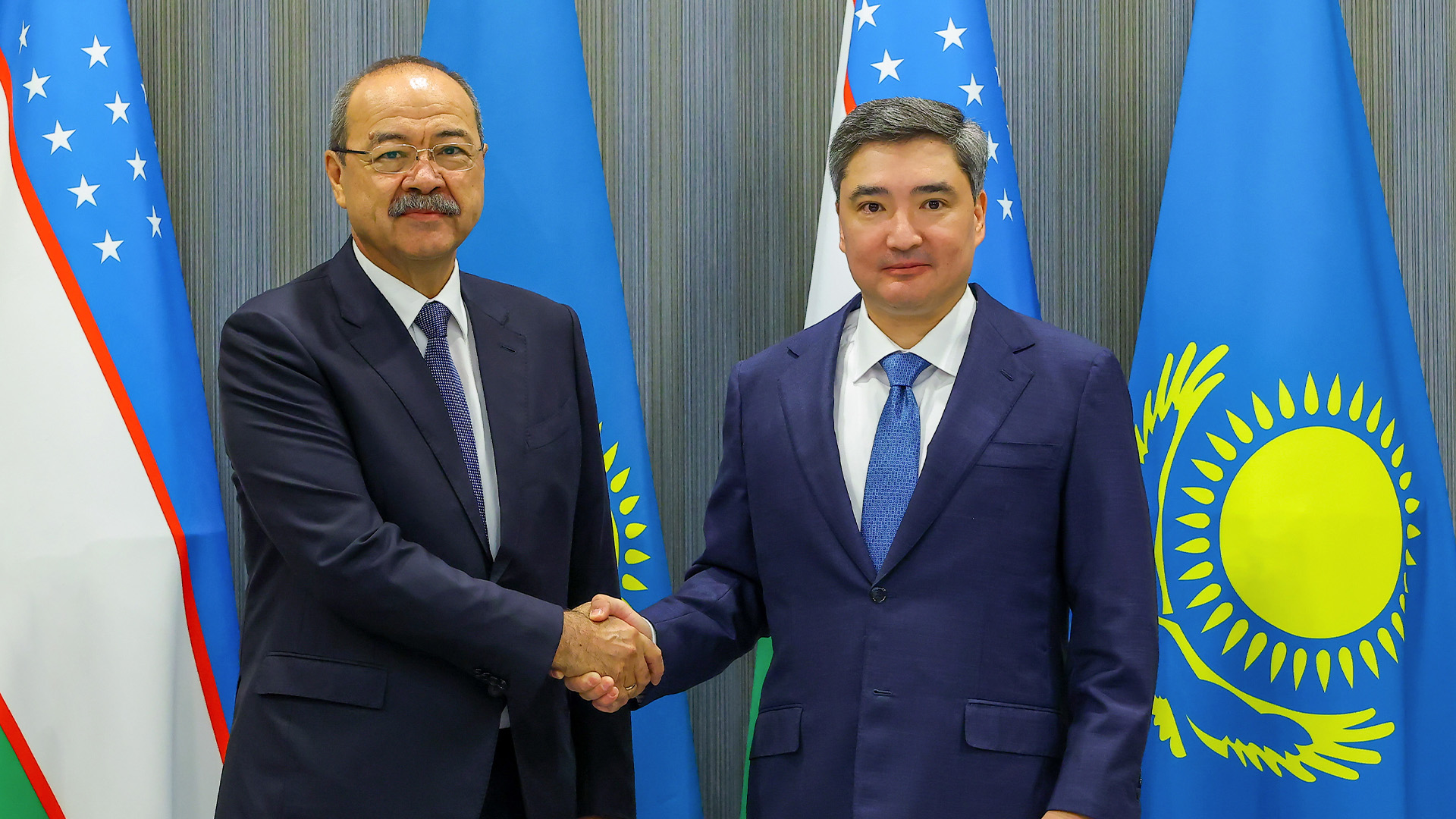
From L to R: Uzbek Prime Minister Abdulla Aripov and Kazakh Prime Minister Olzhas Bektenov. Photo credit: PM’s press service.
The agreements were concluded following the 23rd meeting of the Kazakhstan-Uzbekistan Joint Intergovernmental Commission and the inaugural Council of Regional Leaders, co-chaired by Kazakh Prime Minister Olzhas Bektenov and Uzbek Prime Minister Abdulla Aripov.
The leaders reviewed implementation of agreements reached by Presidents Kassym-Jomart Tokayev and Shavkat Mirziyoyev. They discussed priorities for expanding cooperation in trade, investment, industrial production, transport, regional development and cultural ties.
“Thanks to the joint efforts of our heads of state, multifaceted cooperation between our countries continues to develop dynamically and today serves as a successful example of partnership for the entire Central Asian region,” Bektenov said.
Aripov said the governments remain committed to implementing the tasks set by both presidents during their meetings in Bukhara, Astana and Turkistan this year.
“I am ready to take all necessary measures to fulfill these instructions. I am confident that today’s negotiations will contribute to the further development of trade, investment, industrial, transport, interregional and cultural cooperation,” he said.
Transport and logistics
Transport connectivity featured prominently in the discussions as both countries seek to strengthen regional trade corridors. According to Bektenov, rail freight between Kazakhstan and Uzbekistan increased 16% in 2025, reaching 32.3 million tons. The two governments have adopted a joint action plan to increase railway corridor capacity from 35 million to 60 million tons.
The prime ministers also visited the Aktau International Sea Trade Port, Kazakhstan’s largest maritime hub and a key component of the Trans-Caspian International Transport Route (TITR). Covering 44 hectares, the port can handle nearly 12 million tons of cargo annually and provides year-round connections to the Caucasus, Central Asia and the Caspian region.
According to Bektenov, Kazakhstan completed dredging works at the Kuryk Port in 2025, becoming the first Caspian state to do so. Similar dredging at Aktau is expected to finish by the end of this year, allowing fully loaded vessels to enter the port safely while increasing cargo capacity.
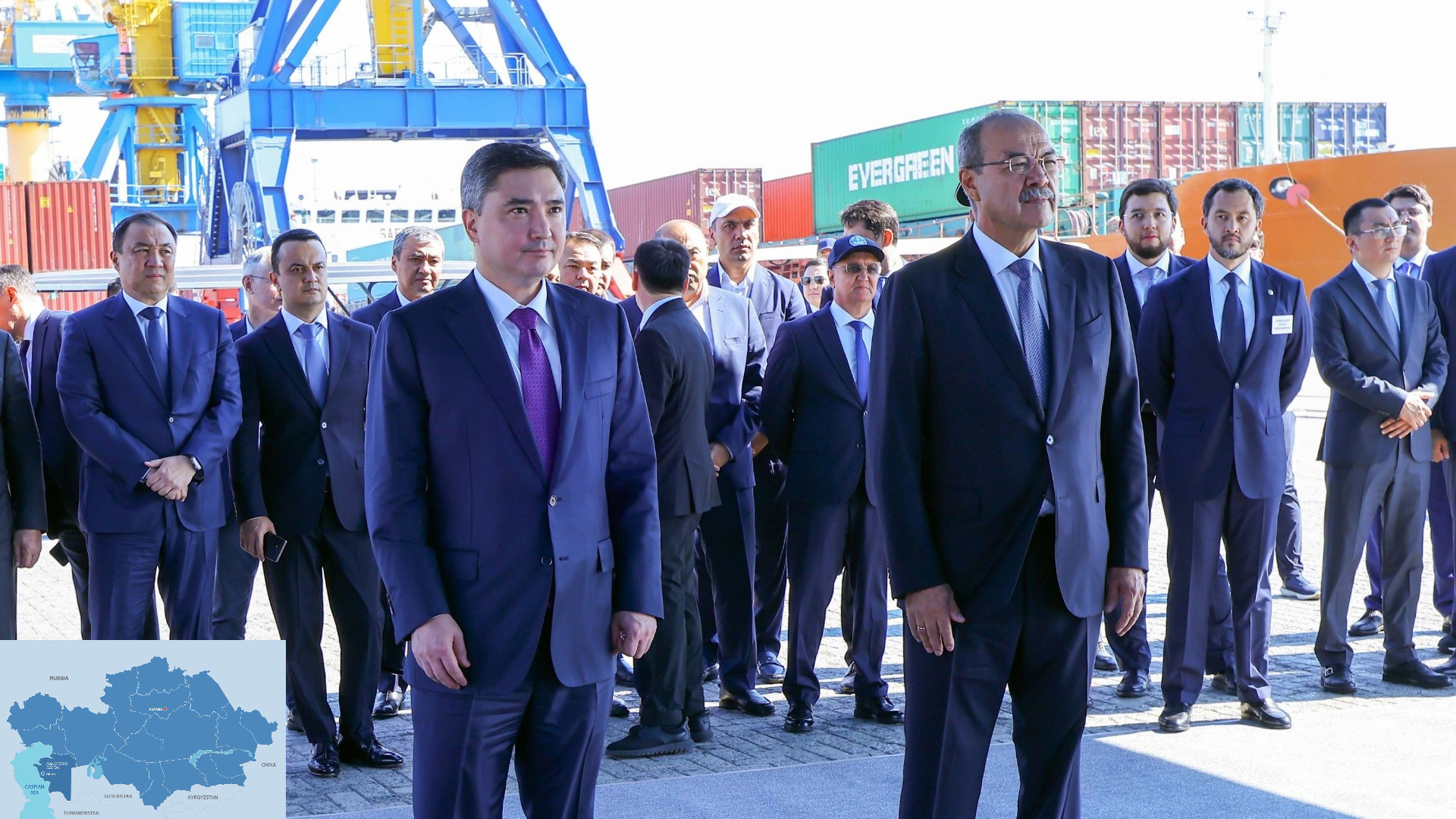
Kazakh and Uzbek prime ministers also visited the Aktau International Sea Trade Port on July 23. Photo credit: PM’s press service. Click to see the map in full size. The map is designed by The Astana Times.
According to Kazakhstan Temir Zholy Chairman Yelzhas Otynshiyev, the combined capacity of the Aktau and Kuryk ports now stands at 22 million tons annually.
He highlighted that container transit through Kazakhstan’s Caspian ports along the TITR has increased 3.8 times between 2022 and 2025. To support further growth, Kazakhstan has launched the first phase of a new container hub at Aktau with an annual capacity of 140,000 TEU, which is expected to expand to 240,000 TEU after completion of the second phase in 2027-2028.
The country has also ordered six new container vessels, four scheduled for delivery in 2027 and two in 2028, while modernization continues on the Shalkar-Beyneu and Beyneu-Mangystau railway sections to improve cargo access to Aktau and Kuryk.
Cargo handled through Aktau and Kuryk on behalf of Uzbekistan increased by more than 60% in 2025, supported by favorable tariffs and improved transport infrastructure.
“Our task is to provide Central Asian cargo with fast and reliable access to the markets of the Caucasus, Türkiye and Europe. Kazakhstan is ready to expand transit of Uzbekistan’s export cargo through the ports of Aktau and Kuryk,” Bektenov said.
Trade and investment cooperation
Kazakhstan and Uzbekistan continue to deepen economic integration, with bilateral trade reaching $4.8 billion in 2025. During the first five months of 2026, trade increased 37% year-on-year to $2.3 billion.
Bektenov highlighted Kazakhstan’s export potential in metallurgy, mechanical engineering, petrochemicals, chemicals, pharmaceuticals, transport equipment and construction materials, while emphasizing implementation of a $7.8 billion investment and trade roadmap designed to diversify bilateral trade and attract new investment.
Industrial cooperation remains one of the partnership’s fastest-growing areas. The two countries are jointly implementing 80 projects worth more than $1.8 billion. Fifteen projects valued at $227 million have already been launched, creating nearly 5,000 jobs, while six additional projects worth $102 million are under active implementation. Authorities are also developing 59 new initiatives totaling approximately $1.5 billion.
