
ALMATY – Kazakhstan plans to increase exploration drilling over the next three years, with up to 200 exploration and appraisal wells expected to be drilled by 2028. While the expansion could help replenish the country’s resource base, experts say the real challenge will be turning geological discoveries into economically viable projects.
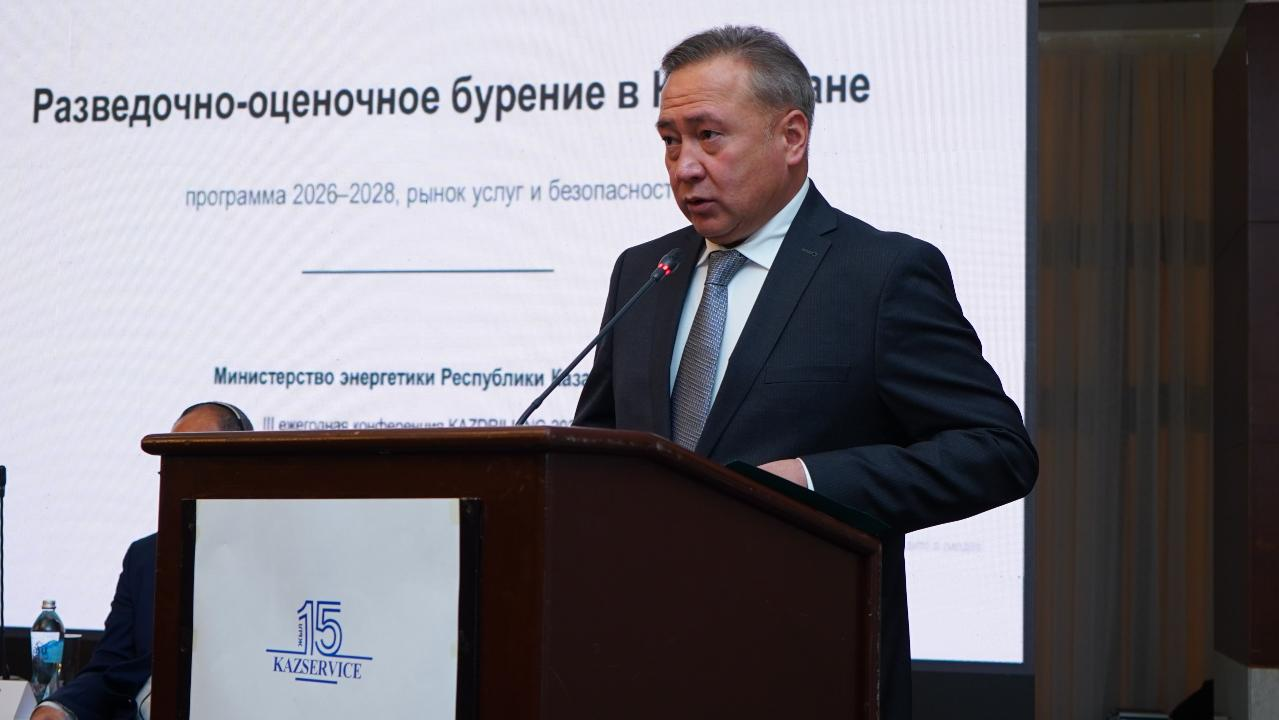
Yerlan Akbarov. Photo credit: Ministry of Energy.
Speaking at the KAZDRILLING conference in Atyrau, Vice Minister of Energy Yerlan Akbarov said exploration and appraisal drilling could reach around 80 wells in 2026 and increase to up to 120 wells annually in 2027–2028, reported the Ministry of Energy on Sept. 7.
The government sees higher drilling activity as necessary to identify new deposits and replenish Kazakhstan’s hydrocarbon resource base. The plans come as Kazakhstan seeks to increase geological exploration while also developing the domestic drilling and oilfield services sector.
More drilling targets underexplored basins
Particular attention is being given to relatively underexplored sedimentary basins that are considered to have significant oil and gas potential. The government has also simplified the process for allocating such areas. Following submission of an application, the Ministry of Energy is to hold an auction within 10 working days.
The work programs for selected areas require seismic surveys covering at least 30% of the relevant block during the first three years, followed by the drilling of exploration wells. This approach is intended to accelerate the movement from identifying prospective areas to obtaining more concrete geological data.
However, the number of wells drilled will not by itself determine whether the programme succeeds.
Discovery is only the beginning
For investors, the key distinction is between identifying a resource and establishing that it can support a commercially viable project.
“Much work is being done by companies to find these resources, but this is only the beginning of the journey,” said Nurlan Saurambayev, the managing partner of Aurin Capital, an investment and strategic advisory firm focused on mining and natural resources in Kazakhstan.
For a discovered resource to become a developed project, reserves need to be confirmed, appropriate extraction and processing technologies identified, and infrastructure requirements addressed to establish whether the project is feasible. He stressed that this process requires more than geological expertise.
“Mining projects are long-term and capital-intensive, so they need to be implemented sequentially: geological exploration, resource assessment, technological studies, engineering, financing and construction,” Saurambayev said.
Skipping stages in this chain can lead to incorrect investment decisions, capital losses and other risks, according to the expert.
The point is particularly relevant as Kazakhstan increases exploration activity. A larger number of discoveries can strengthen the country’s resource base, but it does not necessarily translate into a proportional increase in production, exports or government revenues.
The economic value of a discovery ultimately depends on whether companies can demonstrate that the resource can be extracted and processed at a competitive cost and supported by the necessary infrastructure and financing.
Domestic drilling industry expected to benefit
Alongside exploration, the government is seeking to increase the share of domestic companies and equipment in the drilling industry. Kazakhstan already has manufacturing capabilities in the sector. The Atyrau-based Zhigermunaıservis plant, for example, produces drill bits, stabilizers and other drilling equipment.
The development of local suppliers could allow the expected increase in drilling activity to generate benefits beyond the discovery of new reserves, including demand for domestic equipment, services and skilled workers.
“Our task is to create a sustainable and competitive market for drilling services,” Akbarov said. “The result should be new geological discoveries, replenishment of reserves, development of domestic production, creation of qualified jobs and increased tax revenues.”
The extent to which those benefits materialize will depend partly on whether domestic companies can develop capabilities that remain competitive as exploration and production projects become more technically demanding.
Critical minerals add another dimension
The exploration push also has implications beyond oil and gas. Kazakhstan is seeking to expand exploration for critical and rare-earth minerals as global demand for materials used in energy, technology and advanced manufacturing increases. Saurambayev said the country has an opportunity to strengthen its position in global value chains, but stressed that geological resources alone are insufficient.
“It is possible, but the presence of resources alone is not enough,” he said. “It is necessary to develop processing and move up the value chain where economically justified.”
That would require technologies, capital, infrastructure and experienced project teams, he said.
Kazakhstan’s expanded drilling programme could provide the geological foundation for future production, but there is a considerable distance between a promising well and a functioning industrial project.
For hydrocarbons, this means establishing commercial reserves and production potential. For critical minerals, the challenge can be even broader, extending from exploration and resource assessment to beneficiation, processing and access to markets.
