
ASTANA – Long constrained by its landlocked geography, Kazakhstan is seeking to turn its position between Europe and Asia into a source of economic and geopolitical leverage. As trade disruptions and competition drive demand for diversified supply chains, Astana is investing in new transport corridors to establish itself as an indispensable transit hub and translate connectivity into diplomatic influence.
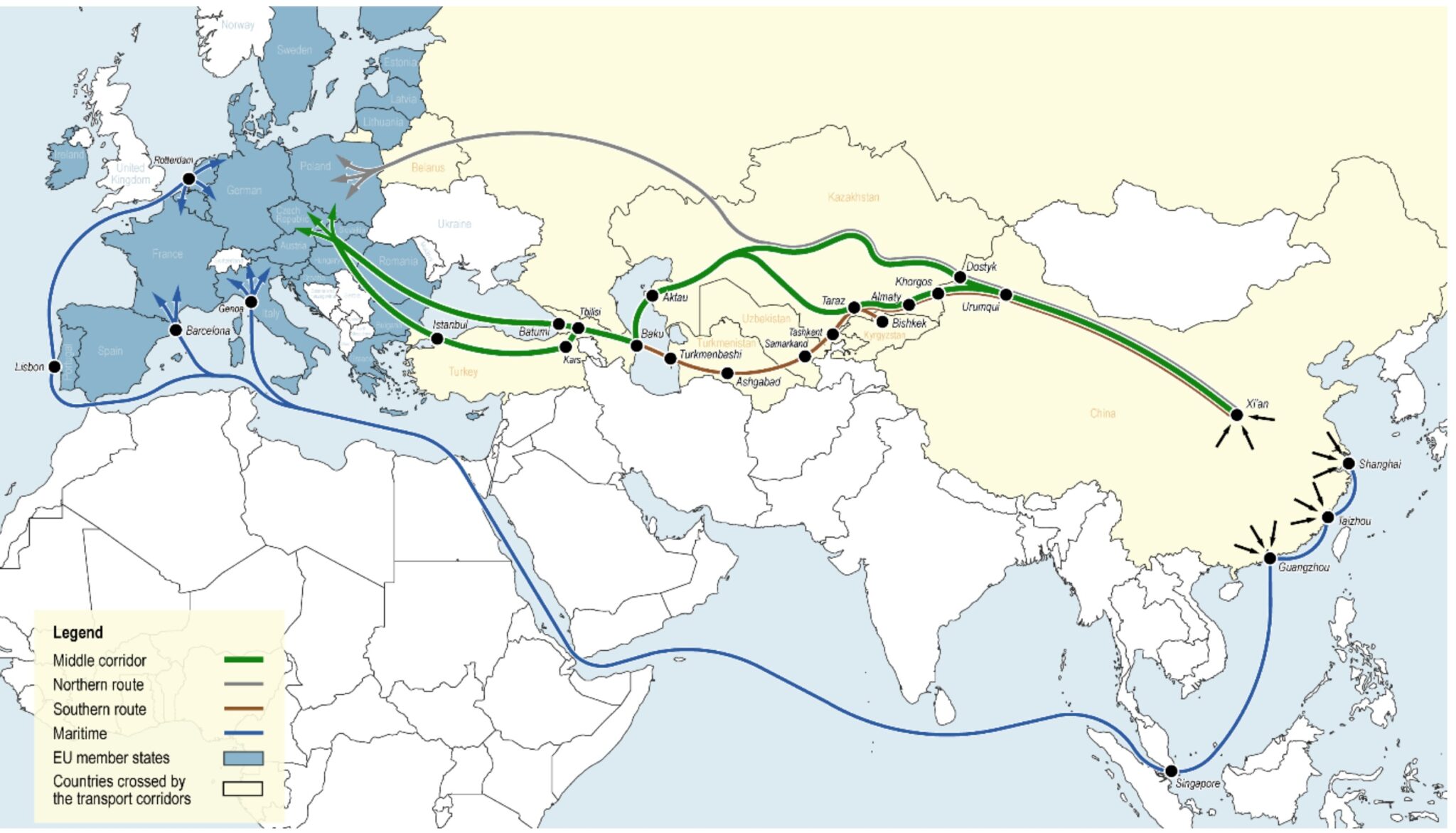
The Middle Corridor route. Photo credit: The Astana Times.
“Transport diplomacy has long been a pillar of economic diplomacy. Today, efficient transport and logistics networks are becoming strategic assets that shape economic competitiveness, and a country’s role in regional economic cooperation,” Head of Research Department of the Eurasian Development Bank (EDB) Alexey Kuznetsov told The Astana Times.

Alexey Kuznetsov, Head of Research Department of the Eurasian Development Bank. Photo credit: The EDB’s press service
Located between China, Europe, Russia, Central Asia and the Caspian Sea, Kazakhstan is developing railways, roads, ports and logistics hubs while expanding connections along several international transport corridors.
The scale of the sector is reflected in recent figures. Kazakhstan transported 540.5 million tons of cargo in January-July, up 0.9% from the same period a year earlier, according to the Bureau of National Statistics. Cargo turnover increased 1%, while road freight transportation grew 6.2%.
Government data shows that transit freight reached 21.7 million tons in January-June, up 24% from 17.5 million tons a year earlier.
Building Eurasian connectivity
Kazakhstan is seeking to strengthen its role not simply as a transit country but as a major regional connectivity hub.
“For Kazakhstan, modern transport, logistics, and warehousing infrastructure are essential for addressing the challenges of a landlocked geography. At the same time, the country has become one of Eurasia’s most important transit hubs,” said Kuznetsov.
He said international transport and logistics partnerships are central to Kazakhstan’s connectivity diplomacy, positioning the country as an influential player in shaping Eurasia’s regional agenda.
According to the EDB’s Transport Projects Observatory, Kazakhstan accounts for 53% of transport corridor investments planned or under implementation in Central Asia through 2035.
“More than $32 billion is expected to be invested in 55 major transport projects, including construction of the Center-West motorway, the Uralsk-Atyrau and Kyzylorda-Saksaulsk roads, and the Moiynty-Kyzylzhar railway. These investments will strengthen East-West and North-South trade routes and further position Kazakhstan as a strategic transport crossroads linking Europe and Asia,” Kuznetsov said.
Road construction, reconstruction and repairs cover around 11,000 kilometers nationwide in 2026. Kazakhstan also plans to repair 11,000 kilometers of railway tracks by 2029.
International financing is supporting part of the expansion. In February, the World Bank approved an $846 million guarantee to mobilize $1.41 billion in commercial financing for a major railway connectivity project along Kazakhstan’s section of the Middle Corridor.
However, Kuznetsov emphasized that infrastructure alone cannot determine whether a transport route succeeds.
“Transport connectivity depends equally on ‘soft infrastructure’: harmonized regulations, efficient border-crossing procedures, coordinated corridor development, and digitalization of transport services and documentation,” he said.
The World Bank estimates cited by Kuznetsov suggest that cutting border delays by 50% through regulatory harmonization and digital solutions could increase exports from Central Asian countries along transport corridors by an average of 18%.
For Kazakhstan, this means that the competitiveness of its routes will depend not only on the number of roads, railways and terminals built, but also on how efficiently they operate.
The Middle Corridor and geopolitics
At the center of Kazakhstan’s connectivity strategy is the Trans-Caspian International Transport Route, which connects China with Kazakhstan, the Caspian Sea, Azerbaijan, Georgia and Europe.
For political scientist Tair Naumov, the importance of such routes extends beyond trade.
“Investment in transit infrastructure requires a certain level of trust between countries, including confidence in political relations and the security of investments,” Naumov said in an interview with The Astana Times.
Once a route becomes operational, however, it can also strengthen those relations by creating greater economic interdependence.
“When countries rely on the same transport routes, their interests become more closely connected. If a corridor becomes important to foreign trade, there is a stronger incentive to maintain stable relations and keep existing agreements in place,” he said.
Naumov noted that this interdependence can eventually acquire a security dimension.
“If a country becomes an important transit hub, its stability becomes an interest not only for the country itself but also for its neighbors and major trading partners,” he said.

Damir Kayumov, PhD, with a bachelor’s degree in economics and law. Photo credit: Kayumov’s Instagram page
Damir Kayumov, PhD, with a bachelor’s degree in economics and law, takes a similar view, emphasizing the economic interests created by shared logistics networks.
“Good logistics creates mutual interest between countries. The more participants there are, the safer it becomes. And the more economic ties pass through Kazakhstan, the greater its role in the region,” Kayumov told The Astana Times.
The Middle Corridor illustrates this dynamic. While it does not yet account for a dominant share of Kazakhstan’s transit flows, its rapid growth could give it greater strategic importance.
From transit to economic value
For Kazakhstan, stronger economic ties along these routes are only part of the opportunity. The bigger question is how the country can turn growing transit flows into broader economic value at home.
“I would not reduce the transport strategy to transit alone. If a container simply passes through Kazakhstan, the country earns comparatively little. It is much more interesting when logistics centers, warehouses, manufacturing and service companies emerge alongside the route,” Kayumov said.
Such an approach would allow Kazakhstan to capture more value from its position in Eurasian supply chains.
“Then the transport corridor begins to work for the regions and for our industry. Kazakhstan receives much more income. The service model that develops around the entire flow allows us to earn more and create more jobs,” he said.
Kayumov noted that attracting cargo also requires competitive and predictable routes. Border delays, limited port capacity, container shortages and differences in procedures can increase costs and make a route less attractive to businesses.
“A convenient route must be fast, clear and predictable. For business, it matters how long cargo remains at the border, how quickly documents are processed and how much railway capacity is available,” he said.
According to Kayumov, digitalization can help address some of these challenges. Electronic document management, for example, can reduce corruption risks while speeding up operations.
TRIPP and the wider connectivity network
The development of new routes beyond Kazakhstan could expand the country’s connectivity options.
The Trump Route for International Peace and Prosperity (TRIPP) is a proposed transport link through Armenia connecting Azerbaijan proper with its Nakhchivan exclave. Kazakhstan has expressed interest in participating in the project and linking it with the Middle Corridor.
“For the Trans-Caspian route, TRIPP provides an additional option for moving cargo after the Caspian Sea toward Türkiye and Europe. The more such branches there are, the more resilient and attractive the entire corridor becomes,” Kayumov said.
For Kazakhstan, the interest is largely pragmatic. As a landlocked country, it needs several reliable routes to major markets.
However, Kayumov noted that the project’s value for Kazakhstan would depend on how effectively it is integrated into the country’s existing transport network.
“What is more important for us is not formal participation in the project, but its integration with our existing transit hub. This means having unified tariffs, digital borders, digital document management and clear, predictable delivery times,” Kayumov said.
“The more reliable routes connect Central Asia with Europe through Kazakhstan, the greater the economic and political value of our geography and our role in connecting different markets,” he added.
