
Starting in the final weeks of May 2026, and lasting until mid-July, the Schools of Policy for civil servants and members of the Academies of Public Administrations of the five Central Asian countries have been offered as part of the activities within the 5+1 format “Central Asia-Italy.”
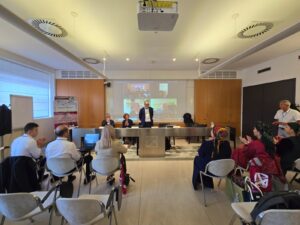
School of policy in Milan. Photo credit: Maurizio ACCIARRI.
The schools, which have been financially sponsored and officially supported by the Italian Ministry of Foreign Affairs and have been hosted by four different universities in Italy, have welcomed 80 participants from Kazakhstan, the Kyrgyz Republic, Tajikistan, Turkmenistan, and Uzbekistan, are the concrete result of almost a year of work, planning, and cooperation between the governments of Italy and the Central Asian republics following the Joint Declaration of the Heads of States and Government signed in Astana on May 30, 2025, which explicitly referred to the creation of “knowledge networks” at paragraph 22.
The idea of the Schools of Policy has been conceived as part of the broader BRIDGE initiative, which underpins many of the 5+1 initiatives between Italy and Central Asia. The BRIDGE initiative (Building Resilient Institutional Dialogue for Governance and Education) is a flagship advanced-training and capacity-building initiative designed to strengthen long-term cooperation between Italy and its partner countries in Central Asia by translating high-level diplomatic dialogue into structured, operational cooperation grounded in knowledge exchange, institutional capacity-building, and joint project development. It was initiated and coordinated by Ca’ Foscari University of Venice with the aim of creating a transnational community of experts and civil servants from Italy and Central Asia capable of responding to common developmental challenges as well as to support intergovernmental dialogue from below.
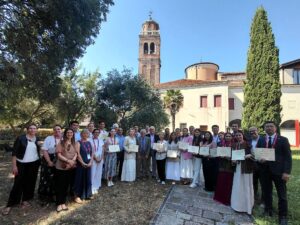
School of policy in Venice. Photo credit: Carlo Frappi
The project of the Schools of Policy, which is unique in its kind, consists of five different parts. First, an introductory module online focused on the political, social, and economic relations between Italy and Central Asia. The participants had the opportunity to familiarise themselves with the institutional and diplomatic background of the 5+1 “Central Asia-Italy” and benefitted from a presentation by officials of the European External Action Service to better situate the current cooperative efforts in the wider European dimension.
Second, on June 15-19, there was school of policy on sustainable agriculture at the University of Bologna in partnership with the Università degli Studi della Tuscia, focusing on cutting-edge topics such as precision agriculture, water resource management, and climate adaptation strategies for tree crops also through project-development laboratory activities. In this endeavour, agriculture is not approached as an isolated sector, but as a strategic policy field situated at the intersection of climate change, water governance, food security, and territorial development — all central priorities within the evolving partnership between Italy and the countries of Central Asia.
The third step was the school of policy on connectivity and infrastructures offered by Sapienza University of Rome, June 22-26, organized by the Interdepartmental Research Centre for Geopolitical Studies and Territorial Analysis – CISGAT of Sapienza University of Rome in cooperation with FS Engineering, the engineering company of the Ferrovie dello Stato Italiane Group. This School, dedicated to the theme “Connectivity & Infrastructure – Logistics, Transport and Digitalization,” explored the strategic role of transport infrastructure, multimodal corridors, and connectivity governance in the economic development and regional integration of Central Asia. Through lectures, seminars, case studies, applied discussion sessions, and project-oriented activities, the school aimed to strengthen the capacities of public officials, experts, and practitioners in the fields of infrastructure planning, logistics, project financing, sustainability, and the digital transformation of transport systems.
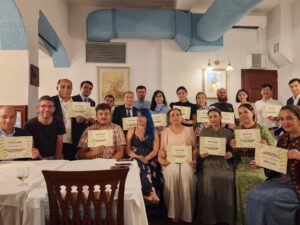
School of policy in Bologna. Photo credit: Andrea Zinzani.
Following this, the Central Asian participants had the chance to attend the School of policy on the water-health nexus at Ca’ Foscari University of Venice, July 6-10. The school, organised by Ca’ Foscari Department of Asian and North African Studies in cooperation with the Italian National Institute of Health and Sogesid S.p.A., aimed to familiarise the participants with an initial normative and conceptual framework – Directive (EU) 2020/2184, the Water Safety Plan approach, the UNECE/WHO-Europe Protocol on Water and Health, and Integrated Water Resources Management – to then move towards operational topics such as chemical and emerging contaminants, microbiological risks, treatment processes, disinfection, materials in contact with drinking water, network efficiency, building water safety, Legionella, wastewater, sludge, reuse and Sanitation Safety Planning. Through lectures, interactive discussions, group work, a project design workshop and technical visits to treatment plants, the School translated regulatory and scientific knowledge into operational priorities, pilot actions and possible pathways for regional cooperation, culminating in the development of a concise “Venice Roadmap.”
The final step, still ongoing, is the School of policy on renewable energy, hosted by University of Milano-Bicocca, July 13-17. Drawing on European and international experience, the school addresses key topics such as decarbonisation strategies, renewable energy technologies, electricity networks, smart grids, energy efficiency, security of supply, investment planning, green finance and analytical tools for decision-making. Particular attention is given to the interaction between regulatory frameworks, technologies and the specific conditions of Central Asian countries, which combine abundant energy resources with emerging challenges related to diversification, network resilience and sustainability.
The successful edition of the Schools of Policy is mostly due to the relentless diplomatic, institutional, educational, logistical cooperation between the different actors (ministries, universities, research centres, and administrations) in Italy and Central Asia, demonstrating that the C5+1 format between Italy and Central Asia fully delivers concrete and strategic results when there is political will, epistemic capital, and mutual understanding of the values of reciprocity, respect, equality, and flexibility, both at the top-down and the bottom-up level.
The author is Filippo Costa Buranelli, an Associate Professor in International Relations at the University of St. Andrews, UK.
