
ALMATY – President Kassym-Jomart Tokayev invited Chinese technology companies to expand their presence in Kazakhstan during a roundtable with Chinese business leaders in Shanghai on July 16, presenting the country as an emerging hub for artificial intelligence, digital infrastructure, smart logistics and high-tech manufacturing.
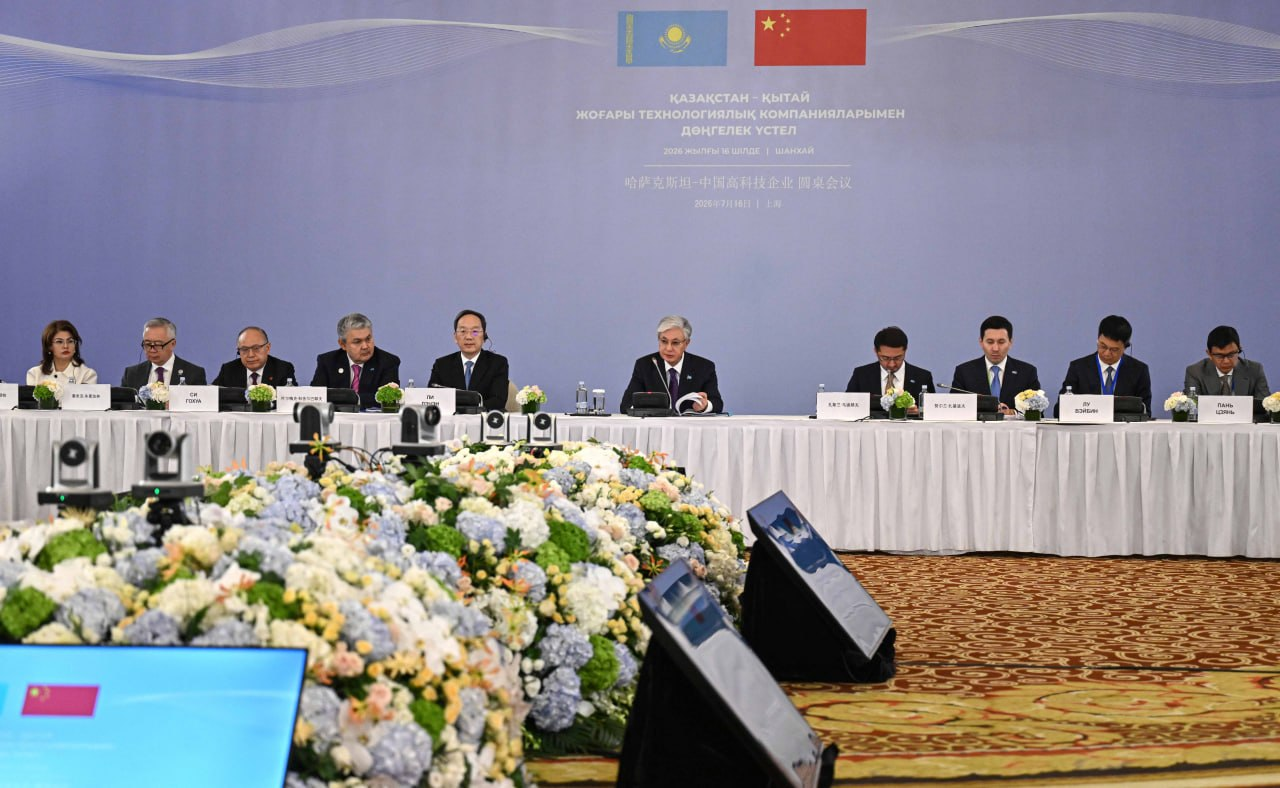
President Tokayev arrived in Shanghai at the invitation of Chinese President Xi Jinping on July 16. Photo credit: Akorda.
Speaking ahead of the World Artificial Intelligence Conference (WAIC), Tokayev said Kazakhstan aims to build long-term partnerships that go beyond capital investment to include technology transfer, research and innovation, reported Akorda.
AI infrastructure at the center of investment strategy
Positioning AI as a key engine of Kazakhstan’s future economic growth, Tokayev outlined several flagship projects designed to attract global technology companies.
Among them is Data Center Valley in Ekibastuz, which he described as a strategic initiative aimed at becoming the backbone of Kazakhstan’s and Central Asia’s digital infrastructure. The project will provide ready-to-use sites for hyperscale data centers, cloud computing and AI infrastructure under a special investment regime supported by stable electricity supplies.
Tokayev said the vision extends beyond building data centers, bringing together supercomputing capacity, AI laboratories, research institutions, educational programs, startups and export-oriented digital services into a single innovation ecosystem.
President Tokayev also highlighted the development of Alatau, a new city being built under a Digital by Default concept. Planned as a smart city, Alatau will feature intelligent transport systems, digital payments, energy-efficient infrastructure and a regulatory framework supporting blockchain, tokenization and digital assets. Investors will also be able to operate within the legal ecosystem of the Astana International Financial Centre (AIFC).
“I am confident that Alatau will become a new center of talent, technology, and investment in Eurasia in the future,” Tokayev said.
Expanding trade and industrial cooperation
Tokayev said the strong political relationship between Kazakhstan and China has laid the foundation for expanding economic cooperation, noting that bilateral trade reached a record $49 billion last year while cumulative Chinese investment in Kazakhstan has exceeded $30 billion.
According to Tokayev, more than 8,500 companies with Chinese participation now operate in Kazakhstan, including major firms such as CNPC, CITIC and Huawei.
“We highly appreciate the significant contribution of Chinese businesses to the modernization of the Kazakh economy. In recent years, our countries have successfully implemented numerous important joint projects. As a result, we have created jobs, introduced advanced technologies, and strengthened our cooperation in the industrial sector,” he said.
He highlighted several ongoing industrial projects, including a major gas chemical complex with Sinopec, a corn deep-processing plant with Fufeng Group, a cotton-textile cluster with Lihua Group, and expanding Chinese automotive production in Kazakhstan involving brands including HOWO, Yutong, JAC, Changan, Great Wall Motor and Chery.
According to Tokayev, these projects demonstrate that bilateral cooperation is increasingly centered on innovation, advanced manufacturing and industrial modernization.
Smart logistics
Tokayev also called for closer cooperation in transport and logistics, saying Kazakhstan aims to become the principal land bridge connecting China with Central Asia, the Caucasus, the Middle East and Europe.
He noted that around 85% of rail freight moving between China and Europe passes through Kazakhstan, while the country has invested more than $35 billion in transport and logistics infrastructure over the past 15 years.
“In short, we must create a space where goods can cross borders as quickly and efficiently as data can be transmitted over a digital network. I believe that Kazakhstan and China can work together to establish new global standards that will improve the efficiency of international trade,” Tokayev said.
He also highlighted that Kazakhstan is developing Smart Cargo, a unified digital platform that integrates customs, logistics and commercial services into a single ecosystem designed to create a seamless Eurasian transport corridor.
Digital agriculture and future growth
Agriculture was another major focus of Tokayev’s address, with him arguing that future competitiveness increasingly depends on data, artificial intelligence and digital technologies rather than on natural resources alone.
He said Kazakhstan has harvested 27 million tons of grain for two consecutive years, attributing the record output to modern technology and improved management. More than 200 agricultural enterprises currently operate as smart farms, while another 650 farms are gradually introducing digital technologies, including drones, satellite monitoring and precision agriculture.
Tokayev said Kazakhstan is also developing a national digital traceability system to monitor agricultural products from farms to consumers, supporting the country’s ambition to become Central Asia’s leading agri-industrial hub.
“The goal is to increase agricultural production and develop a high-value-added food industry. By doing so, we aim to make Kazakhstan a leading agro-industrial hub in Central Asia,” he said.
Concluding his remarks, President Tokayev reaffirmed Kazakhstan’s commitment to providing a favorable investment environment for Chinese businesses through legal protections, modern infrastructure, skilled labor and government support, expressing confidence that the two countries could jointly shape “the new technological era of Eurasia.”
During the working visit to Shanghai, Kazakhstan and China signed more than 70 commercial agreements worth over $15 billion. The agreements cover the fields of artificial intelligence and digitalization, transport infrastructure, finance, the agro-industrial complex, mechanical engineering, and other high-tech industries.
