
ASTANA – President of Montenegro Jakov Milatović called on Kazakh students to take an active role in public life and become agents of change in a rapidly changing world during a June 20 meeting as part of his first official visit to Kazakhstan.
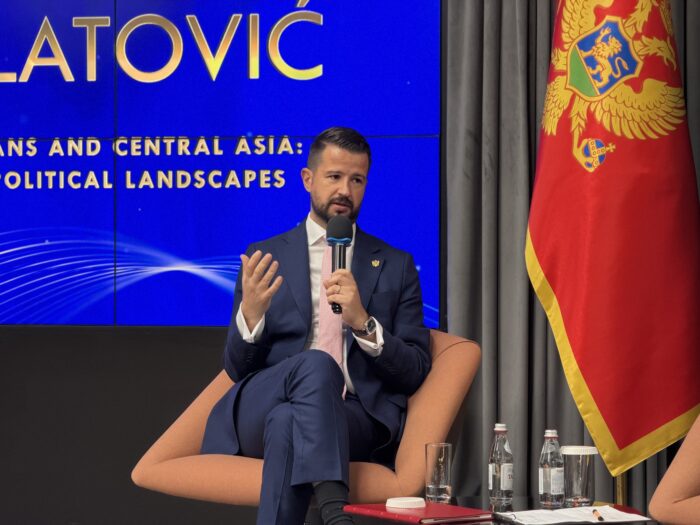
Jakov Milatović. Photo credit: The Astana Times/ Nargiz Raimbekova
Speaking at the Maqsut Narikbayev University in Astana, Milatović recognized Kazakhstan as a political and economic power in Central Asia, commending its multi-vector foreign policy. He also said “despite differences in geography and in size,” Kazakhstan and Montenegro are “united by remarkably similar challenges, aspirations and ambitions for the future.”
“We share far more than common challenges. We share a tradition of hospitality deeply rooted in our cultures and our people. Forged across the vast Kazakh steppes and the rugged landscape of Montenegrin barren crust,” he said.

Milatović underlined the importance of balancing energy and experience in public leadership. Photo credit: The Astana Times/ Nargiz Raimbekova
Milatović also drew parallels between the two countries’ historical pathways to independence that demonstrated the “road to self-determination is rarely an easy one.”
“But that the pursuit of freedom and the right to chart one’s own destiny are causes worthy of every sacrifice. Reminding us that freedom is never merely inherited. It is earned, safeguarded and entrusted to those who come after us,” Milatović said.
“Today’s international order is marked by growing fragmentation, the weakening of multilateralism and the return of power politics. In many ways, the world is entering a new great game. But this time, let our countries be among its players. Let us not merely adapt to the changes around us, but help shape them. Together, let us build a world that is more just, more prosperous and more secure,” he said.
Milatović also discussed Montenegro’s goal to become EU’s next member, a target set to be reached by 2028.
“Our goal is very clear: to become the 28th member state of the EU by 2028. Thus demonstrating that the enlargement policy of the European Union is alive, is credible and that it still has transformative force,” he said.
Speaking about the future of the United Nations, Milatović said its efficiency is questioned by growing divisions among five permanent members of the Security Council and urged broader representation of voices on the table.
Milatović prioritized structural economic transformation and fair labor market practices to address brain drain and youth migration.
“More meritocracy, especially when it comes to access to the labor market related to government jobs and state-owned enterprises. And number two is more economic opportunities in the private sector. Basically, speedier economic convergence with the countries where usually the labor flows out,” he said.
When asked about his experience as one of Europe’s youngest leaders, Milatović underlined the importance of balancing energy and experience in public leadership.
“The biggest advantage is the energy that you are bringing to be persistent about changing things. The biggest disadvantage is obviously the lack of life experience. Sometimes, perhaps, you see things a bit differently if you are a bit older. But I think now with the digital age and with everything which is happening in the world, being young is more of an advantage than not being young,” he explained.
He described persistence as an essential quality for anyone pursuing a career in public life.
“In order to succeed in anything in life, you need to be persistent about it. That’s it. So if there is one thing that you should remember, never give up, be persistent about solving problems,” he said.
For Milatović, this is the first official visit to Kazakhstan, as the two countries mark 20 years of bilateral ties. On June 19, he met with President Kassym-Jomart Tokayev.
