
ASTANA – Central Asia is entering a decisive phase in its response to climate change, with experts warning that while governments increasingly understand the scale of the risks, the real challenge now lies in turning commitments into coordinated action.
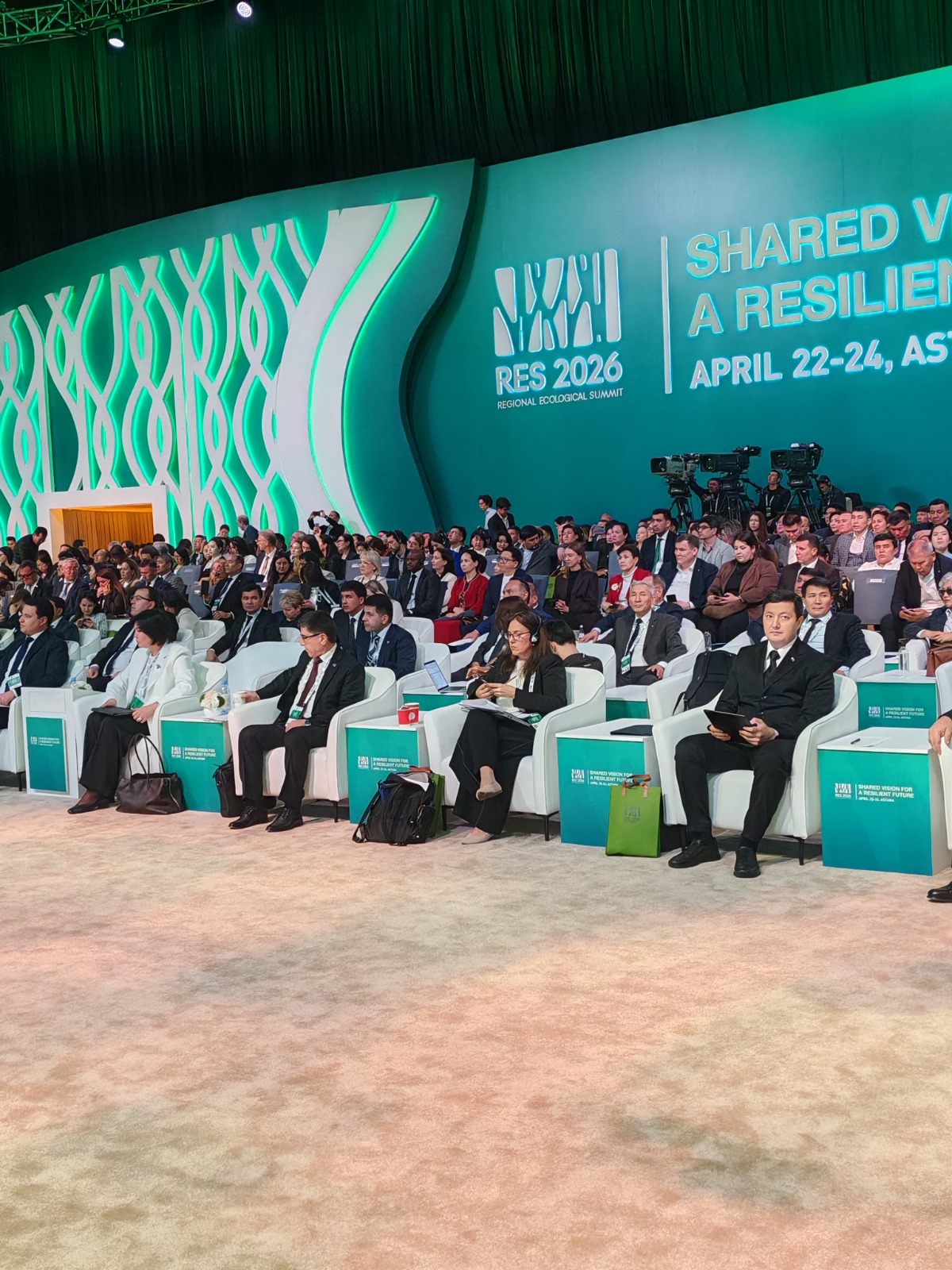
Photo credit: RES
“The companies and communities in Central Asia know very well what the problems are. But they are all finding ways to take advantage of new options to drive an agenda that is creating more jobs, more growth, sharing prosperity while building a livable planet,” said Valerie Hickey, director for environment at the World Bank Group, addressing the opening of the Central Asian Conference on Climate Change in Astana on April 22.
The conference took place as part of the Regional Ecological Summit in the capital on April 22-24. The latest edition was in Ashgabat in May 2025.
Hickey commended the countries in the regions for demonstrating how to attract private investment while easing pressure on public finances, pointing to investments in core infrastructure, particularly energy and water, as well as efforts to strengthen business regulation and create a predictable environment that supports private sector activity.
“We are very proud to be part of just, for example, three of these initiatives. At the World Bank Group, we have invested $1 billion in RE-MET, which is the Regional Energy Market Interconnectivity and Trade Program, which forms the basis of ensuring a shared regional power market that will bring down the price of energy and increase opportunity for small business, for big business, for every community-led organization,” she explained.
She emphasized that the effort goes beyond coordinating investment and that technical assistance should be aligned as well. She highlighted cooperation with the United Kingdom, the Swiss government, and the European Commission under the Central Asia Water and Energy Program, aimed at ensuring coordinated advice, technical support and investment in the region’s critical water and energy resources.
“Central Asia is among the few countries that are taking advantage of their natural endowment and using nature as the affordable and available technology that it is, not just to deliver on opportunity, not just to create jobs, but again, to make sure to build a livable planet,” she said.
No longer just an ecological issue
Kazakhstan’s Vice Minister for Ecology and Natural Resources Mansur Oshurbayev said climate change has long ceased to be just an ecological issue.
“It is also a question of the stability of the economy, security and efficiency of state policy. In these conditions, the transition to low-carbon development and transformation of energy systems are of particular importance. For Central Asian countries, this means the need to simultaneously ensure energy security, modernize infrastructure and reduce the environmental impact of the economy,” said Oshurbayev.
Kazakhstan submitted its third Nationally Determined Contributions (NDCs) in October 2025, committing to a 17% unconditional emission reduction target and below 1990 levels by 2035, and up to 25% with international support.
Oshurbayev commended the conference as a solid platform for “open dialogue, exchange of experience and search for practical solutions.”
“Not only challenges that our countries face are discussed here, but also the specific steps that need to be taken together. Today, climate change in Central Asia is no longer a question of the future. We feel its consequences already now,” he said.
Need for better coherence and implementation
UN Assistant Secretary-General and Special Representative of the Secretary-General for Disaster Risk Reduction Kamal Kishore described the climate crisis as an “emergency that is already at our doorstep.” He urged greater coherence, stronger cooperation and scaled-up implementation, stressing that disasters are not inevitable. Even amid a climate crisis, early, collective and decisive action can prevent hazards from turning into disasters.
“NDC 3.0 must move beyond actual commitments and become a tool for managing shared risks, reducing vulnerability and strengthening resilience. Fortunately, the region is already making important progress in this regard. All Central Asian countries have now developed and updated their NDCs with several already advancing to NDC 3.0 and ambition is increasing. But as we all know, ambition alone is not enough,” said Kishore.
He stressed that effective implementation in Central Asia depends on three key enablers. First, policies must be grounded in a comprehensive understanding of risk, aligning climate action, disaster risk reduction and development planning to avoid fragmented approaches.
“Climate action cannot be disconnected from realities on the ground. Yet, too often, climate policies, disaster risk reduction and development plans operate separately in different silos. This creates blind spots,” said Kishore, citing heat risks that are often overlooked in urban planning, and water stress is not fully incorporated into disaster preparedness.
Stronger regional cooperation is also essential, as climate risks such as water stress, droughts and floods transcend national borders. Kishore said Central Asia can learn from other regions in their approaches to managing transboundary cooperation. As an example, he noted the Mekong River Commission in Southeast Asia and the International Center for Integrated Mountain Development in the Himalayas.
The third enabler, according to him, relates to financing that should better support resilience, with more coordinated and accessible investment directed toward adaptation and disaster preparedness.
“Climate impacts are already imposing high economic costs across the region, but we also know that investing in resilience is far more cost-effective than responding and recovering from disasters. The evidence is there in ample measure,” said Kishore.
Investing in early warning systems can reduce disaster losses by up to 30% with just 24 hours notice, he added.
Increased quality of NDCs
Addressing the conference, Mariana Panuncio-Feldman, director of country engagement at NDC Partnership, reported a noticeable improvement in the quality of NDCs developed across the region.
The partnership represents a global coalition of developed and developing countries working to advance ambitious climate action aligned with national development priorities while supporting the goals of the Paris Agreement and the Sustainable Development Goals. The partnership has more than 260 members.
“We are seeing that three countries have so far submitted NDCs, Kyrgyzstan being the first one, and Uzbekistan and Kazakhstan following in the fourth quarter of 2025, and two countries are submitting NDCs in 2026, Turkmenistan and Tajikistan,” she said.
“First of all, we are seeing that all three NDCs 3.0 from this region submitted today extend the range to 2035. The new targets build on the previous NDCs, reflecting a progression in ambition, and more importantly, a more realistic assessment of the country’s ability to set targets that they can deliver,” she said.
Panuncio-Feldman said NDCs 3.0 place greater weight on adaptation, underscoring the need to manage climate risks across entire economies. The plans themselves are becoming more rigorous, as targets are backed by stronger data, policy measures are more detailed, and governments are coordinating more closely across ministries while engaging national stakeholders.
“Last but not least, NDCs reflect a growing effort to align the mid-term targets that NDCs encapture with development strategies set by the countries and with long-term strategies for decarbonization,” she said.
She said as of April 1, 136 countries that are parties to the Paris Agreement have submitted new NDCs to the United Nations Framework Convention on Climate Change (UNFCCC).
“Since the adoption of the Paris Agreement, NDCs have evolved from being high-level commitments to becoming a foundational element for the architecture of 21st-century climate governance, helping position climate action as fundamental in driving sustainable development, economic growth, and well-being. As we look to the last decades, however, a duality has emerged,” she said.
Even as the architecture of global climate cooperation grows more sophisticated, she said the political and physical realities remain complex. The nationally determined nature of climate commitments is central, ensuring action reflects domestic priorities rather than external pressure.
While NDCs are improving and becoming more institutionalized, challenges remain, said Panuncio-Feldman.
Many countries struggle to meet UNFCCC deadlines as they balance implementing current NDCs with developing new ones.
“And I think that part of what we’re seeing is that as countries institutionalize and hopefully as they move ahead with elements such as enhancing their enhanced transparency framework and embedding better modeling and capacity as well as monitoring capacity, this will create a stronger foundation that will ease the development of future targets,” she said.
Progress has also been made in aligning NDCs with development strategies, but commitments now need to be translated into detailed roadmaps, investment and implementation plans.
