
There is a particular confidence with which societies talk about women, especially other people’s women. Labels come easily: traditional, obedient, oppressed, resilient. Central Asian women, and Kazakh women in particular, have long lived under the weight of these borrowed descriptions.
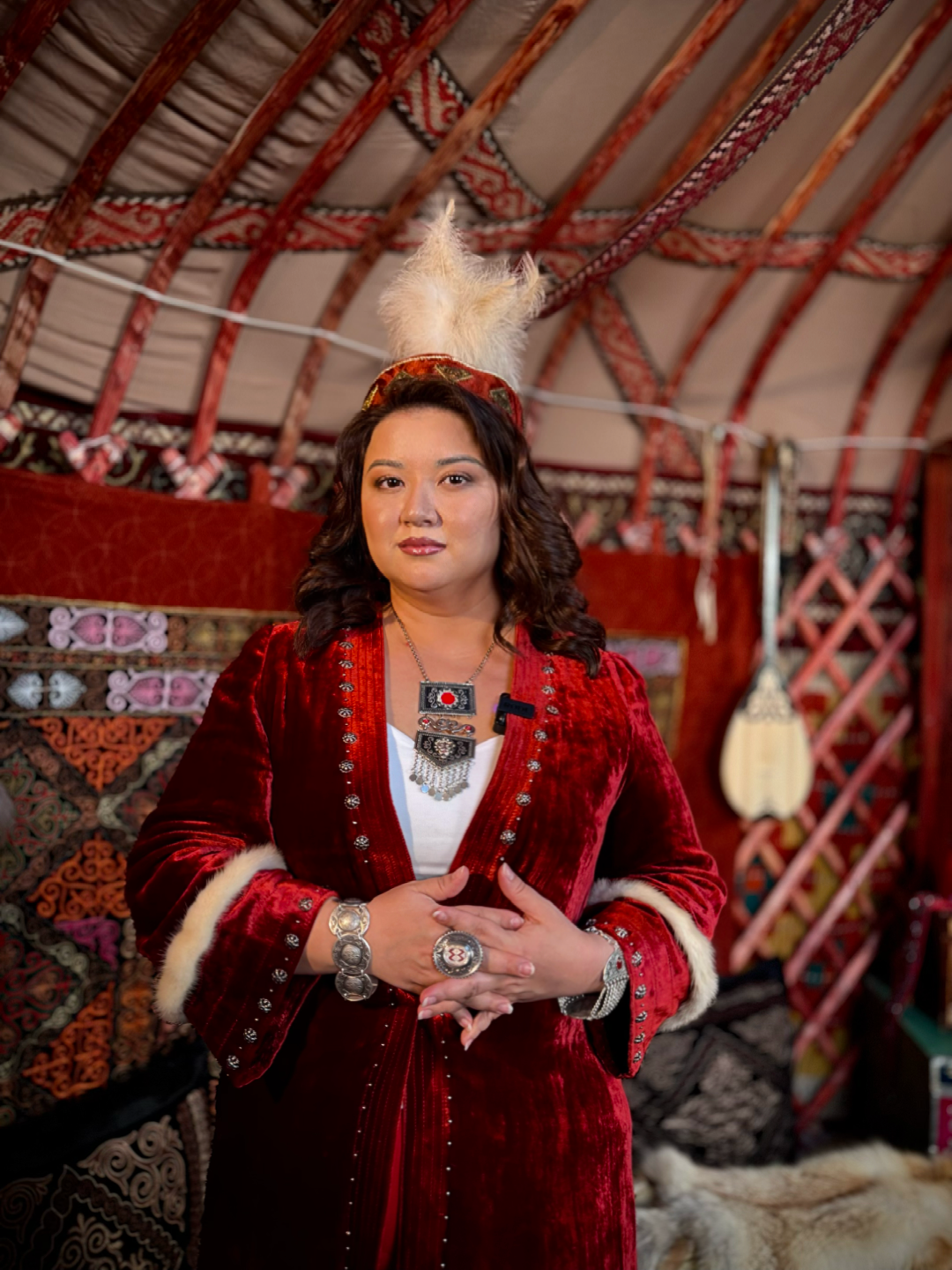
Aida Haidar.
But the more I spoke with researchers while working on a special report for The Astana Times YouTube channel, the more it became clear: many of these ideas were never really ours to begin with. They were assigned.
When I spoke to anthropologist Alima Bissenova, she challenged one of the most persistent assumptions — that women in traditional societies were passive or dependent. In reality, she explained, in both agricultural and nomadic economies, the family functioned as a unit of production, and women worked alongside men in sustaining it. And that changes everything.
Because life on the Kazakh steppe did not operate on symbolic roles, it operated on survival. For centuries, households were responsible for their own food, livestock and material production. Women were not confined to the domestic sphere: they were central to the economy itself. They processed dairy, managed resources, raised children, and, when necessary, took over responsibilities in the absence of men.
You do not build a system like that on dependency. And yet, that is often how it has been described.
Part of this disconnect, as Bissenova noted in our conversation, comes from the way Central Asian societies were historically interpreted. Practices were translated through colonial and European frameworks that did not always capture their meaning. The example she returned to was kalym, often labeled as a “bride price,” when in reality it functioned as a form of exchange between families.
What outsiders saw became the narrative. What they did not see — the labor, the negotiation, the balance — was left out. It is difficult to correct a story you did not write.
And then came the twentieth century.
When I spoke to Aliya Sagimbayeva, vice president of the International League of Ancestral Lineage (Asia), she described that period as a succession of shocks compressed into a single generation: revolution, collectivization, famine, repression, war. In her words, it was a time when entire family structures were pushed to the brink and when, more often than not, it was men who disappeared first. They were sent to war, arrested, and taken away.
And in their absence, women stepped in. Not symbolically: completely.
Sagimbayeva told me that many Kazakh women of that generation took on responsibilities that had not traditionally been theirs. They were raising children, sustaining households, and preserving entire family lines. There was little room for emotion. Survival required something else. But what stayed with me most was how she described the role of women not just within a household, but within a lineage.
In her view, responsibility extended beyond the immediate family. It was about maintaining connection — between generations, between branches of a family, between past and future. Even today, she said, people return to find their paternal roots, sometimes decades later, because something feels incomplete without that connection.
At the same time, she pushed back against the idea that strength and femininity cancel each other out. A woman, she said, can take on responsibility, stand alongside men, and still remain fully within her identity as a woman.
Which brings us to today.
Modern Kazakhstan is a very different society. Women pursue higher education, build careers, and lead institutions. But what becomes clear through these conversations is that this is not a break from the past. It is a continuation, but under different conditions. Sagimbayeva described this through the idea of an inner resource, a word that could be translated as self-sacrificial zeal. In other words, the ability to take responsibility, to act, to carry others through difficult circumstances. It is a quality she sees across generations.
The roles have changed. The context has changed. But something underneath has remained. So who is the Kazakh woman?
The more I worked on this story, the clearer it became that the question itself may be misleading.
There has never been a single, fixed model. Not in the nomadic past, where survival required flexibility and shared responsibility. Not in the twentieth century, when women were forced to adapt to extreme historical pressure. And not today, when their roles continue to expand in a very different social and economic reality.
What we often describe as “tradition” is, in fact, a selective reading of the past, one that highlights certain roles while overlooking others. And what we call “modernity” is not a rupture, but another phase in a much longer process of change.
Kazakh women have never been static. Their roles have evolved with the conditions around them. And to understand who they will become next, we do not need a crystal ball. We only need to look back at how our great-grandmothers survived, how they carried their families through famine, war and upheaval, and how they brought us all into this reality.
Because in the face of geopolitical challenges, wars, and even cultural wars, Kazakh women know how to remain resilient. They have strong roots, and those roots will help them withstand whatever comes next.
And I think, in many ways, I have already given you the answer.
But how will that role continue to evolve, and who gets to define it?
And perhaps the more uncomfortable question is, who has been defining it until now?
What was the real role of women in Kazakh society? Watch our full report on The Astana Times YouTube channel.
