
ASTANA – Kazakhstan marks the 180th anniversary of renowned Kazakh akyn (poet) and improviser Zhambyl Zhabayev on Feb. 28. Widely regarded as a giant of folk poetry, his song legacy remains a defining chapter in the history of Kazakh verse.
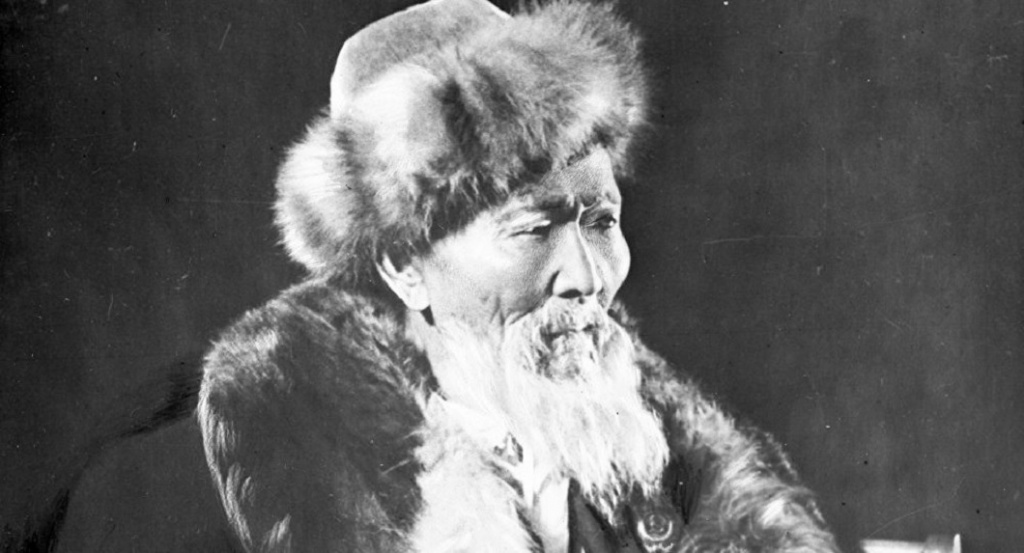
Zhambyl Zhabayev, a renowned Kazakh akyn and improviser. Photo credit: e-history.kz
Early life and artistic path
Zhabayev was born in 1846 in an aul (village in Kazakh) at the foot of Mount Zhambyl in present-day Zhambyl Region. He showed musical talent from childhood and developed an early love for the dombra, a traditional Kazakh instrument, and folk song. A formative meeting with the celebrated improvisational akyn Suyunbai set him on his artistic path. With the dombra in hand, the young poet began traveling across the steppe.
Years of wandering deepened his understanding of people’s lives, hardships and hopes. He gained renown in aitys, the improvised poetic duels that tested wit, memory and musicality. His satire struck at bai elites and their retainers with biting precision. His work combined protest themes with heroic narratives about batyrs (warriors). Two of his epic poems, “Utegen-batyr” and “Suranshi-batyr,” were recorded later in the Soviet period.
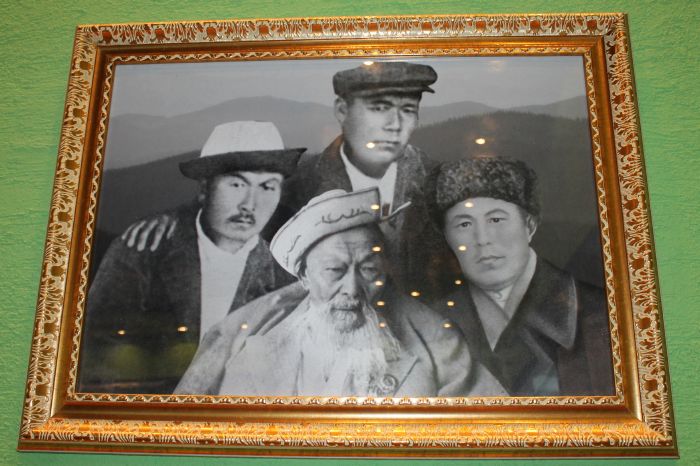
Zhabayev with his sons (left to right): Algadai, Tezekbai and Iztileu. Photo credit: Ainur Rakisheva
Initially performing mainly in the reflective tolgau style (poems that are slightly longer than lyrical verses), Zhabayev turned to improvisation in his teens.
Scholars note that in the 19th century akyns became influential social voices, traveling widely, absorbing history and culture, and articulating public aspirations.
The late 19th century, when Zhabayev’s creative work matured, was a time of upheaval across the Kazakh steppe. Russian imperial reforms imposed new administrative systems that eroded traditional structures and strained communal ties. Distrust, bureaucratic abuse and social inequality deepened.
Like many oral poets of his generation, Zhabayev turned his art toward critique. His early repertoire featured sharp satirical miniatures exposing greed, arrogance, bribery and idleness, as well as narrative song-tales such as “The Khan and the Akyn” and “The Tale of the Lazy Man.” These works cemented his reputation in poetic contests and among audiences hungry for truth spoken in verse.
Eyewitnesses described Zhabayev in his prime as robust, energetic and direct in manner. Poet Taiyr Zharokov recalled meeting him in 1928 in Karakastek, where local akyns were competing in a yurt. Zharokov wrote that the elderly singer, broad-chested and smiling brightly, improvised with infectious energy as listeners urged him to continue.
Zhabayev’s voice also joined moments of historical rupture. During the 1916 uprising against a tsarist rule, he moved among rebel groups, performing fiery appeal songs. Most were lost, but two surviving poems, “The Tsar’s Decree Tightens” and “The Ominous Edict,” evoke clashes in the Kargaly, Samsy and Uzynagash regions and preserve the emotional register of resistance.
A national symbol
The Soviet period transformed Zhabayev from a regional bard into a national symbol. He took part in major cultural gatherings, including the 1919 assembly of Zhetysu folk poets and the 1934 Congress of Masters of the Arts. In 1936, he joined the Decade of Kazakh Literature and Art in Moscow.
That same year, at age 90, he gained nationwide fame after Pravda newspaper published his tolgau, “My Homeland,” which portrayed Kazakhstan’s past and present. He soon became a prominent cultural figure of the Soviet era. From then on, literary dignitaries recorded and translated his improvisations, allowing them to circulate widely across the Soviet Union. Zhabayev became a cultural ambassador of Kazakh oral heritage within the Soviet literary sphere. He returned to Moscow on later visits and, in 1937, traveled to Georgia.
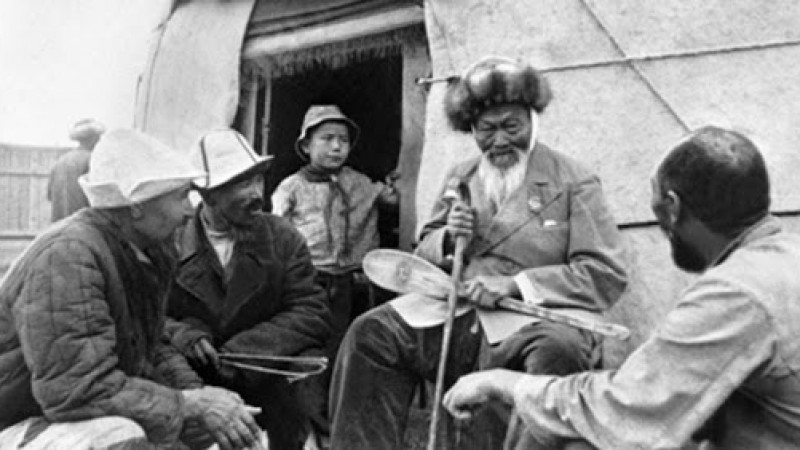
Zhabayev remained highly productive in old age, composing more than 140 songs and poems in his last decade. Photo credit: e-history.kz
He received major state honors and served as a deputy of the Supreme Soviet of the Kazakh SSR and a member of the Union of Writers.
Zhabayev’s creative output surged in advanced age. In his final decade he composed more than 140 songs and poems, including the autobiographical “My Life”. In the poem, he celebrated unity among the peoples of the Soviet Union, writing that his “dear family” included “Uzbek and Georgian, Tatar and Russian, Bashkir and Kyrgyz,” and that his song and hospitality were shared with all.
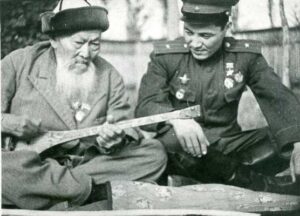
Zhambyl Zhabayev and Baurzhan Momyshuly. Photo credit: e-history.kz
During the Second World War, at age 95, he wrote patriotic works collected in volumes such as “Maidan Zhyry” (Songs of War) and “The Impregnable Fortress.” His poem “Leningraders, My Children!” became especially well known and was distributed in besieged Leningrad, what is now St. Petersburg.
Zhabayev died on June 22, 1945, eight months short of his 100th birthday, in a 12-room house built for him in 1938. He was buried beside the home, surrounded by an apple orchard. A mausoleum was erected there in 1946, and the house was later opened as a literary-memorial museum. Today, the site is a cultural landmark of the Almaty Region and Kazakhstan.
Visitors to the memorial complex are greeted by two pyramidal trees planted in 1938. Nearby, a garage displays Zhabayev’s personal M-1 automobile, presented to him during his lifetime and still in working condition.
Anniversary events
In Almaty, the Zhambyl City Youth Library hosted a festive event marking three milestones: the poet’s 180th birth anniversary, the 50th anniversary of the library’s founding and the 30th anniversary of it being named after him on Feb. 26.
The celebration highlighted the library’s role in youth education and cultural development. A thematic exhibition presented archival documents and rare materials dedicated to Zhabayev’s life and artistic legacy.
“In 1996, the library won a national competition dedicated to Zhabayev’s 150th anniversary and received his name. This is both an honor and a responsibility. Our collection includes his works, and readers, from young people to researchers, come here to explore his legacy and Kazakhstan’s spiritual heritage,” said Banu Dauletbayeva, head of the library.
Commemorative events are also held in other parts of the country.
