
ASTANA – The national exhibition titled “New Discoveries in the Archaeology of Kazakhstan” opened Feb. 14 in Astana, presenting recent research by the Margulan Institute of Archaeology alongside rare artifacts from leading museums and scientific institutions nationwide.
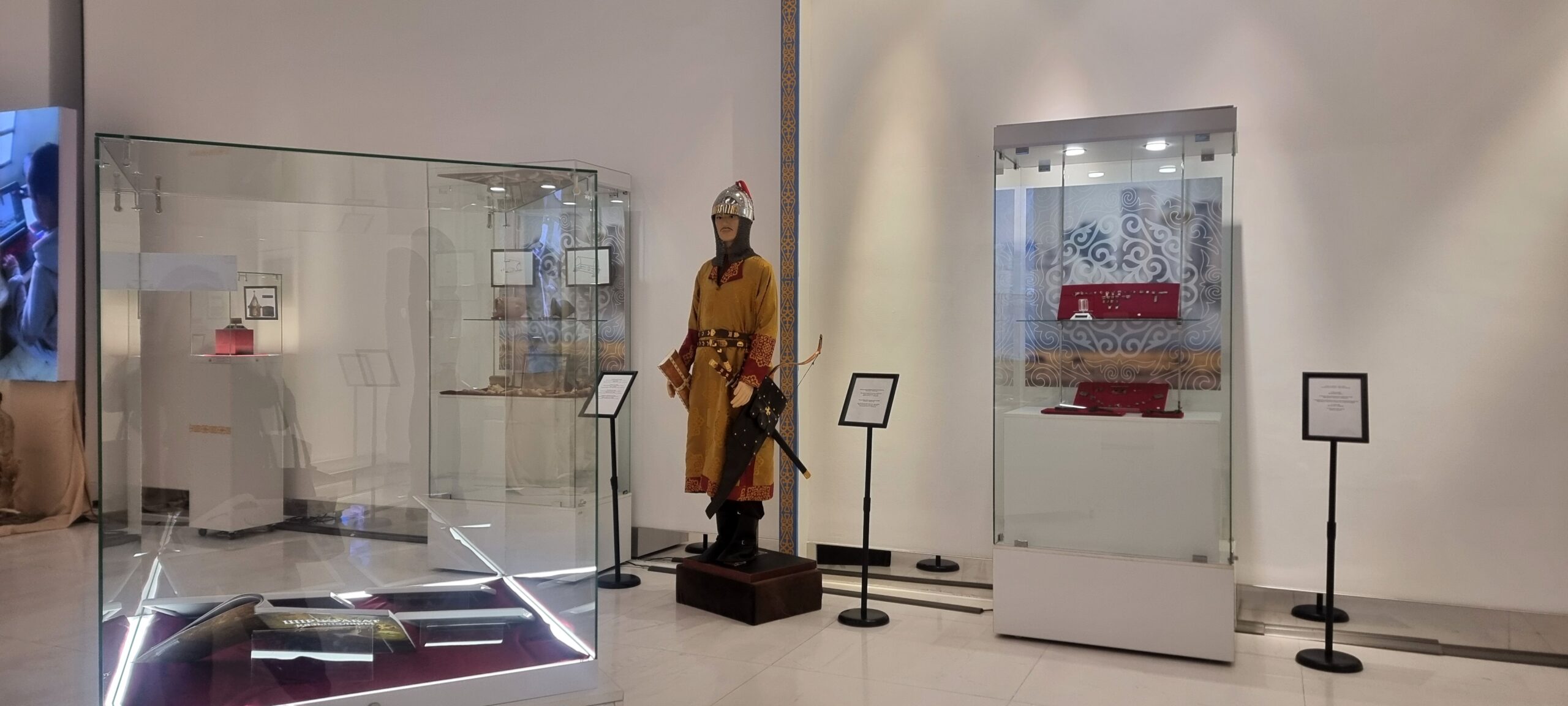
The archaeology exhibition opened in Astana on Feb. 4 and runs through March 4. Photo credit: The Astana Times
The exhibition is dedicated to the 35th anniversary of Kazakhstan’s independence. It traces the country’s history from early human settlement in the Stone Age through Bronze Age mining, the rise of Saka-era nomadic societies, and the development of medieval cities and urban culture.
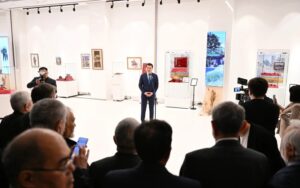
State Counselor Erlan Karin attended the opening of the exhibition on Feb.14. Photo credit: Akorda
For the first time, the exhibition presents results of last year’s field research, data from international collaborative projects and studies published in leading international journals. It also features 23 scholarly books and around 300 artifacts documenting Kazakhstan’s ancient past.
Among the highlights are items from the Karabau and Karakuduk burial mounds, illustrating the applied art of nomadic tribes that lived around 2,500 years ago and reflecting their advanced craftsmanship. The exhibition also includes some of the oldest known chariot burials and heavy spearheads in Eurasia, discovered in Saryarka, demonstrating the early development of military technologies and advanced metallurgy in the region.
Rare Kangly-period artifacts from the Turkistan Region, including ram-head protomes and vessels with zoomorphic handles from the Kultobe settlement and Myntobe burial ground, offer insight into the daily life and beliefs of this ancient culture.
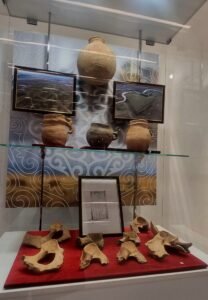
Rare artifacts from the Turkistan Region. Photo credit: The Astana Times
“The state pays special attention to national history as a key foundation of our identity. This is reflected in the draft Constitution’s preamble, which affirms the continuity of the millennia-old history of the Great Steppe,” State Counselor Erlan Karin said, as quoted by the Akorda press service.
He noted that many artifacts and discoveries featured in the exhibition will be included in the first volume of the forthcoming seven-volume academic edition, “History of Kazakhstan from Ancient Times to the Present Day,” which will cover up to one million years of history.
Astana resident Aibek Dosymbetov, who visited the exhibition with his children, said such initiatives are important for society.
“As society develops, we increasingly seek to understand our origins and history. History helps educate the younger generation and shape future values. Interactive technologies allow children to vividly see how everything happened,” he told The Astana Times.
“It is encouraging that the exhibition covers all archaeological periods, from the Stone Age to the Middle Ages. This reflects the scale and chronology of work carried out by our archaeologists,” he added.
The exhibition will run through March 4 at the Presidential Center. Admission is free.
