
ASTANA – Countries across South and Central Asia are accelerating efforts to strengthen their artificial intelligence readiness, investing in digital infrastructure, skills and public-sector deployment as governments move from strategy to implementation, according to the last December release of the Government AI Readiness Index.

Photo credit: Shutterstock
The eighth edition of the report aims to address the question of the extent to which a government harnesses AI to benefit the public. It analyzes 195 countries across 69 indicators and 14 dimensions. It features six pillars: policy capacity, governance, AI infrastructure, public sector adoption, development and diffusion, and resilience.
“We still have government at the center of our question, but can now engage with the multiple ways in which governments are leveraging AI for citizen benefit. From public services to sectoral use-cases in education and health, and the important role of government in building the skills and expertise for the 21st century digital economy,” reads the report.
The report, produced annually by London-based Oxford Insights, describes the South and Central Asia region as an “exciting microcosm of the global AI landscape.”
“Countries such as Kazakhstan and Uzbekistan are focusing heavily on accelerating their AI readiness – investing in digital and AI infrastructure, talent, and international collaborations. India is also carving an important path, leveraging its strong domestic digital public infrastructure – and sizable human capital – to advance the ‘INDIAai’ mission,” reads the report.
Regional leader
India leads South and Central Asia in AI readiness, ranking 27th globally with a score of 66.55. The country’s advancement is driven by its latest measures, including new AI governance guidelines, plans for a national AI Governance Group supported by technical experts, and nearly $1.3 billion in funding for AI infrastructure over five years. The report also highlights the importance of India’s hosting of the 2026 AI Summit.
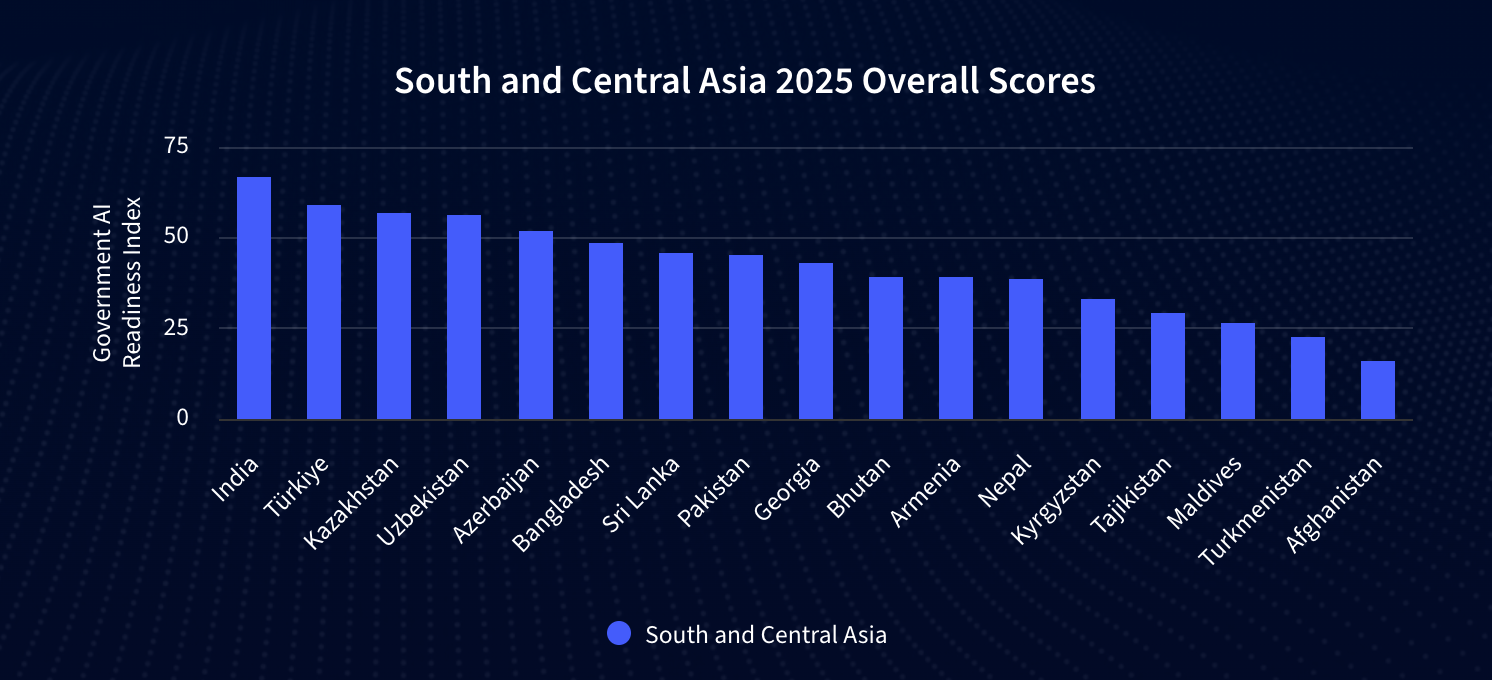
South and Central Asia scores in the ranking. Photo credit: Oxford Insights
Türkiye ranks second in the region, placing 53rd globally with a score of 58.91. While the report noted that some earlier national strategy commitments remain unfulfilled, the country still boasts strong digital and innovation foundations. The report mentioned a dedicated technology visa for international AI talent as a “promising example.”
Kazakhstan ranks third in the region, taking 58th place globally with a score of 56.70. This is a sizeable jump from 72nd spot in the ranking’s 2023 edition.
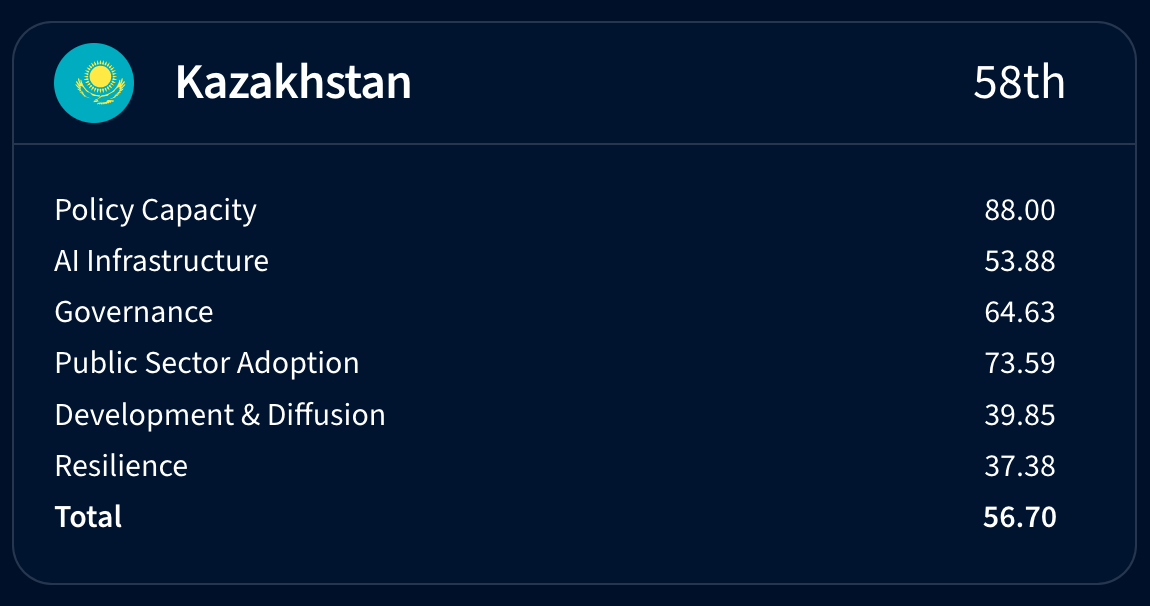
South and Central Asia scores in the ranking. Photo credit: Oxford Insights
The launch of its first domestic supercomputer in July marked a turning point, expanding national computing capacity. Uzbekistan is also advancing rapidly, with President Shavkat Mirziyoyev setting a target of training five million AI specialists by 2030 and embedding AI across public administration.
Experts project the region will continue to perform well in AI readiness, driven by governments’ use of AI in the public sector.
“More widely, the region’s focus on e-Government delivery has been recognised for a number of years. Building on these important strengths, the region is continuing to augment its compute capacity and also exploring ways to strengthen local innovation ecosystems,” reads the report.
Experts stress that succeeding in AI is not an “overnight phenomenon.” The challenge for countries is to align their strategy, skills, infrastructure and cross-border cooperation to ensure AI has a positive and sustained impact.
Skills as priority
Human capital has emerged as a central focus, according to the report. In 2025, Kazakhstan pledged to train one million citizens in basic and advanced AI skills. The initiative is framed as a foundation for a new approach to public services and economic growth.
Kazakhstan is opening the Alem AI, which will feature a TUMO center for teenagers aged 12 to 18. The innovative educational space will offer free training in animation, programming, 3D graphics, and generative AI. It also hosts the Tomorrow School, Kazakhstan’s first peer-to-peer AI school for young people. The free two-year program focuses on practice, teamwork, and critical thinking, covering modern programming languages such as Golang, JavaScript, Python, and Rust.
Uzbekistan’s President Shavkat Mirziyoyev announced a similarly bold commitment to train five million AI experts and position AI as a key tool of the public sector and public service delivery.
Bipolar global landscape
The report underlines that the current AI landscape is increasingly shaped and dominated by China and the United States, whose competition is influencing access to technology, supply chains and technical standards worldwide. However, it has not deterred South and Central Asian governments from pursuing their own paths.
“China’s AI research output in 2024 matched the combined publications of the U.S., U.K. and EU, with 156 institutions each producing over 50 AI papers, a distributed research infrastructure unmatched elsewhere. Models like DeepSeek and Alibaba’s Qwen have demonstrated performance rivalling Western counterparts at a fraction of the development cost, challenging assumptions about the necessity of cutting-edge hardware,” reads the report.
Many countries are adopting mixed strategies: strengthening domestic capacity while remaining open to international collaboration. AI sandboxes, public-private partnerships and cross-border research initiatives are becoming more common.
At the same time, calls for AI sovereignty are growing in strength. Countries and regions are exploring ways to reduce dependence on foreign technology stacksю
“The G20 in the U.S., G7 in France, and the Global AI Summit in India will convene countries at vastly different stages of readiness. We expect to see clearer distinctions emerge between ‘model makers,’ the handful of nations with the resources and talent to build cutting-edge AI and ‘model takers’ managing AI’s impacts on their societies and economies. And, as DeepSeek reminded us, surprises remain part of the landscape,” writes Oxford Insights CEO Richard Stirling.
