
ABU DHABI — Masdar, the United Arab Emirates’ clean energy champion, announced financial close on a $225 million package for the solar power plant and battery storage project in southern Uzbekistan on Jan. 15, on the sidelines of Abu Dhabi Sustainability Week. Senior officials from both countries attended, underscoring the political weight behind Uzbekistan’s clean energy push.
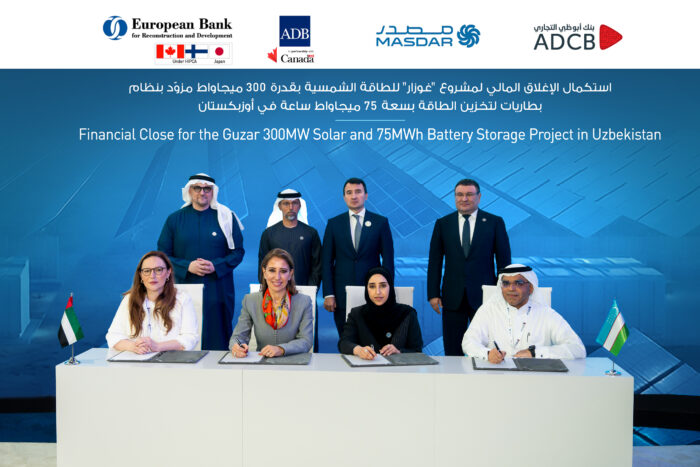
Once operational, the project expected to avoid more than 400,000 tonnes of CO₂ annually and generate enough electricity to power the equivalent of 60,000 homes. Photo credit: Masdar
According to Masdar’s press service, the financing covers the 300-megawatt Guzar solar power plant and a 75-megawatt-hour battery energy storage system in Uzbekistan’s Kashkadarya Region. Masdar CEO Mohamed Jameel Al Ramahi said the deal reflects the depth of the partnership with Uzbekistan, where the company has been active since 2021.
“Since 2021, Masdar has been proud to collaborate with our partners in Uzbekistan to deliver over 2 gigawatts of renewables capacity to support the country’s ambitious clean energy goals,” he said.
He added that the country’s wind and solar resources, along with supportive regulations, make it a key growth market as Masdar targets 100 gigawatts of global capacity by 2030.
The European Bank for Reconstruction and Development (EBRD) will provide up to $195.5 million, including funds from Canada and Finland, under the High Impact Partnership on Climate Action and the Japan-EBRD Cooperation Fund. The Asian Development Bank is contributing $30 million, including support from LEAP 2 and the Canadian Climate and Nature Fund for the Private Sector in Asia. Abu Dhabi Commercial Bank provided hedging for the transaction.
Under a public-private partnership with Uzbekistan’s national grid operator, Masdar will design, build and operate the project. Once operational, it is expected to avoid more than 400,000 tons of CO2 annually and generate enough electricity to power the equivalent of 60,000 homes, contributing to Uzbekistan’s target of sourcing 54% of its electricity from renewables by 2030.
Masdar’s total investment in Uzbekistan now exceeds $2 billion. Its portfolio includes the country’s first utility-scale solar project, the 100-megawatt Nur Navoi plant, and a recently signed agreement to develop Uzbekistan’s largest standalone battery storage project, 300 megawatt/600 megawatt-hour in the Navoi Region.
While Uzbekistan anchors Masdar’s Central Asia expansion, the company is also advancing a major wind project in Kazakhstan. In an interview with The Astana Times, Masdar COO Abdulaziz Alobaidli said the planned wind power plant in the Zhambyl Region, set to become the largest in Central Asia, has moved from wind measurement into the development phase after the signing of a power purchase agreement.
Beyond wind, Masdar is also developing a round-the-clock clean energy project in Kazakhstan, which was announced during a high-level visit by the Crown Prince of Abu Dhabi in May 2025.
At the time, Masdar and the Samruk Kazyna National Welfare Fund signed a cooperation agreement to advance projects that provide up to 500 megawatt-hours of continuous power, supported by energy storage systems of up to 2,000 megawatt-hours. According to Alobaidli, the project remains in the development phase.
