
ABU DHABI — Masdar, a clean energy champion of the UAE capital, is marking its 20th anniversary this year, having launched operations in 2006, long before renewable energy became a global buzzword. The Astana Times spoke with Masdar’s Chief Operating Officer Abdulaziz Alobaidli, on Jan. 12, on the eve of Abu Dhabi Sustainability Week (ADSW) 2026, held under the patronage of the company.
According to Alobaidli, ADSW has firmly established itself as a global platform where policymakers, decision-makers, investors, and innovators converge to discuss sustainability and clean energy.
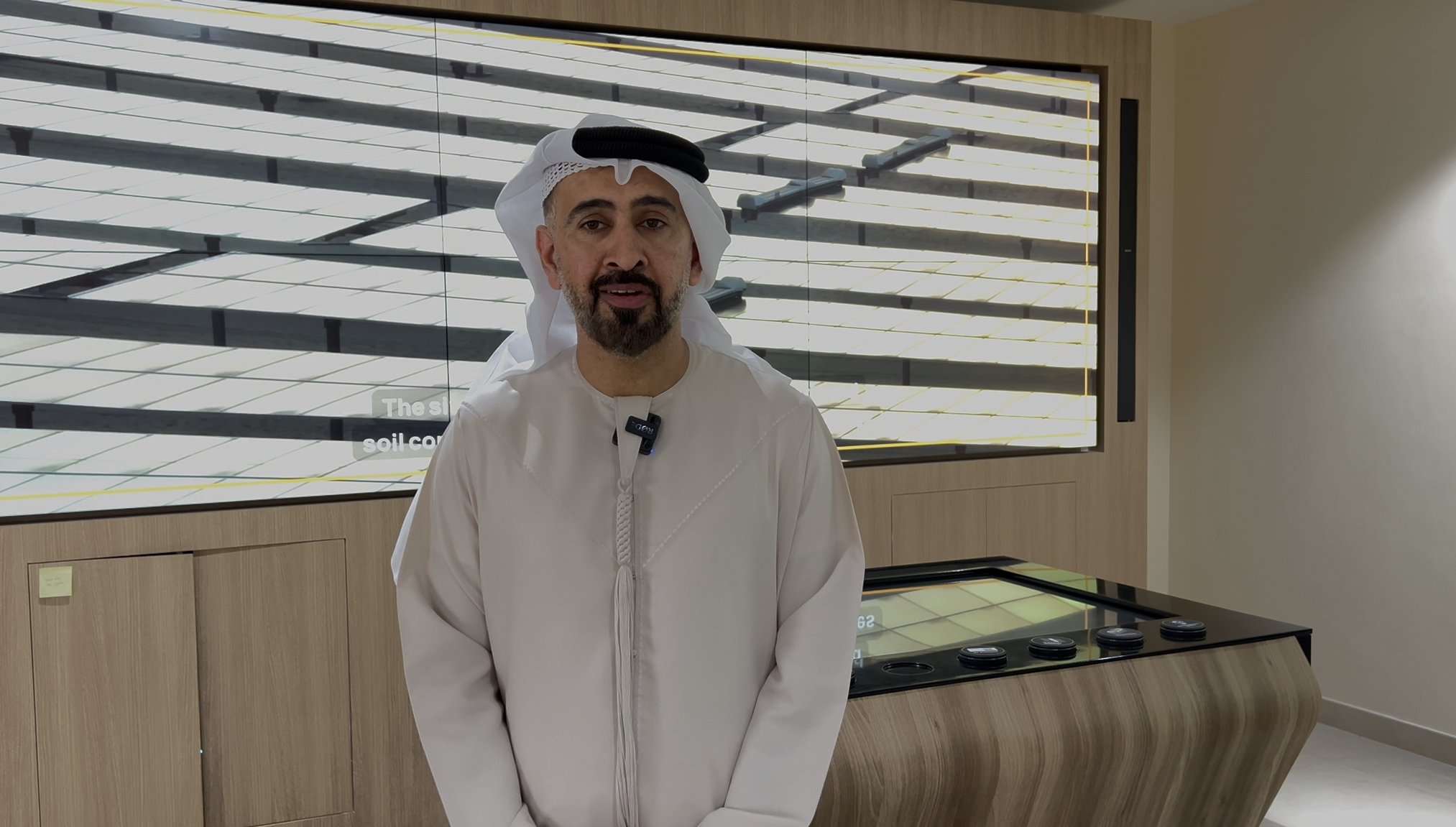
The Astana Times spoke with Masdar’s COO Alobaidli, on Jan. 12, on the eve of ADSW 2026 Photo credit: The Astana Times
“This year, the focus is on the nexus of next all-system goals. We are advocating that it is time for systems to work together: power, water, sustainability, food, and beyond. It is time to take pragmatic steps and real actions to ensure we deliver on national climate commitments while accelerating the deployment of clean energy,” he said.
Reflecting on the company’s journey, Alobaidli noted that when Masdar was founded, renewable energy was far from mainstream and was largely confined to technical papers, pilot projects, and small-scale applications.
“However, the leadership of this country (UAE) made a deliberate decision to invest in renewable energy at scale: to diversify the economy and energy supply. They wanted to send a clear message to the world: if we can do it, everyone can do it. Today, we are proud to see this vision becoming reality across the globe,” he said.
Alobaidli said Masdar has developed projects in more than 40 countries across six continents, stressing that the company has gone beyond deployment to help shape the renewable energy sector itself.
“Many of our projects were first of their kind. We developed the region’s first concentrated solar power project, proving that solar energy is viable even in dusty and humid environments. We deployed the first floating PV project in Indonesia, offering a solution for countries with high population density and limited land availability. We also participated in the development of the first floating offshore wind projects off the coast of Scotland, in high-wind conditions,” he said.
Kazakhstan and Central Asia: from wind to system solutions
Masdar’s ambition and expertise have increasingly extended to Central Asia, including Kazakhstan.
“In Central Asia, we remain one of the largest renewable energy investors, with Uzbekistan, Azerbaijan, and Kazakhstan as core focus markets. We also continue dialogue with other Central Asian countries, supporting energy policy development and reform to improve bankability and attract investment,” Alobaidli said.
When The Astana Times met with Alobaidli during ADSW 2025 last January, discussions centered on a wind power plant in Kazakhstan’s Zhambyl Region, set to become the largest in Central Asia. At the time, the project was still at the wind measurement stage. Asked about its current status, Alobaidli said progress has been substantial.
“We have signed the Power Purchase Agreement, and we have moved into the development phase. Wind projects are slightly different from solar. The development phase is generally faster, but it requires very specific on-site work. You cannot rely solely on satellite or historical data. You need to install wind masts and conduct at least one year of real, ground-based measurements in order to make the project bankable,” he said.
The wind measurement campaign began more than two quarters ago, and the results exceeded expectations. Alobaidli emphasized that community engagement is a core principle for Masdar. He recalled his visit to Taraz just over two months ago, where he met with local residents to discuss the project and its implications.
“Kazakhstan is a country with strong ties to land: nomadic traditions, agriculture, and herding. For us, a key principle is that our projects should not have a negative impact on local communities. Two months ago, I was in Kazakhstan, in Taraz and met with local communities to explain the project, discuss potential impacts, and explore how we can work together whether through compensation mechanisms or by ensuring that communities themselves become part of the project. This is a very important element for us,” he explained.
On financing, Alobaidli said the project has attracted strong interest from both development finance institutions and commercial banks.
“Overall, the project is progressing as planned. What remains is to finalize the wind measurement campaign, complete the documentation, and then move into construction, hopefully within this year. That is our current plan,” he said.
Beyond wind power, Masdar is also advancing a round-the-clock clean energy project in Kazakhstan. During the Crown Prince of Abu Dhabi’s high-level visit to Kazakhstan in May 2025, Samruk-Kazyna National Welfare Fund and Masdar signed a cooperation agreement to develop projects that provide up to 500 megawatts (MW) of continuous power supply, along with energy storage systems of up to 2,000 MW. According to Alobaidli, the project remains in the development phase.
“This includes land assessments, determining the optimal size and configuration of the project, identifying potential end users, and assessing the impact on the grid. These studies naturally take time, but once they are completed, the project should move much faster,” he said, adding that it is important for Masdar to demonstrate that this model is scalable beyond the UAE.
Uzbekistan is another key Central Asian market for Masdar and the first country the company entered in the region. To date, Masdar has five projects already in operation there.
“Uzbekistan has become a very attractive investment destination, and we now see many international players entering the market. For some time, we enjoyed being almost the only investor, but today the market is quite crowded. That is actually a very positive sign for the country and for the Uzbek people,” Alobaidli said.
Scaling up: Masdar’s global progress so far
Looking ahead, Alobaidli pointed to Masdar’s announcement last year of the world’s first gigascale, around-the-clock renewable energy project, describing it as a milestone for the industry.
“Not only can it reduce carbon emissions, but it can also meet what we call baseload or main demand, providing 24-hour electricity. These solutions do more than power homes; they unlock clean energy adoption for hard-to-abate industries that previously hesitated due to intermittency concerns. Today, those same industries are increasingly eager to deploy such solutions,” he said.
He also recalled that at the end of 2022, Masdar set a bold target of reaching 100 gigawatts of installed capacity by 2030.
“I am proud to say that we are already halfway there. In less than three years, we have tripled the company’s capacity and today stand at close to, or slightly above, 50 gigawatts of portfolio capacity, supported by a strong and advanced pipeline that will be deployed in the coming years,” he said.
According to Alobaidli, this progress has been driven not only by shareholder support but also by transformative acquisitions, including Masdar’s expansion in Greece through the acquisition of Terna Energy and in Spain through partnerships with Endesa and Saeta Energy.
“These moves gave us boots on the ground and access to local talent. As a result, Masdar is no longer growing solely from Abu Dhabi; we now operate through multiple hubs across the United States, Africa, Europe, and the Middle East, strengthening our ability to deliver on our 100-gigawatt ambition by 2030,” he said.
With five years remaining and another 50 gigawatts to deliver, Alobaidli said the company is confident in its trajectory.
“This is something we have done before, and with a larger, more international Masdar family, we are more capable than ever of achieving it,” he said.
Equally important, he stressed, is ensuring that growth remains diversified and resilient.
“While we have significantly expanded our presence in developed markets such as the United States and Europe, developing markets remain central to our strategy. The Global South is especially important to Masdar, and we continue to grow across Africa, Central Asia, and the Asia-Pacific region,” he said.
