
ASTANA — Transport corridors and logistics hubs are transforming how Central Asia grows and competes. But how can the region truly benefit from this shift, and what does it mean for the economies of both Central Asia as a whole and Kazakhstan in particular? To unpack these questions, Chief Economist of the Eurasian Development Bank (EDB) and one of the key architects behind its macroeconomic forecasts and long-term infrastructure and industrial strategies Evgeny Vinokurov joined The Astana Times YouTube channel.
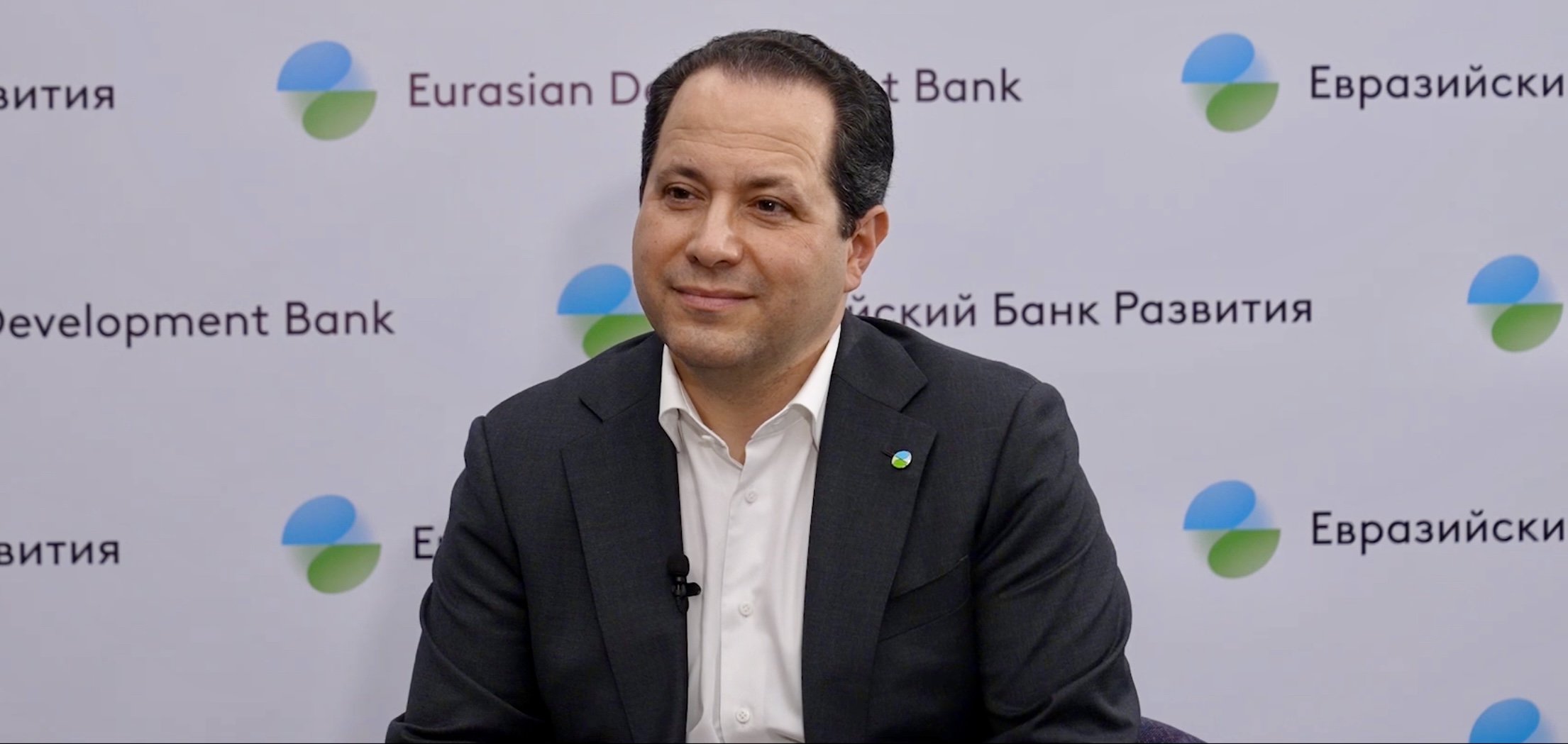
Evgeny Vinokurov. Photo credit: The Astana Times
Central Asia comes of age as an economic region
According to EDB estimates, Central Asia concluded 2025 on a strong footing, with growth reaching 6.6%, the highest level since 2012. Looking ahead, the bank expects the region to maintain solid momentum.
“Twenty years ago, Central Asia was not a region in economic terms. It was a collection of countries. Now, it’s an economic region with a GDP of around $600 billion. That’s our forecast for 2026,” Vinokurov said.
He noted that EDB was among the first institutions to highlight Central Asia’s long-term growth potential, noting that the region has grown at an average rate of 6% over the past 25 years, making it one of the most remarkable success stories of this century.
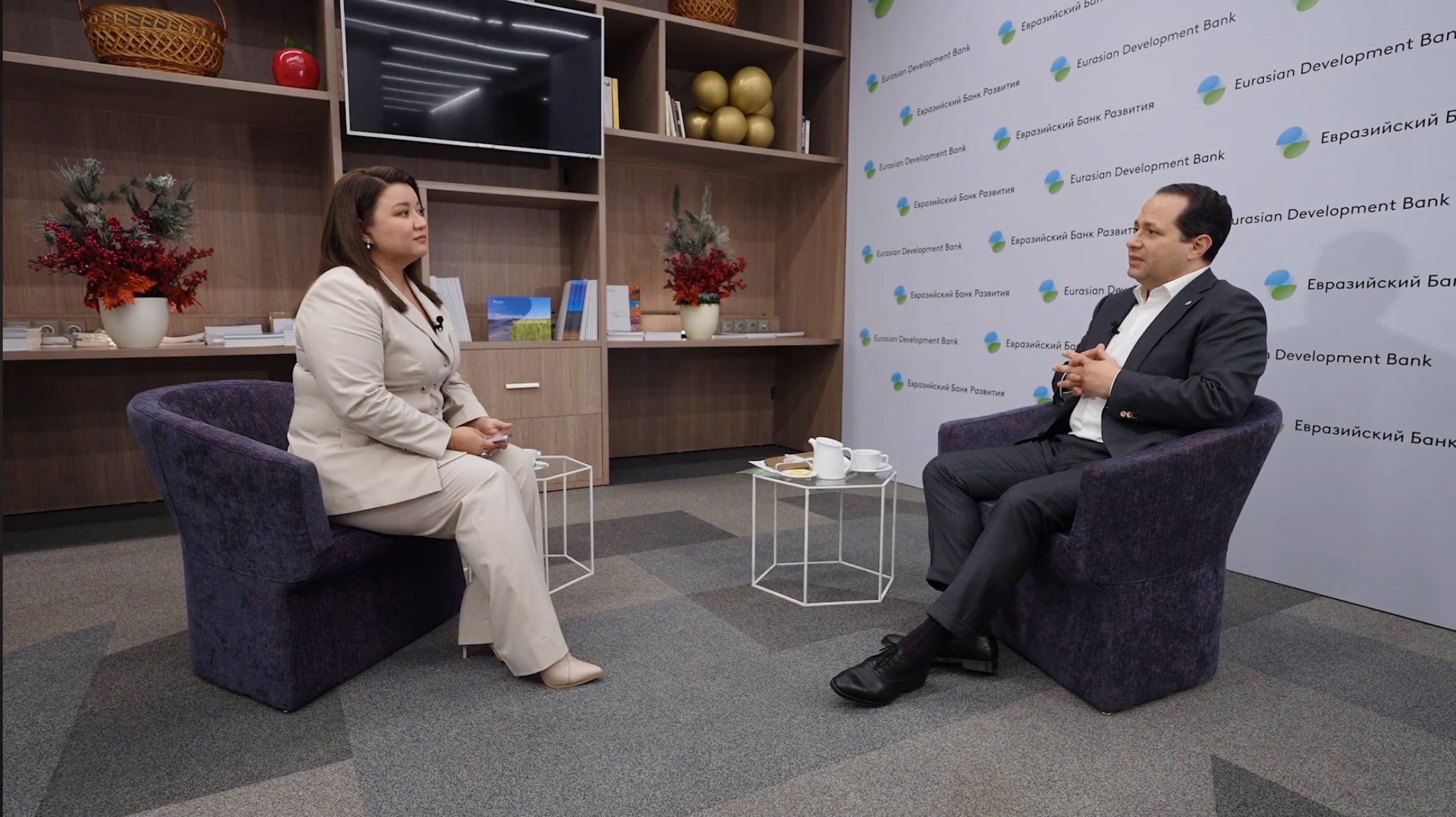
Evgeny Vinokurov spoke to The Astana Times correspondent Aida Haidar. Photo credit: The Astana Times
“We were among the early forecasters of this success story. Several years ago, we started telling the world: pay attention to Central Asia. It’s a turnaround story. It’s one of the fastest-growing regions globally. Invest here, come here, visit Central Asia not only for its history, but also for its future. Today, we are fortunate to see this narrative becoming mainstream,” Vinokurov said.
Discussing EDB’s baseline outlook, Vinokurov said the region is expected to continue growing at 5–6%, driven by multiple engines. Kazakhstan remains the largest contributor, followed by Uzbekistan, while smaller economies are expanding at even faster rates.
“Kyrgyzstan has been growing by more than 9% annually, and we estimate that in 2026 it will be the fastest-growing economy in Central Asia. Tajikistan is growing very steadily at around 8%,” he said.
“So it’s a fairly homogeneous story. The region as a whole is becoming economically notable. In early 2025, Central Asia became a half-trillion-dollar economy, and next year it is set to reach $600 billion,” he added.
Trade Wars: the risk everyone stopped talking about
Despite the upbeat outlook, Vinokurov cautioned that downside risks remain. Among them are so-called “black swans,” but one risk, he said, has quietly slipped off the global radar: the continuation of trade conflicts.
“This was the number one issue in the spring, when everyone was concerned about tariffs and escalation. Then it somehow subsided, and many forgot about it. I wouldn’t,” he said.
According to Vinokurov, renewed trade conflicts and further fragmentation of the global economy would pose a serious risk to Central Asia.
“We are small, open economies. We are price takers, and we export large volumes of oil, gas, ferrous and non-ferrous metals. All of this would suffer if trade conflicts escalate. The continuation or resurrection of trade wars is a risk that should not be forgotten,” he explained.
Why EDB bets on industry and agriculture
Vinokurov emphasized that EDB distinguishes itself from other multilateral development banks by focusing on industrial and agricultural projects.
“Globally, multilateral development banks provide about $200 billion in loans annually. That’s a lot but it’s not enough. The investment gap in developing countries is widening,” he said.
Against this backdrop, EDB has taken a different approach.
“Historically, around 35–40% of our portfolio has gone into industrial projects and industrial agriculture, areas other development banks rarely prioritize. Most focus on basic infrastructure and the social sector. We go deeper. We take risks. We do project finance,” Vinokurov said.
He noted that EDB has financed major industrial projects in Kazakhstan and, as of this year, has expanded this approach to Uzbekistan, Kyrgyzstan, and Tajikistan. “This is one of the key value propositions EDB brings to the region,” he added.
Warehousing: the hidden backbone of growth
One of EDB’s flagship studies last year focused on warehousing infrastructure, which the Bank describes as a turning point for Eurasia this decade. According to Vinokurov, many people still think of warehouses as dull boxes on the outskirts of cities, where in reality, modern warehousing is high-tech, complex, and central to logistics. He noted that logistics accounts for roughly 25% of the price consumers pay in supermarkets, with warehousing as a major component.
“Central Asia is hugely underserved in that sense. In developed economies, there are three to four square meters of warehouse space per capita. In China, it’s one square meter. In Russia, 0.4. In Kazakhstan, just 0.08 and even less in other Central Asian countries,” he said.
According to Vinokurov, three structural forces are driving demand: the reconfiguration of trade routes, particularly the rise of North–South corridors alongside East–West routes; rapid growth in e-commerce; and rising demand for specialized warehousing, including agricultural, pharmaceutical, and temperature-controlled facilities.
“Kazakhstan is particularly well-positioned. Where North–South and East–West routes intersect, synergies emerge. We see at least three major logistics nodes: Almaty, Astana, and Shymkent with strong potential for warehouse development,” he said.
While demand for Class A warehousing is strong, Vinokurov warned that location risk remains critical.
“If developers choose the wrong location or bet on trade flows that don’t materialize, risks increase. My advice is to start thinking about specialized warehousing early: temperature control, agricultural hubs, before the market fully shifts,” he said.
Beyond transit: turning corridors into industry
Logistics, Vinokurov stressed, cannot be separated from transportation. The Eurasian Transport Network–2035 brings together more than 300 large-scale infrastructure projects worth around $230 billion.
“What we are witnessing now is historic. For more than a thousand years, connectivity in Central Asia developed along East–West routes, starting with the Great Silk Road. Only now are we seeing the emergence of large-scale North–South corridors,” he said.
Despite being home to five landlocked economies, Central Asia, and Kazakhstan in particular, stands to benefit from this shift.
“Kazakhstan is often described as the country farthest from the world ocean. The reality on the ground is better than that. However, the task now is to develop connectivity in all directions and turn the region into a true transport crossroads,” Vinokurov said.
Among the key initiatives are the North–South corridor via the Caspian Sea, linking Kazakhstan and Turkmenistan to Iran, and the proposed Trans-Afghan Corridor, which would connect Central Asia to the Indian Ocean.
“The Trans-Afghan Corridor has great potential, but it will require political consensus, significant funding, and serious risk mitigation,” Vinokurov said.
Climbing the industrial ladder
Ultimately, Vinokurov argued, transit alone is not enough.
“Transit block-trains passing through Eurasia bring about $2 billion in revenue. That’s profitable, but it’s not the main prize. The real prize is when a country sits on these flows and converts them into industrial development,” he said.
He noted that Central Asian economies, especially Kazakhstan, with the region’s highest income per capita, have reached a stage where further growth requires building an industrial base.
“There’s a concept called the industrial ladder. Countries move from low value-added production toward higher-tech goods. Kazakhstan is somewhere in the middle. The task now is to keep moving up,” he explained.
As a concrete example, Vinokurov cited a joint EDB-United Nations Industrial Development Organization initiative to develop the region’s irrigation equipment manufacturing capacity.
“Central Asia imports between $150 million and $300 million worth of irrigation equipment annually and produces little itself. That market size is already sufficient to launch local production first for domestic demand, then for export,” he said.
For the full conversation, watch the video interview on The Astana Times YouTube channel.
