
ASTANA – Kazakhstan handles approximately 84% of freight transported between China and Central Asia, placing it at the center of a rapidly expanding regional trade network. Trade between China and the five Central Asian countries nearly tripled between 2020 and 2025, rising from $23.5 billion to almost $70 billion, according to a Nov. 19 analytical brief by the Eurasian Development Bank (EDB).
Photo credit: Shutterstock
China has become the region’s largest trading partner, accounting for nearly 30% of its total merchandise trade in 2025, up from 17-18% in 2020-2021. All rail freight between China and Central Asia passes through Kazakhstan, primarily via the Dostyk and Altynkol border crossings. Kazakhstan also accounts for nearly half of the region’s total trade with China, connecting Chinese production centers with Central Asian markets and destinations farther west.
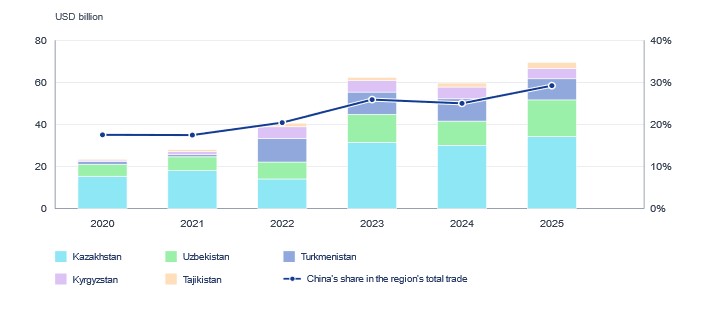
Trends in bilateral trade between Central Asian countries and China, in billions of dollars (left scale) and China’s share of Central Asian countries’ total merchandise trade, % (right scale). Sources: National statistical agencies of Central Asian countries, TradeMap.
This growing role brings both opportunities and challenges. Rising freight volumes are straining existing infrastructure, making expanded railway capacity, more efficient border crossings and fewer logistical bottlenecks essential to maintaining Kazakhstan’s position as a regional transport hub. Several major infrastructure projects are now underway across Central Asia to accommodate growing trade and strengthen the region’s connections to international markets.
Why the numbers are rising
Growing trade has translated directly into higher demand for transport services. In 2025, approximately 51 million metric tons of freight moved between China and Central Asia by rail and road. Rail accounted for 35.6 million tons, while road transport carried another 15.4 million tons.
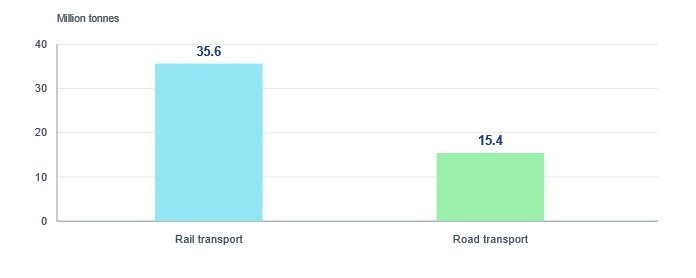
Volume of freight traffic between Central Asia and China in 2025, in millions of metric tonnes. Source: EDB analysts’ calculations
Freight flows continued to increase in 2026, with rail traffic reaching 31.8 million tons in the first 10 months, an 8% increase compared with the same period in 2025.
The increase builds on an established trend. In October 2025, the EDB reported that transit cargo flows through Central Asia grew 70% between 2020 and 2024, highlighting the region’s growing role in Eurasian trade.
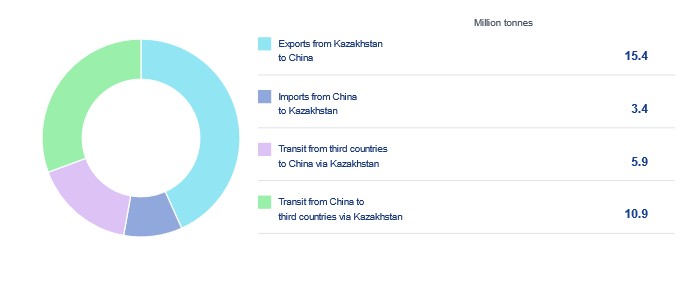
Volume of rail freight traffic with China via the Kazakhstan railways network in 2025, in millions of metric tonnes. Sources: KazakhstanTemirZholy National Company, calculations by EDB analysts
The latest growth reflects stronger demand for Chinese goods alongside expanding export capacity across Central Asia. It also reflects changes in the region’s business landscape.
Road transport, for example, is gaining importance as more small and medium-sized businesses require flexible logistics for smaller shipments. Improvements in customs procedures, international transport agreements and digital systems have also made cross-border road freight easier.
Rail remains the backbone of regional freight transportation, particularly for large volumes of goods moving over long distances. Road transport, however, offers an alternative for time-sensitive, high-value and perishable products.
The EDB estimates that untapped trade potential between China and Central Asia amounts to approximately $39.3 billion. This suggests that trade could expand further, creating additional demand for transport infrastructure and logistics services.
New railway lines could change the map
Among the most important developments is the construction of the Ayagoz-Bakhty railway in Kazakhstan. The planned 272-kilometer line is expected to enter operation by the end of 2027, with an initial design capacity of 20 million metric tons annually. The project will support the development of a third railway crossing between Kazakhstan and China, adding another route for freight transportation.
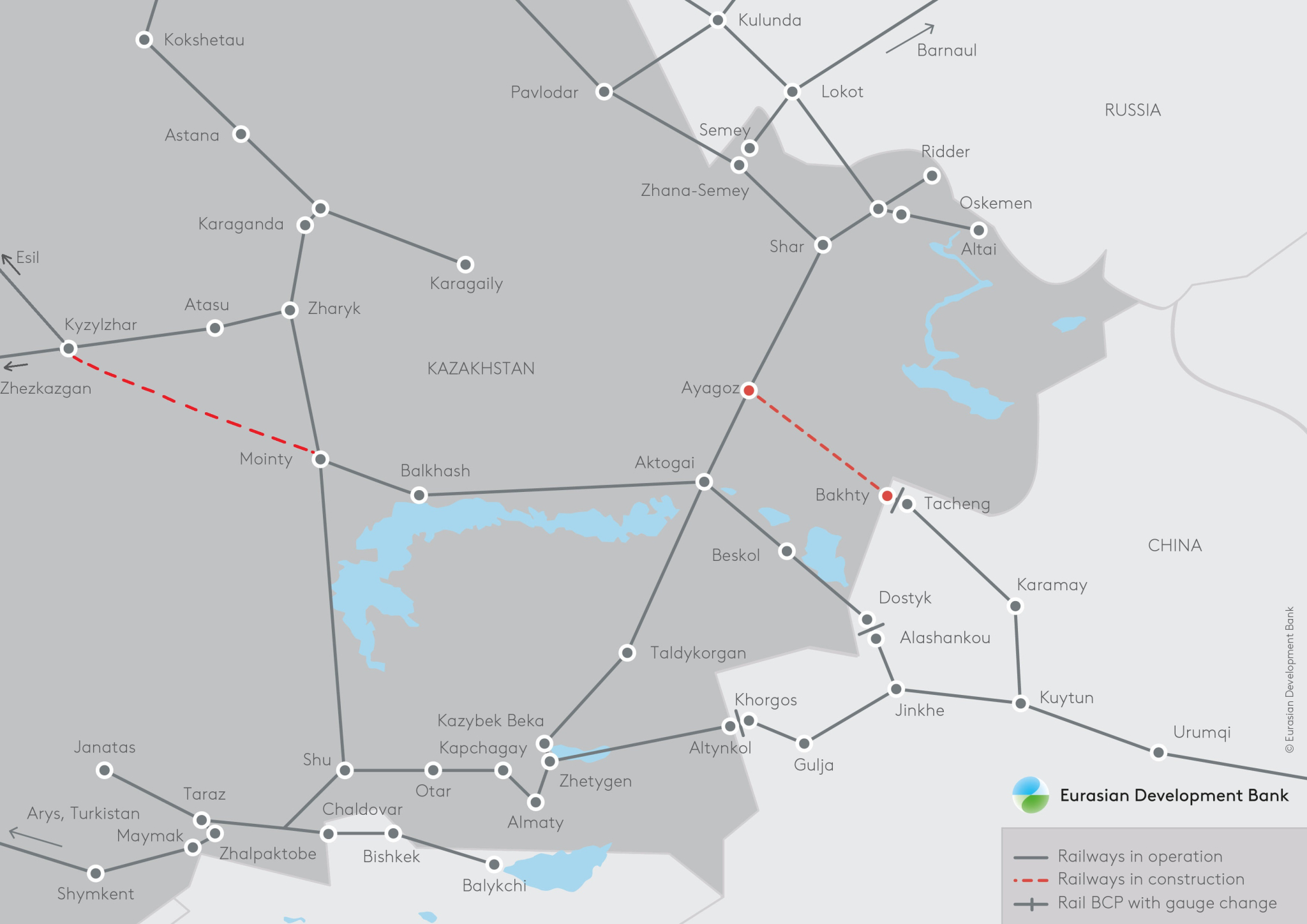
Projects for the Ayagoz–Bakhty and the Moyynty–Kyzylzhar railway sections. Source: EDB.
Another project, the 323-kilometer Mointy-Kyzylzhar railway, is scheduled to be completed by the end of 2026. The new line is expected to shorten transport distances along the Middle Corridor and the Central Eurasian Corridor by 149 kilometers while easing capacity constraints on existing sections.
Beyond Kazakhstan, the China-Kyrgyzstan-Uzbekistan railway is one of the region’s most ambitious connectivity projects. The planned 523-kilometer route will connect Kashgar in China with Andijan in Uzbekistan through Kyrgyzstan. Its initial design capacity is estimated at 7 million metric tons of freight annually, with the potential to increase to 20 million tons following a second phase of development. For the Kyrgyz Republic, the railway would improve connectivity between its northern and southern regions while generating transit revenue. For Uzbekistan, it would provide a more direct connection to China and strengthen its potential as a regional transport center. Together, these projects could create additional connections between Central Asian transport networks and major routes linking China with Europe, the South Caucasus and the Middle East.
The Middle Corridor is part of a bigger picture
Railway development is also strengthening the region’s position along the Trans-Caspian International Transport Route, also known as the Middle Corridor. The route connects China and Central Asia through Kazakhstan, across the Caspian Sea to Azerbaijan and Georgia, and onward to Türkiye and European markets.
At the same time, the Central Eurasian Corridor provides another major overland connection between China, Russia, Belarus and European destinations. These routes offer businesses additional options for moving goods across Eurasia and help distribute freight across different transport networks.
Still, the scale of the opportunity should be viewed realistically. In 2025, overland railway routes through Central Asia accounted for just 2.4% of the total number of containers shipped from China to European countries. This indicates that, despite growing traffic and significant investment, there is considerable room for expansion.
Infrastructure is only the beginning
China is playing a major role in financing and developing the region’s transport infrastructure. According to the EDB, more than 20 projects involving Chinese companies are currently underway in Central Asia, with a combined investment value exceeding $12 billion. Chinese banks and commercial companies have provided more than $7 billion through loans, grants and foreign direct investment. Many of these projects are connected to China’s Belt and Road Initiative, which seeks to strengthen trade and infrastructure links across Eurasia.
For Central Asian countries, the challenge now is to ensure that new transport connections deliver benefits beyond transit revenues. More railway capacity and highways can improve trade, but efficient logistics also require modern warehouses, reliable border procedures, digital customs systems and competitive transport services.
The EDB specifically identifies the shortage of modern Class A warehouses as a potential constraint on the further development of road freight. This is not a new challenge. The EDB has previously highlighted the region’s shortage of modern warehousing facilities, estimating demand at nearly 2 million square meters.
Ultimately, Central Asia’s growing connectivity with China presents an opportunity to become more than a region through which goods simply pass. The countries can strengthen their roles in trade, logistics, distribution and regional manufacturing. The next stage will depend not only on how many kilometers of railway are built, but also on whether countries can turn these connections into broader economic opportunities.
