
ASTANA – For three decades, Steven Gilbert had lived in Kazakhstan as a humanitarian worker and English teacher. Today, the American archaeologist is helping rewrite the history of the Zhetisu Region. He leads the excavations at Ilibalyk, a medieval Silk Road city where his team found the first clearly Christian cemetery in Kazakhstan dating to before the arrival of the Russian Empire.
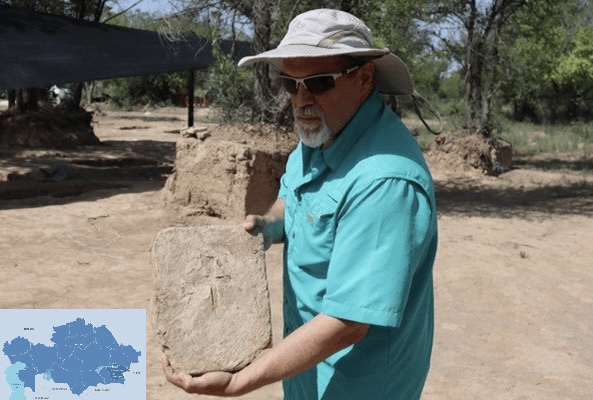
Photo credit: Dr. Steven Gilbert. Click to see the map in full size. The map is designed by The Astana Times.
Gilbert drew wide public attention this summer after a video of him speaking fluent Kazakh spread on social media, where viewers praised his pronunciation.
Born in Amarillo, Texas, in 1964, Gilbert came to Kazakhstan in 1993, shortly after independence, together with his wife, Elizabeth, through a humanitarian organization. In an interview with The Times of Central Asia, he said their work included food aid in the Aral Sea region and exchange programs. The couple began learning Kazakh as soon as they arrived and lived in the country continuously until 2024. Earlier Russian-language media reports said Gilbert headed the humanitarian organization Senim and taught English.
His path to archaeology began in 2014, when a schoolteacher in the village of Usharal in the Panfilov District found a one-meter Christian gravestone. The stone, now kept at the Center for the Rapprochement of Cultures in Almaty, connected Gilbert with archaeologists from Kazakhstan and the United States, and he returned to the U.S. to study archaeology. Today, he is an assistant professor of intercultural studies and associate director of the Tandy Institute for Archaeology at Southwestern Baptist Theological Seminary in Texas, and he divides his time between the two countries.
Ilibalyk lies in the Ili River valley near the Chinese border, just beyond the Dzungarian Gate. Armenian, Persian, and Chinese sources from the 12th to 14th centuries mention the city, which was a stop on the road to Almaliq, the capital of the Chagatai rulers. Excavations began in 2016 as a joint project of the Lanier Center for Archaeology in the U.S. and Kazakh specialists. The site covers about five square kilometers and had never been excavated before, although part of it was damaged after 1933, when the area became a Soviet collective farm.
According to Gilbert, a Turkic-speaking Christian community lived in Ilibalyk for almost two centuries, from the 12th to the 14th century. Its members lived alongside Muslims, Buddhists, Manichaeans, and followers of the traditional beliefs known today as Tengrism. Christian cemeteries of that era had already been found in neighboring Kyrgyzstan, but Ilibalyk provides the first reliable evidence of such a community on the territory of modern Kazakhstan.
The team has found more than 50 gravestones, known as kairaks, bearing cross images. Six carry epitaphs: four in Old Turkic, a predecessor of modern Turkic languages including Kazakh, and two in Syriac, the liturgical language of the Church of the East. The names include biblical ones such as Petros and Isho, as well as Central Asian names such as Shirin and Tegiz.
In one section of the cemetery, archaeologists found at least five women buried with boqtaq headdresses, worn by high-status married women, often called khatuns. Their graves contained scissors, daggers, and rings. Gilbert believes the women may have come from the kereit or naiman tribes, whose daughters often married Mongol rulers, including Genghis Khan’s sons. Next to the cemetery, the team uncovered the foundations of a funerary chapel measuring 23 by eight meters, where local Christians prepared the dead for burial. Gilbert said it is the first such structure archaeologists have ever found.
The city’s place on the trade routes is also visible in the finds. The news media El.kz reported that excavators uncovered pearls and corals, goods that could have reached the steppe only by long-distance caravan trade and that point to wealthy residents.
Yet the burials also reveal hard lives. Signs of malnutrition appear in almost everyone buried at the site, child burials are about as numerous as adult ones, and few people lived to old age. Gilbert links the famines to harsh winters and civil wars between the Chagatai and Yuan uluses, as well as within the Chagatai ulus itself.
The team combines traditional digging with LiDAR-equipped drones, ground-penetrating radar, radiocarbon dating, and preliminary ancient DNA analysis. The work is carried out under Kazakh law together with Rutrum, an Almaty-based cultural resource management company, and international partners including the Swiss Society for the Exploration of Eurasia. Specialists and volunteers from South Korea, Australia, the United Kingdom, Singapore, Uzbekistan, Russia, and different regions of Kazakhstan have joined the project. This year’s team numbered almost 40 people, including residents of Usharal.
All artifacts belong to Kazakhstan and leave the country only when the government lends them to international exhibitions. The state protects the site, and Gilbert said residents have begun to take pride in it and report illegal metal detectorists. He hopes museums in the Panfilov District and other regions will one day display the Christian gravestones and tell the story of Ilibalyk’s people.
Gilbert says the Kazakh language has been central to his work. “Knowing Kazakh brings you closer to the heart of the people,” he told Kazakhstanskaya Pravda.
He noted that most Kazakhs he talked to did not know that Christians lived on their land almost a thousand years ago. For him, these discoveries show how religiously diverse the ancestors of the Kazakh people were, long before the modern state emerged.
