
ASTANA – Kazakhstan is seeking to translate its energy base and position between major markets into digital leverage as data centers, advanced chips and artificial intelligence infrastructure emerge as strategic assets in an intensifying global technology contest.
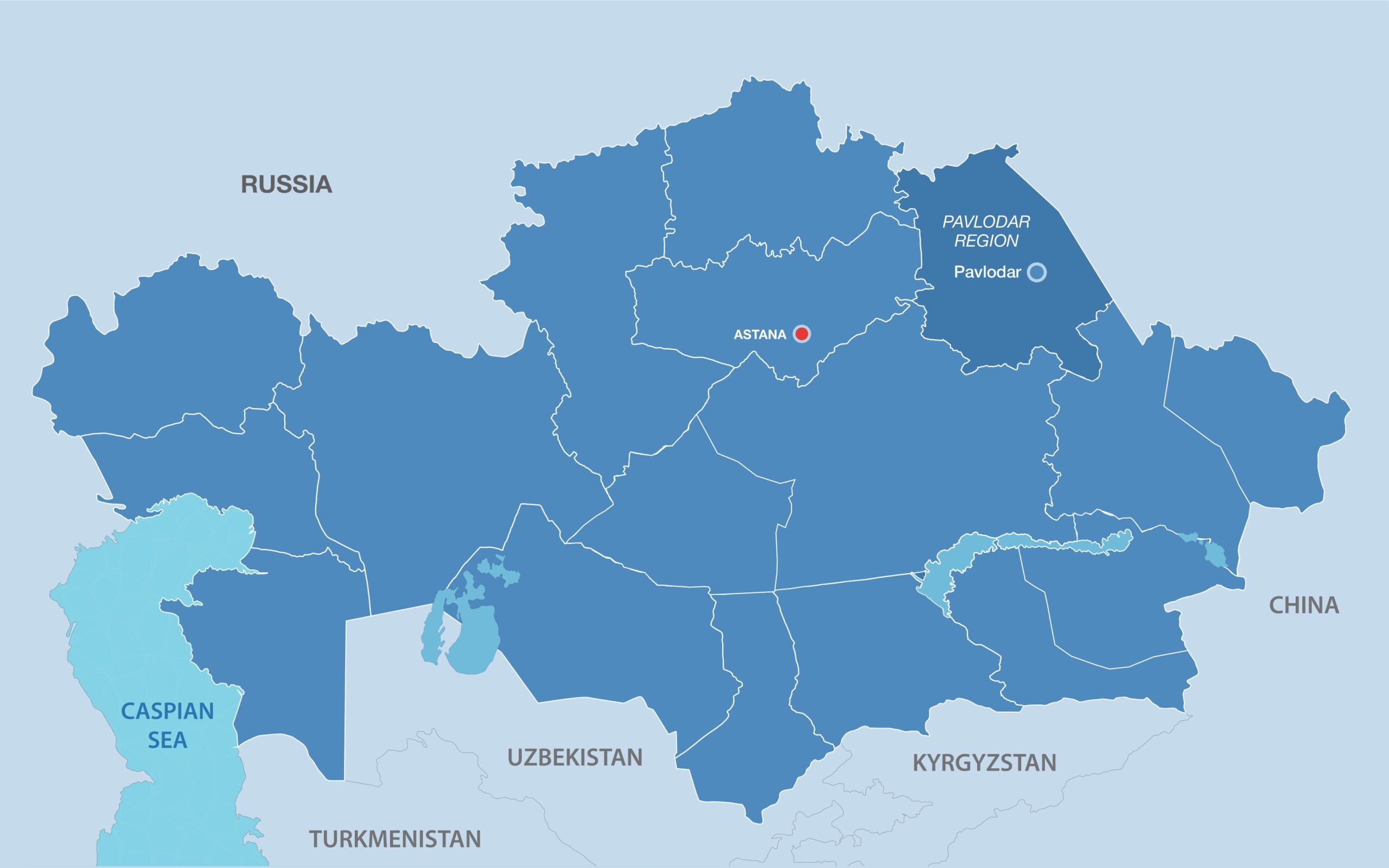
This is how the Data Center Valley will look like once it is operational. Photo credit: Data Center Valley LinkedIn account Click to see the map in full size. The map is designed by The Astana Times.
At the center of the nation’s ambition is the Data Center Valley in Ekibastuz, an industrial city in the Pavlodar Region long associated with coal mining and electricity generation. The project is designed to expand in stages into a computing center with a total capacity of up to one gigawatt.
Officials say the project is intended to support AI development, attract international technology companies and create a new export-oriented segment of the digital economy. KT-Telecom, a subsidiary of Kazakhstan’s largest telecommunications provider, Kazakhtelecom, will operate the project.

From L to R: co-founder and CEO of Firebird AI Razmig Hovaghimian, Kazakh Prime Minister Olzhas Bektenov and Deputy Prime Minister and Minister of AI and Digitial Development Zhaslan Madiyev. Photo credit: primeminister.kz
It has been backed by a $10 billion investment from Firebird, a U.S.-based artificial intelligence cloud and infrastructure company, and Nvidia. The planned $10 billion investment is expected to support a large-scale computing cluster equipped with 100,000 advanced GPUs, including Nvidia’s GB300 and Vera Rubin systems. Project estimates indicate that the cluster could generate at least $3 billion in annual export revenue, create highly skilled jobs and attract major international technology companies.
Construction is underway on the project’s first 50-megawatt facility. Excavation for its energy center and AI factory is nearly complete, while foundation work and construction of administrative facilities continue. The main data-center buildings and power units are due to be completed by the end of December, followed by commissioning in May 2027 and the start of operations in June.
The project is part of a broader effort to move Kazakhstan beyond being primarily a consumer of foreign digital services. Alongside other data-center projects and the Trans-Caspian fiber-optic cable, which links Kazakhstan and Azerbaijan and recently completed a key stage, it reflects Astana’s attempt to turn the country’s energy base and position between major markets into greater strategic autonomy, creating a digital counterpart to the transport and energy corridors that have long shaped its foreign policy.
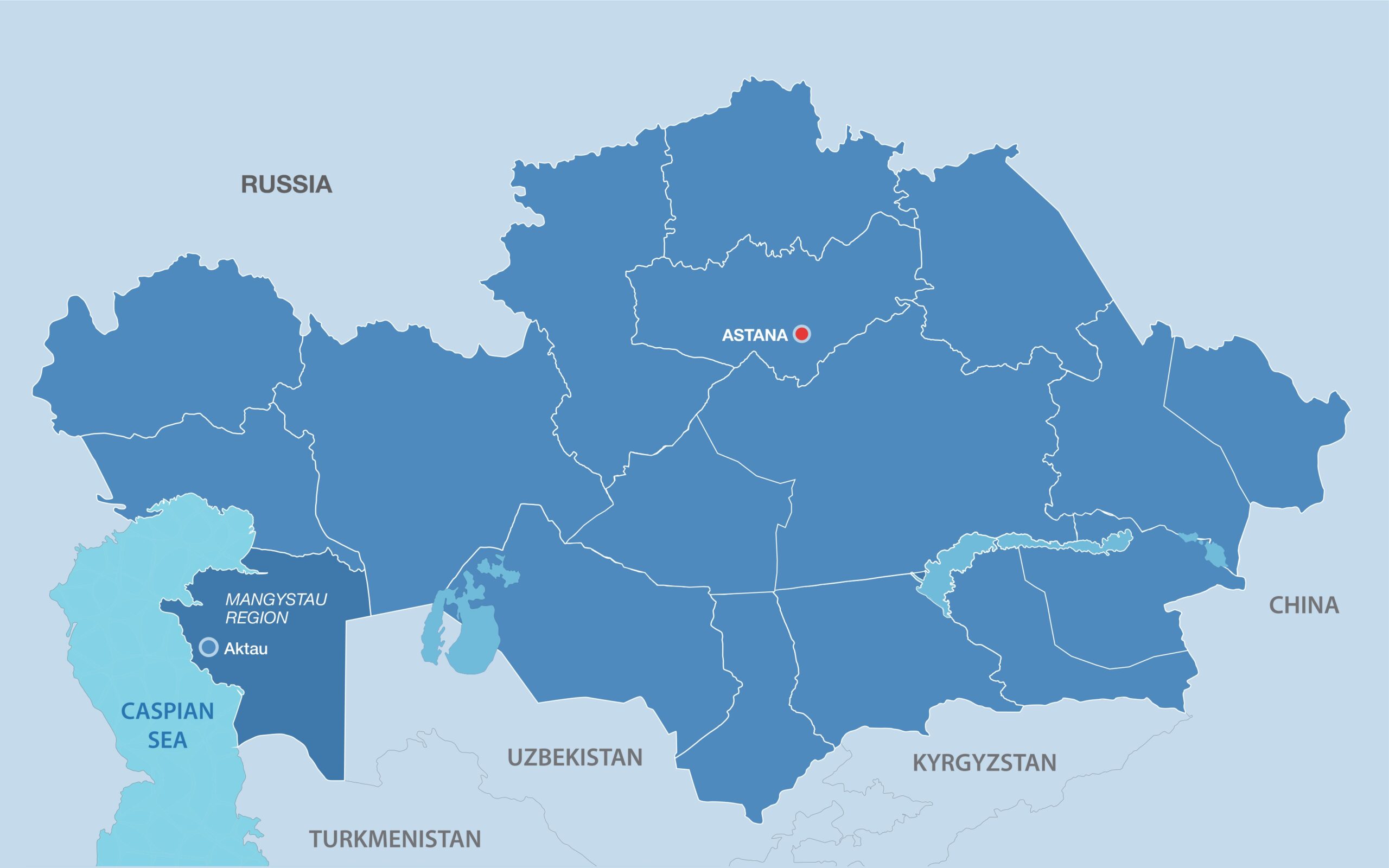
The Trans-Caspian cable project began in 2025. Photo credit: PM’s press service. Click to see the map in full size. The map is designed by The Astana Times.
Digital power
Annual global investment in data-center infrastructure is projected to increase from about $800 billion in 2026 to $1.8 trillion by 2050, according to the United Nations.
The rapid development of AI has also illustrated a network of technological dependencies that governments increasingly consider as questions of economic and national security.

Alexandre Ferreira Gomes. Photo credit: clingendael.org
Alexandre Ferreira Gomes. Photo credit: clingendael.org
Alexandre F. Gomes, a research fellow at the Clingendael Institute’s EU and Global Affairs Unit, divides the AI ecosystem into four interdependent layers: data, the models trained on it, the infrastructure that provides computing capacity and the advanced chips that perform the calculations.
Data is the “raw material” used to train AI models, Gomes told The Astana Times.
Data centers provide the computing capacity needed to develop and operate those models, while semiconductors form the technological foundation of the system. Chips are another essential part of the infrastructure, Gomes said, describing them as the “brains” of data centers and the “components that perform the calculations and operations that allow models and applications to run and be developed, and data to be stored.”
Control over those layers, however, is concentrated among a handful of countries and companies, said Gomes.
U.S. companies lead in advanced chip design and cloud services, Taiwan is central to semiconductor manufacturing, the Netherlands and Japan supply critical chipmaking equipment, while China controls parts of the critical-mineral supply chain and has developed its own models, cloud platforms and digital infrastructure.

Olaf J. Groth. Photo credit: haas.berkeley.edu
Olaf Groth, a technology policy expert, senior adviser and entrepreneur-in-residence at UC Berkeley’s Institute for Business Innovation, described a data center’s geopolitical value as “the stack of technological dependencies concentrated in one jurisdiction” from chips and electricity to fiber-optic connections and the laws governing access.
“And all of that sits under someone’s law, who can then decide who gets what upgrades, who can do what with the technology, even who gets switched on or off and on what terms. That leverage helps those making the different layers, especially advanced compute and models, to project their interests,” Groth told The Astana Times.
Groth said control over technology is increasingly shaping trade, investment and political relationships. He noted the competition is producing what he called “competing geotech clubs between the U.S. and China,” placing pressure on smaller and middle powers to align with one technological ecosystem or find ways to work with both.
For Kazakhstan, which has joined both the U.S.-led Pax Silica technology supply-chain initiative and the China-backed World Artificial Intelligence Cooperation Organization, this creates a familiar foreign-policy challenge in a new domain: how to cooperate with competing powers without becoming excessively dependent on either.
Sovereignty
Hosting data within national borders can give governments more control over sensitive information and reduce exposure to disruptions abroad. But experts say physical location alone does not amount to complete digital sovereignty.
“Sovereignty here is tiered, and it matters which tier you are building or buying,” said Groth.
“Kazakhstan is building basic compute independence, provided the terms allow full jurisdictional control over what happens with the chips, the models that ride on them at any given time, and who has access to the data that goes in and out. What that does not yet deliver is model sovereignty, because imported frontier models remain revocable,” he explained.
Imported frontier models can be subject to licensing requirements, export controls, technical restrictions or decisions made by foreign providers. According to Groth, Kazakhstan should continue developing specialized domestic models, not necessarily to displace American or Chinese systems, but to build expertise and strengthen its ability to negotiate how imported models are adapted to the country’s language, culture and economy.
Kazakhstan has begun developing its own large language models. The Institute of Smart Systems and Artificial Intelligence, or ISSAI, presented the country’s first domestically developed LLM to the government in December 2024.
Ownership of the infrastructure is equally important. A data center may be physically located in Kazakhstan while its cloud services are operated by a foreign company subject to another country’s laws.
“In Europe, many DCs in the continent are actually run by American companies, and the European cloud services market is dominated by American providers such as Microsoft, Google, Amazon Web Services, IBM or Oracle. This has geopolitical importance,” Gomes explained.
That creates potential exposure to foreign jurisdiction even when servers are located within Europe. Gomes explained that under the U.S. CLOUD Act, covered service providers can be required to produce data within their possession or control, including data stored abroad.
The same distinction will be important for Kazakhstan. Building data centers within the country could strengthen domestic computing capacity and keep sensitive information closer to home, but it would not necessarily place that data entirely beyond foreign legal or corporate control.
The strategic question for governments is therefore both whether they possess data, Gomes said, and how they manage the dependencies running across the entire technology stack.
“In short, geopolitical power lies in finding the best balance in managing all the dependencies that emerge from the supply chains that underpin the elements above. The less dependencies a country has and the more chokepoints it controls, the better,” said Gomes.
He noted that locally owned infrastructure can provide an additional layer of protection for government communications, health records and other sensitive information, although it still remains vulnerable to cyberattacks and internal security failures.
“In a world that is increasingly geopolitical, where even dynamics between allies are changing, see for instance the deteriorating relation between the U.S. and the EU, we are moving, at least in the so-called West, to a ‘just in case’ type of economy,” said Gomes, adding that in this context, reducing dependencies, diversified suppliers and reduced exposure to chokepoints justify additional costs.
Strategy for Kazakhstan
Groth said Kazakhstan’s most effective strategy would be to establish clear protocols with both the United States and China covering data security, localization, access and the domestic use of imported technologies.
Such arrangements would need to protect Kazakhstan’s agency while also addressing the national-security concerns of its technology partners. If successful, Groth said, Kazakhstan could become a “trusted AI, data and compute broker for the region.”
He also pointed to digital embassies as one possible mechanism, an approach Kazakhstan’s Ministry of Artificial Intelligence and Digital Development is exploring.
Digital embassy refers to an arrangement under which a country stores critical data or digital systems abroad while retaining legal authority over them through specific agreements.
“Digital embassies, spearheaded by KSA, Estonia and the World Economic Forum, are the practical instruments on both sides of that trade. Offering them to partners across Central Asia, South Asia, the Middle East and Europe, and negotiating Kazakhstan’s own ‘embassies,’ inside the data centers being built there, is how you get compute resilience that does not depend on any single jurisdiction staying friendly,” Groth explained.
Groth said Kazakhstan could also include its uranium, critical minerals, transport corridors and energy assets in wider negotiations over technology investment, research and processing capacity.
Digital ambitions meet energy constraints
Global electricity consumption by data centers is projected to more than double from around 485 terawatt-hours in 2025 to 950 TWh by 2030, equivalent to just under 3% of worldwide demand, according to the International Energy Agency.
The agency said the expansion reveals a mismatch between the speed of the technology industry and that of the energy sector. A data center can become operational within two to three years, while new transmission lines typically take four to eight years to complete in advanced economies.
Gomes said access to affordable electricity, water, land and cooling capacity increasingly determines where data centers are built. Grid congestion has restricted development in places such as Amsterdam, while Finland has attracted new projects because of its comparatively abundant power, available land and colder climate.
“Geography and structural infrastructure conditions are defining factors when thinking about building data centers,” he added.
President Kassym-Jomart Tokayev also acknowledged that Kazakhstan’s digital ambitions cannot be separated from its energy policy.
“Data centers are comparable to metallurgical plants in terms of energy consumption,” Tokayev said in his public remarks in January. “Energy self-sufficiency must therefore be treated as a critical component of state policy.”
Kazakhstan’s electricity system is already operating with a narrow balance between supply and demand. In 2025, electricity consumption rose 3.8% to 124.6 billion kilowatt-hours, while generation increased 4.4% to 123.1 billion kilowatt-hours, according to national grid operator KEGOC. Overall, the system includes 254 generating facilities with a combined installed capacity of 27.1 gigawatts, with half of them being coal-fired plants.
The government plans to commission 13.3 GW of additional power capacity by the end of 2029, including 12.56 GW of new generation. Energy Minister Erlan Akkenzhenov has said Kazakhstan should be able to meet its domestic electricity needs fully from the beginning of 2027 and establish a stable surplus by 2029.
The first facility in Ekibastuz is scheduled to begin operating in June 2027, but the wider cluster is designed to reach up to one gigawatt. Expanding to that scale will require sufficient generating capacity, substations, transmission infrastructure and reliable water supplies.
That raises questions extending beyond whether Kazakhstan can produce enough electricity, including how the necessary grid upgrades are financed, whether data-center demand could affect electricity costs for households and other industries, and whether a data campus powered heavily by coal can meet the sustainability expectations of global tech companies.
Overall, the data center project will reveal more than just Kazakhstan’s ability to complete a major infrastructure project. What will be watched in the coming years is how Kazakhstan can attract regional demand, retain meaningful authority over the technologies operating on its territory and reduce rather than reproduce its external dependencies.
