
ALMATY – Kazakhstan has completed the most technically challenging stage of the Trans-Caspian Fiber Optic Cable project after an undersea cable reached the country’s Caspian coast on Aug. 5, marking a milestone in efforts to establish a new high-speed digital corridor linking Asia and Europe.
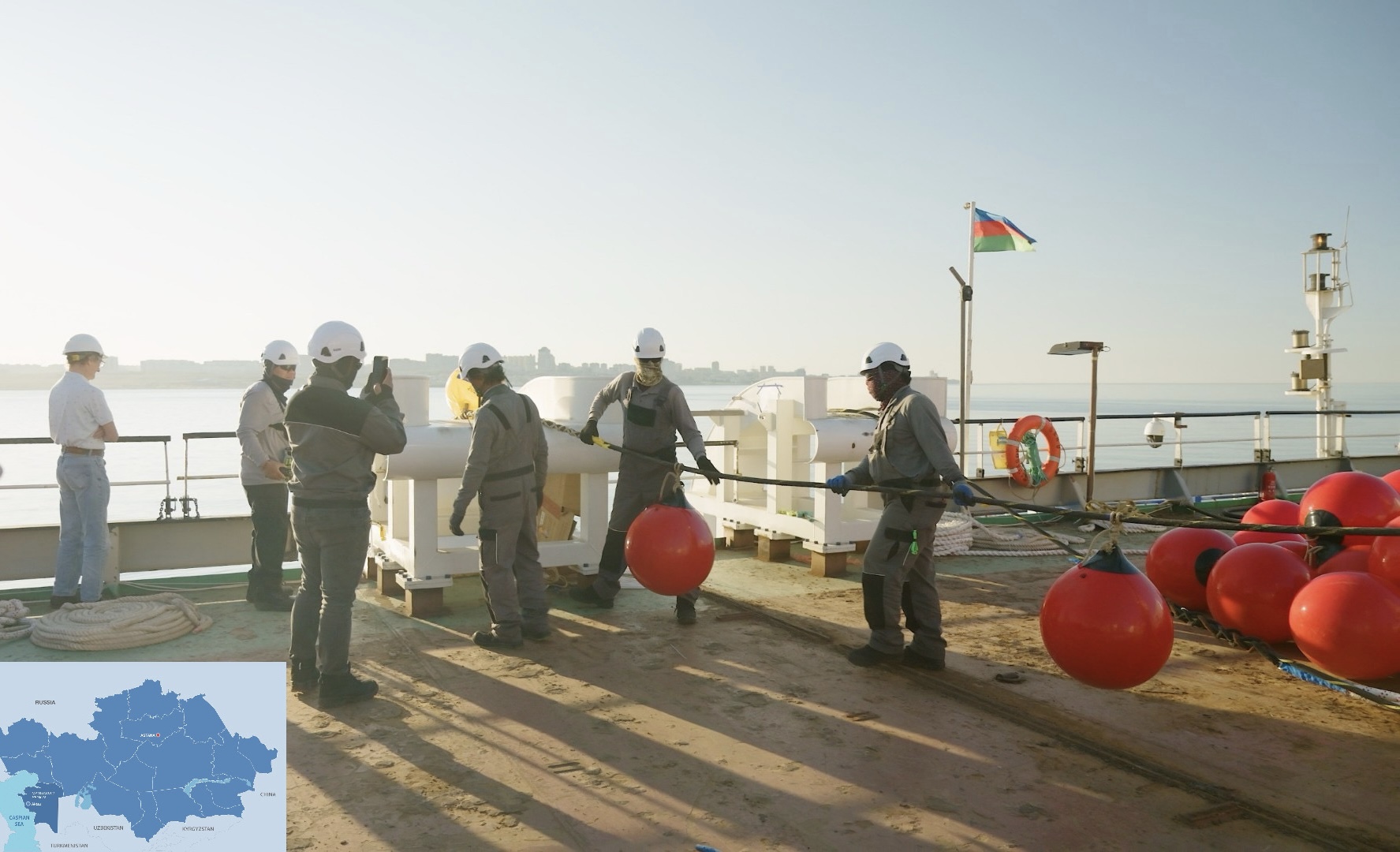
The project began in 2025 with engineering surveys, route selection and factory testing of a specially armored submarine cable manufactured in China. Photo credit: PM’s press service. Click to see the map in full size. The map is designed by The Astana Times.
The submarine cable, laid along the Caspian Sea floor between Aktau and Sumgait, will directly connect the digital infrastructure of Kazakhstan and Azerbaijan, providing an alternative international data transmission route designed to improve connectivity, strengthen network resilience and expand the two countries’ role in Eurasian digital transit.
The project is being implemented by Kazakhtelecom and AzerTelecom International, while the joint venture CaspiLink B.V. will oversee both construction and future operation of the network.
Deputy Prime Minister and Minister of Artificial Intelligence and Digital Development Zhaslan Madiyev, Kazakhtelecom Chairman Bagdat Mussin and AzerTelecom International Chief Executive Ana Nakashidze inspected the completion of the marine installation phase aboard the cable-laying vessel.

Kazakhstan completes the key stage of Trans-Caspian fiber optic cable project. Photo credit: PM’s press service.
“We have completed the most difficult stage of the Trans-Caspian Fiber Optic Cable project – laying the cable along the Caspian Sea floor. The new route will strengthen Kazakhstan’s digital connectivity with global data networks and create the foundation for the further development of artificial intelligence, cloud technologies and modern data centers,” Madiyev said.
According to the ministry, the government completed the regulatory, customs and organizational procedures required to begin construction without administrative delays.
The project began in 2025 with engineering surveys, route selection and factory testing of a specially armored submarine cable manufactured in China. Engineers designed the route to avoid anchorage zones and military training areas while securing the necessary environmental approvals in Kazakhstan’s Mangystau Region.
Construction at sea began in July 2026 using a specialized cable-laying vessel with a displacement exceeding 20,000 tons. Around 70 specialists participated in the round-the-clock operation.
The cable had previously been transported from China to the port of Kuryk before being shipped to Baku, where it was transferred to the cable-laying vessel for installation across the Caspian Sea.
Work is now focused on connecting the cable to coastal infrastructure. Ground infrastructure, commissioning and system testing are expected to be completed this autumn. Unlike many strategic infrastructure projects, the Trans-Caspian cable is being financed entirely by the participating telecommunications operators without state budget funding.
Part of a broader digital corridor
The project forms part of Kazakhstan’s broader strategy to position itself as a regional digital hub alongside its expanding transport and logistics ambitions.
For years, Kazakhstan has sought to strengthen the Middle Corridor connecting China and Europe through the Caspian Sea. While much of that effort has focused on railways, ports and highways, officials increasingly argue that digital infrastructure will become equally important for regional connectivity.
The new fiber-optic route is expected to provide lower-latency and more resilient international data transmission while reducing dependence on existing communication routes. It also complements Kazakhstan’s wider digital agenda, which includes investments in artificial intelligence infrastructure, cloud computing and data centers intended to serve regional markets.
By creating an additional high-capacity data corridor across the Caspian, the project illustrates how Kazakhstan’s concept of connectivity is expanding beyond physical trade routes to include digital infrastructure.
