
Kazakhstan remains the region’s economic anchor and its largest recipient of foreign capital. At the same time, Montfort Eurasia’s Investor Perception Report 2026 for the United Kingdom (UK) and the United States (U.S.) suggests that Central Asia and the Caucasus are moving beyond a traditional foreign direct investment story toward a broader capital markets story.
Photo credit: AI-generated image/ The Astana Times
Yet the report identifies a growing gap: investor appetite is advancing faster than investor understanding.
“Investors’ self-assessed knowledge of the region has plateaued,” the report notes, with average scores of 6.63 out of 10 among UK respondents and 6.79 among those in the U.S. At the same time, the proportion of investors expressing strong or moderate interest remains elevated at 67.1% in the UK and 65.5% in the U.S.
This is the central message of the 2026 survey: Central Asia has moved into a more serious phase of international investor attention, but it now needs to convert visibility into informed, committed capital.
From discovery to deliberation
Montfort Eurasia’s report covers 273 respondents — 137 in the UK and 136 in the U.S. The research used a mixed-methods approach, combining quantitative questions with open-ended responses. The results were then benchmarked against the 2024 and 2025 surveys to identify changes in investor priorities, risk perceptions and strategic outlooks.
The year-on-year comparison is revealing. Investor knowledge has increased significantly from the roughly 4.9 level recorded in 2024, but the sharp improvement seen in 2025 has not continued. Instead, the region appears to have reached a higher baseline of familiarity.
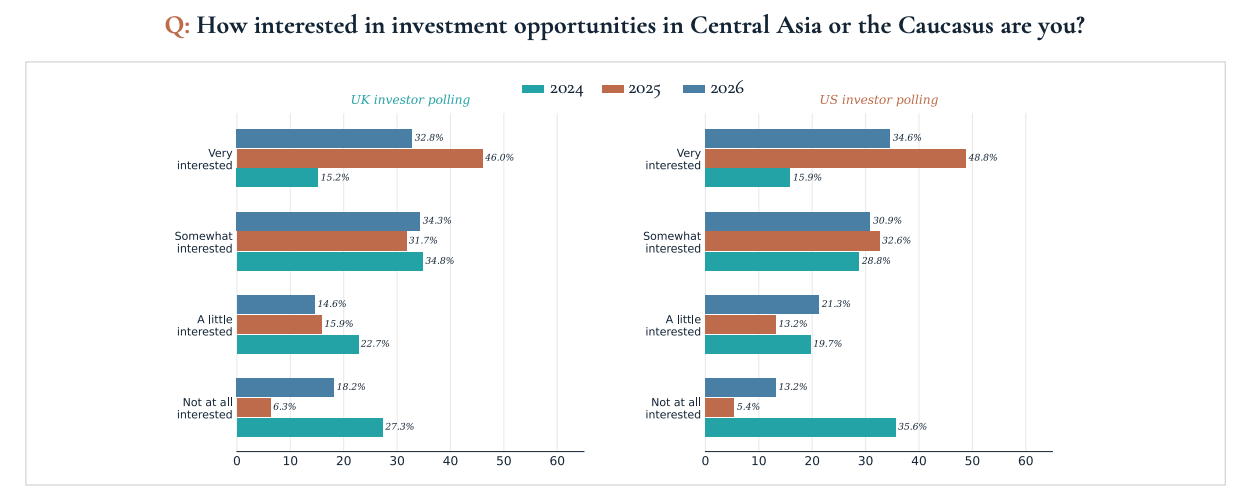
Central Asia is increasingly being evaluated by investors who are already aware of the region and are now asking more difficult questions about political risk, market access, and regulation. Photo credit: Montfort Eurasia’s Investor Perception Report 2026
The same pattern is visible in overall interest. The report describes the current stage not as one of discovery, but of “deliberation”. In other words, investors already familiar with the region are increasingly evaluating Central Asia and asking harder questions about political risk, market access, regulation, investment security and the quality of available information.
That is a meaningful change in audience. Two years ago, much of the international discussion around Central Asia still focused on whether global investors would notice the region at all. Today, the more relevant question is whether governments and businesses can provide enough reliable information for investors to move from interest to due diligence and eventually to transactions.
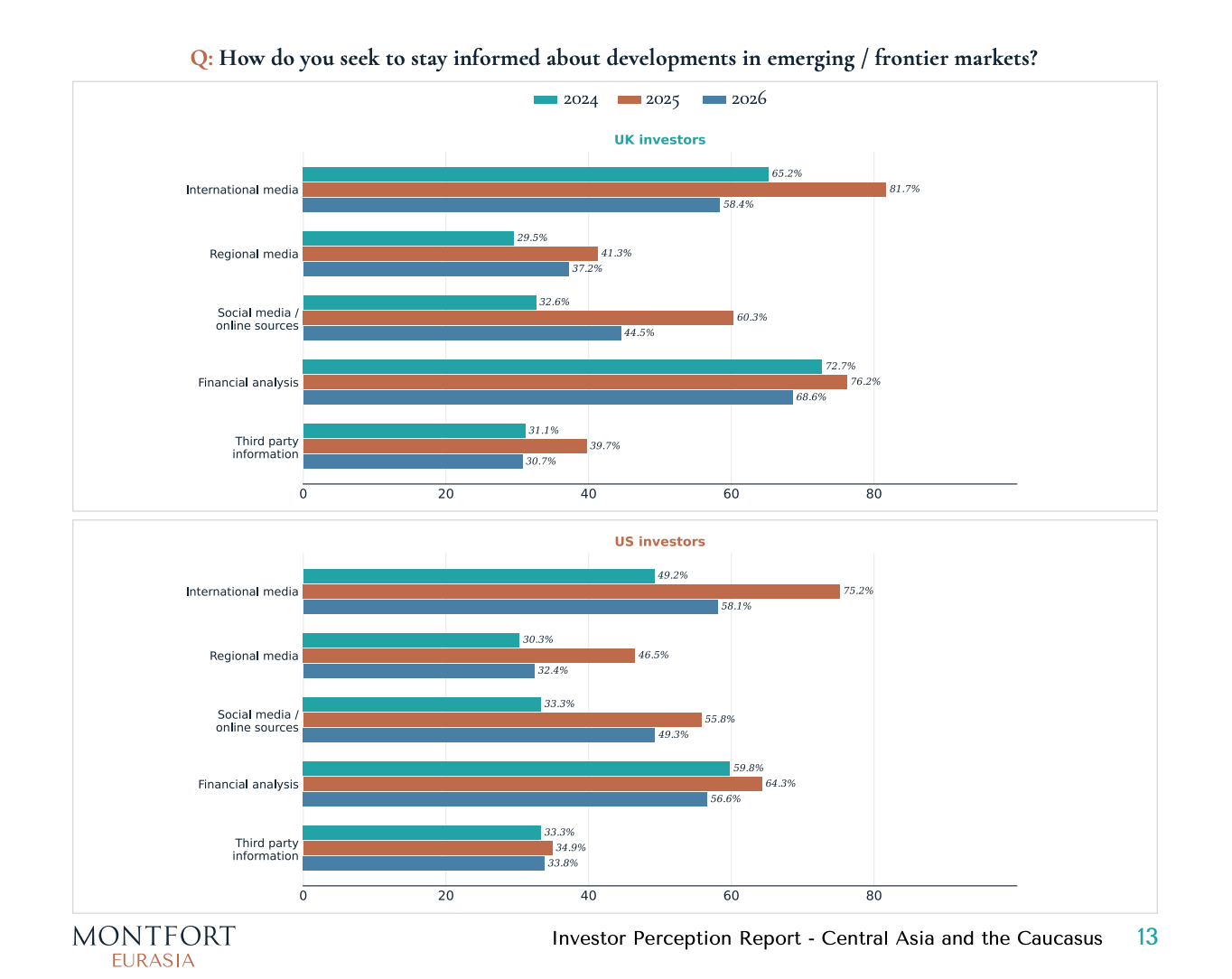
Financial analysis has overtaken international media as the leading source of information about the region. Photo credit: Montfort Eurasia’s Investor Perception Report 2026
The report itself captures that transition. Financial analysis has overtaken international media as the leading source of information about the region, cited by 68.6% of UK respondents and 56.6% of U.S. respondents. That suggests that the market is becoming less dependent on headlines and more dependent on numbers.
Kazakhstan remains the anchor
For Kazakhstan, the report reinforces a familiar position while adding an important new dimension. The country remains by far the largest economy and the leading recipient of foreign capital in Central Asia. According to the report, Kazakhstan attracted around $440 billion in total FDI between 2005 and 2025 and continues to account for close to 70% of all FDI entering Central Asia. Real GDP growth accelerated to 6.5% in 2025, compared with 4.8% in 2024, with strong contributions from industry, transport, construction and trade. Construction expanded by 15.9%, while transport grew by 20.4%.
The report also points to Kazakhstan’s large infrastructure pipeline. The National Infrastructure Plan envisages more than 200 projects with a combined value of around $81 billion through 2029. The government is targeting economic growth to $450 billion and an additional $150 billion in FDI over the same period.
These figures help explain why Kazakhstan continues to occupy a different position from its regional peers.
Among UK respondents, Kazakhstan was identified as the most business-friendly Central Asian market, selected by 10.9% of investors, compared with 2.9% among U.S. respondents. For UK investors, ease of market entry and existing trade links were each cited by 60%, followed by a stable environment at 46.7% and corporate governance at 33.3%.
The distinction between the UK and U.S. views is important. Kazakhstan’s position is stronger among UK respondents, while its standing among U.S. investors has weakened compared with last year. The report notes that Kazakhstan fell from 8.5% to 2.9% among American investors, suggesting that broader geopolitical narratives may be affecting perceptions of the country despite its economic weight.
This is a perception issue rather than an economic one, and those two things increasingly need to be considered separately. Kazakhstan’s fundamentals remain substantial, but investors do not assess fundamentals in isolation. The country is part of a region exposed to the Russia-Ukraine war, tensions around energy infrastructure, changing global supply chains and intensifying competition over critical minerals.
That explains why investment security and political stability remain at the top of the investor agenda. Investment security was a concern for 72.3% of UK respondents and 64.7% of U.S. respondents, while political stability was cited by 56.2% and 52.9%, respectively. For Kazakhstan, the implication is straightforward: scale alone is no longer enough.
The capital markets story is becoming more important
One of the report’s most significant developments is the growing importance of capital markets. Kazakhstan has long relied heavily on FDI, particularly in oil, mining and infrastructure. But the emergence of a broader regional capital markets ecosystem is changing how Western investors view the region.
Vladimir Mikhailovsky, Partner, Capital Markets at Sidley Austin LLP, points to increased Kazakh bond activity in 2026, including debut transactions. He expects diversification to remain a key market feature.
“The popularity of “dim sum” or offshore RMB offerings is likely to continue to grow, as Kazakh issuers seek to diversify their investor base and capitalize on the favorable interest rate environment, ” he said.
This matters because capital-market access can signal financial maturity. A country that can attract investors not only into physical assets but also into bonds, equities and other financial instruments is gradually becoming integrated into a more sophisticated international capital ecosystem.
The regional picture is also changing quickly. In May 2026, Uzbekistan’s National Investment Fund completed the country’s first international equity listing, with the offering more than four times oversubscribed. Sovereign credit ratings across the region were upgraded, while critical minerals moved higher on the strategic agenda of both the U.S. and the European Union (EU).
For Central Asia, that is a notable transition: the story is no longer exclusively about attracting greenfield investment into resource projects. It is increasingly about building investable financial instruments and institutions around the region’s economic expansion.
Critical minerals are changing the conversation
The renewed international focus on Central Asia is also inseparable from the global race to secure critical minerals and diversify supply chains.
Kazakhstan remains particularly well positioned because of its role in uranium and its broader mining potential. The report describes the country as the world’s leading uranium supplier, accounting for 40% of global output in 2025. Mining exploration spending reached a decade high of $127 million in 2025, with almost half directed toward copper projects. Uzbekistan, meanwhile, is emerging as another important mining center, with newly announced deposits of tungsten, lithium and germanium as well as 14 rare-earth sites.
This is where economics and geopolitics increasingly intersect. The report points to the November 2025 C5+1 White House Summit, which generated more than $130 billion in commercial commitments, as well as the EU’s commitment of up to 12 billion euros through Global Gateway. Both developments are presented as evidence that Western governments are no longer viewing Central Asia purely through the lens of traditional development or trade policy.
The region is becoming strategically relevant to discussions about energy security, supply-chain resilience and access to critical raw materials. For Kazakhstan, that creates an opportunity but also raises expectations. Resource wealth can attract capital, but investors increasingly want to know how resources are governed, processed and integrated into longer-term value chains.
Uzbekistan is becoming harder to ignore
While Kazakhstan remains the region’s economic anchor, Uzbekistan is becoming increasingly important to the investor story. The country’s first international equity listing by the National Investment Fund was one of the report’s defining transactions. The offering was more than four times oversubscribed, demonstrating that international investor appetite is not limited to Kazakhstan’s established market position.
The report also highlights the planned launch of the Tashkent International Financial Center, alongside Uzbekistan’s growing mining potential and efforts to deepen its financial infrastructure. But perhaps more importantly, Uzbekistan offers a different investment proposition: a large population, a rapidly transforming economy and the possibility of expanding the region’s consumer and industrial base.
Executive Chairman of East-West Group and Founder and Board Member of the Europe-Uzbekistan Association for Economic Cooperation Oybek Shaykhov argues that international investors still face an information deficit.
“Transparent, consistent and credible communication is not simply a reputational tool; it is a fundamental pillar of investor confidence,” he said.
That observation applies to the wider region, particularly to countries trying to attract investors beyond the traditional circle of state-backed or resource-focused projects.
The geopolitical premium and discount
For Central Asia, the external environment has become more favorable and more complicated at the same time. Associate Director at the Eurasia Center of the Atlantic Council Andrew D’Anieri notes that Central Asia’s growth outlook for 2026-27 looks relatively strong compared with regions more directly exposed to the fallout from the Iran war and higher energy prices. He also points to Russia-related instability and growing water pressures as tests of the region’s resilience.
That combination is likely to define the next stage of the region’s investment story. Central Asia is gaining strategic importance precisely because the international system is becoming less predictable. Supply chains are being redesigned, competition for critical minerals is intensifying, and governments are looking for alternative transport and energy routes.
But the same geopolitical environment also raises the risk premium. The Montfort survey shows that investors are willing to engage with the region despite these uncertainties. The harder question is whether that interest can translate into long-term commitments.
This is where Kazakhstan’s next phase of economic development becomes particularly important. Maintaining high growth is one objective. Converting growth into deeper capital markets, greater financial diversification and more international investor participation is another.
The report suggests that the opportunity is there. Interest among Western investors is dramatically higher than it was two years ago, even if the extraordinary surge of 2024–25 has now stabilized. The challenge is that investors are becoming more sophisticated just as the region competes for larger, more strategic pools of capital.
