
ASTANA — Nomadic societies across the Eurasian steppe developed distinct approaches to war and diplomacy that did not rely on formal treaties or territorial control. Instead, they used flexible strategies, including personal guarantees and family-based agreements, to prevent renewed conflict.
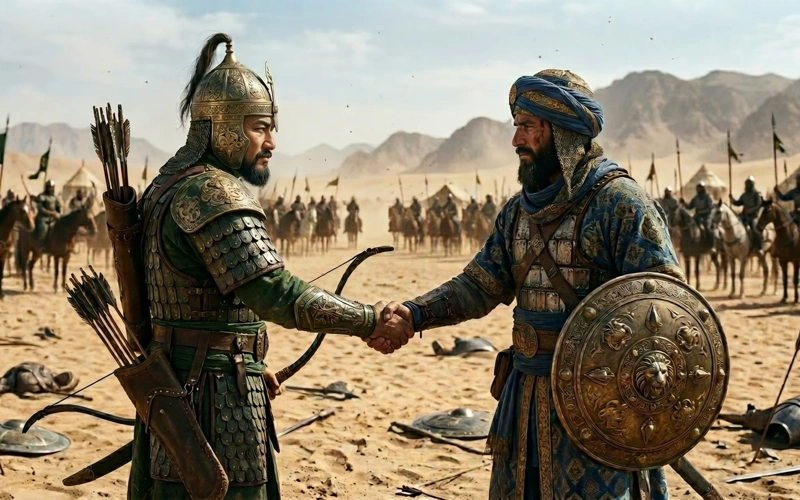
Photo credit: kazinform
According to Edil Noyanov, deputy head of Kazakhstan’s History Department at Al-Farabi Kazakh National University, diplomacy among nomadic societies differed fundamentally from that of sedentary states.

Edil Noyanov, deputy head of Kazakhstan’s History Department at Al-Farabi Kazakh National University.
“Diplomacy of nomads differs significantly from that of sedentary peoples. After wars between settled states, a peace treaty is concluded. According to such agreements, the victorious side collects contributions to compensate for military expenses and imposes taxes, and there is also annexation – the incorporation of captured territories,” Noyanov told Kazinform.
However, nomadic societies did not rely on fixed cities or fortified settlements, which influenced both warfare and postwar arrangements.
“Due to the nomadic way of life, they did not have settlements such as cities and towns typical of sedentary peoples. Therefore, nomads often lured superior enemy forces deep into their territory, retreating, and then launched counterattacks to push them out of their land,” Noyanov said.
“It is known in history that such situations happened during the campaign of Darius I against the Scythians, in the clash between Cyrus the Great and the Saka-Massagetae led by Tomyris, and in the confrontation between Emperor Gaozu of Han and the Xiongnu leader Modu,” he said.
The amanat tradition
A key mechanism for preserving peace was the institution of amanat, under which a close relative of the defeated ruler was handed over to the victor as a guarantee against future aggression.
“As a result of conflicts and wars, the ruler of the defeated side, acknowledging his position and promising not to strike back, transferred his closest person, most often his son, to the victor as an amanat. (…) This was done so that over time the defeated side could not, having regained strength, attack again,” Noyanov said.
He noted that historical references to this practice date back to early periods.
“The first mention can be found in the work ‘Shiji’ [‘Records of the Grand Historian’] by Sima Qian. At the beginning of the third century B.C., the Xiongnu ruler Tumen, after being defeated by the Yuezhi tribe, handed over his eldest son Modu as an amanat,” he said.
The practice continued in later centuries. After a defeat near Syganak in 1457, Abu’l-Khayr Khan of the Uzbek nomadic state gave his three-year-old grandson as an amanat to the Kalmyk ruler Uz-Temir Taishi. It was an episode later known as the “shameful agreement.”
Diplomacy of the Kazakh Khanate
Other states were aware of and sometimes used similar practices in relation to the Kazakh steppe.
“Ruler of the Moscow state Boris Godunov, familiar with this system, captured by deception the brother of Kazakh Khan Tauyekel – Oraz-Muhammad – to strengthen ties with the Kazakh Khanate. The status of the sultan was effectively equated to that of an amanat,” said Noyanov.
Tauyekel Khan tried to secure his release.
“In 1594, in an attempt to return his brother to his homeland, Tauyekel Khan sent an embassy headed by Kul-Muhammad,” he said.
Unlike many hostages, Oraz-Muhammad later rose to prominence and became ruler of Kasimov, within the territory of the Russian state. His enthronement and deeds were recorded in the “Jami al-Tawarikh” chronicle by Kadyrgali, who served as his advisor.
However, not all amanats experienced such outcomes.
“Not all descendants of khans given as amanat had a favorable fate. One of Tauke Khan’s sons, who was in the Dzhungar state, was forced to adopt Buddhism, which effectively ended his future,” said Noyanov.
Tole Bi and peace reservation
In times of crisis, amanat also functioned as a tool to preserve peace. After a period of mass displacement and suffering among Kazakhs in the early 18th century, known as Aktaban Shubyryndy, Alkakol Sulama, often described as the “Great Disaster” caused by Dzhungar invasions, Tole Bi gave his son as an amanat to the Dzhungar state to avoid further conflict.
According to Noyanov, some of these amanats later served their country loyally.
“Tauke Khan’s son Zholan, while in amanat, learned several languages. After returning home, he became a diplomat and made a significant contribution to maintaining peace between the Kazakh Khanate and the Dzhungar state,” he said.
Zholan Toleuly, who spent 14 years in Dzhungar captivity, later emerged as both a military leader and diplomat. Fluent in multiple languages, including Arabic and Chinese, he applied his knowledge of strategy and culture in both negotiations and warfare.
His legacy has recently gained renewed attention. In 2025, an international conference marked the 350th anniversary of Zholan Batyr, contributing to a reassessment of his role in Kazakhstan’s history.
The article was originally published in Kazinform.
