
Khiuaz Dospanova, a famous Kazakh navigator-gunner, inscribed her name into the history of Kazakhstan and the Soviet Union for generations. She was born in the village of Ganyushkino, now in the Atyrau region of Kazakhstan, on May 15, 1922. Her story is a testament to the fact that what is expected of you and what you are actually capable of are often not the same, and she proved that. She was among the “Night Witches” during World War II.
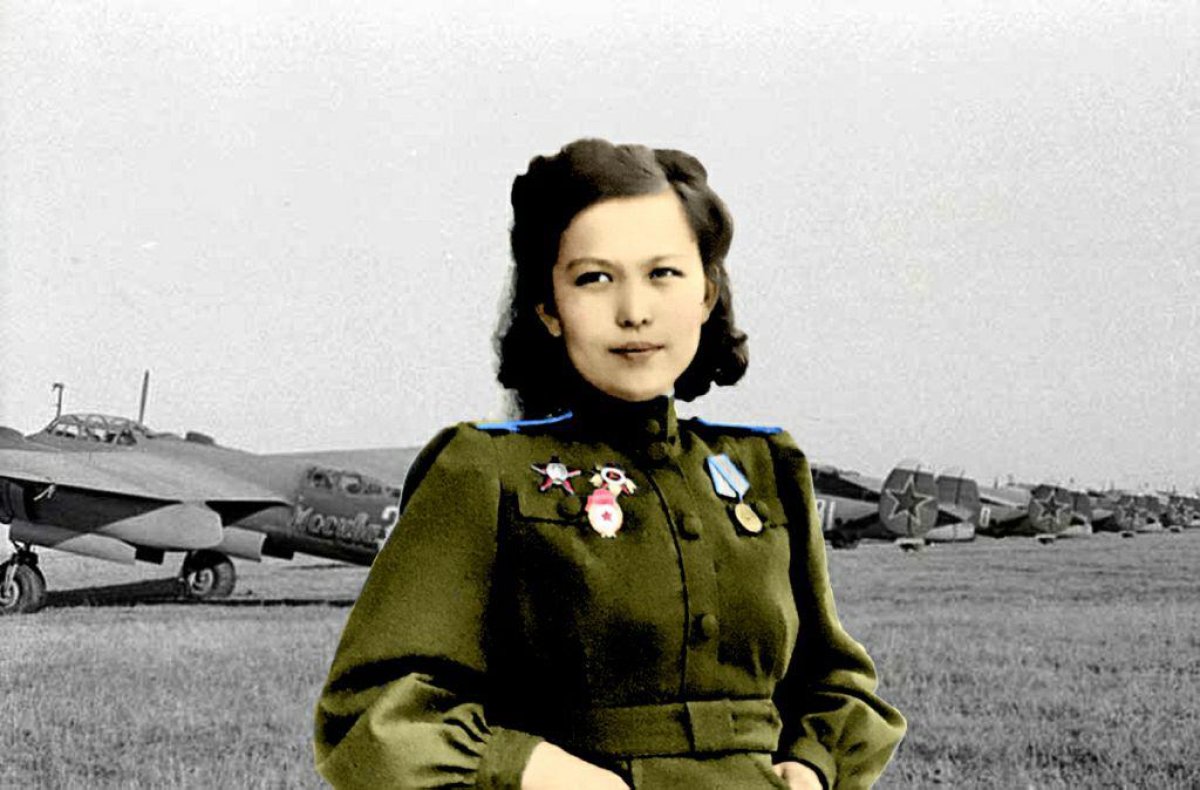
Photo credit: From open internet sources.
A “Night Witch” is not a metaphor you borrow lightly. It was a name given by the Nazi enemy during World War II, reluctantly, almost grudgingly, to women who flew fragile, slow biplanes into the dark, cutting their engines before the final approach so that all you could hear was a whisper. Then—bombs.
To climb into that cockpit required more than training. It required a particular kind of nerve: to mobilize yourself against fear, against physics, against the quiet suggestion that you did not belong there at all. For a young woman, especially one coming from the Kazakh steppe, far removed from everyday contact with machines, let alone aircraft, that leap was not just physical. It was civilizational.
And yet, the idea that she would have been unprepared is misleading. Women of the steppe were never porcelain figures. They worked, managed households, endured scarcity, and, when necessary, made decisions that shaped the survival of families and communities. So in a way, the war did not invent Khiuaz’s resilience. It simply redirected it.
Her trajectory, at first glance, looks almost like a textbook Soviet: a pioneer leader, secretary of the Komsomol organization. She graduated in 1940 with a gold medal. However, there was an early deviation—aviation. She trained at a local aeroclub while still in school, earning a reserve pilot certificate.
Immediately after graduation, she went to Moscow intending to enroll in the Zhukovsky Air Force Academy. However, even then, the system drew a line: she was denied entry due to the absence of women among cadets. It is worth pausing here. Talent was not the barrier. So she pivoted to a safer option and enrolled in a medical institute in Moscow, where she was admitted without an entrance exam.
But life presented her with a different test, one that would challenge her desire to fly not for herself, but to defeat an enemy, fully aware it could cost her life.
War: learning to defy limits
In October 1941, she joined the women’s aviation units organized by the legendary pilot Marina Raskova, a navigator and one of the first women awarded the title of Hero of the Soviet Union. Within weeks, she was in Engels on the Volga river, undergoing accelerated military flight training for combat operations in night bomber aviation. The pace was brutal. The margin for error: nonexistent.
Dospanova became a navigator-gunner in the 46th Guards Regiment, the group that would earn the nickname “Night Witches.” They flew the Po-2, a plywood-and-canvas aircraft that had no business surviving in contested airspace because, by every conventional metric, it was fatally disadvantaged: too slow to escape, too fragile to absorb damage, and too lightly equipped to fight back. In modern terms, it was closer to a motorized kite than a warplane. Yet its very limitations bent the rules of engagement, not by accident, but because the women flying it, including Khiuaz Dospanova, were exceptionally shrewd. They understood exactly how to turn weakness into leverage: flying low to evade detection, exploiting their slow speed to disrupt enemy targeting, and cutting engines to glide in near silence.
Even though the laws of physics set the constraints, they learned how to use them. Something women, more often than not, have had to do throughout their lives.
Navigator-gunner Dospanova carried out combat missions in the most difficult sectors of the front: the Southern Front, Transcaucasia, the North Caucasus, Ukraine, and Belarus. Then came April 1943. A mid-air collision during a night mission. Both legs broken. Severe trauma. The kind of injury that usually ends careers and, in that environment, often lives.
After months of treatment, still in pain and physically compromised, she resumed service. Eventually, her condition forced a transition to staff duties, but by then she had already made her point: something that echoed what was expected not only of women but of the Soviet person as well.
Even though she no longer flew, no longer terrified the enemy in the night skies, she met victory in Berlin, not as an observer, but as someone who had paid for it with her bones. Literally.
Post-War: a second battlefield
After the war, the narrative could have ended quietly: disability, withdrawal, a life narrowed by injury. Instead, Khiuaz Dospanova became actively involved in the country’s social and political life. She rose through party structures, became a deputy of the Supreme Soviet of the Kazakh SSR, and later held senior administrative roles.
This approach to a “second act” matters. It breaks the stereotype of framing wartime heroism as a single, contained episode. For her, the war was not an interruption: it was a defining chapter. She applied the same discipline and endurance to state-building, youth work, and governance. A different battlefield, the same logic: participation over observation.
By the late 1950s, her health had sharply declined. Her injuries were a constant reminder that the physical body can impose limits, even when the spirit remains intact. In 1959, before the age of forty, an age that today often marks only the beginning of a professional peak, she was forced to end her career.
She remained a decorated public figure both in Soviet times and in independent Kazakhstan. In 2004, she received the title of “Halyk Kaharmany” (Nation’s Hero). Today, her name is attached to streets, institutions, and even the airport in Atyrau. And yet, I think there is always a risk in monuments—they simplify the lives they commemorate.
The more uncomfortable, and therefore more useful, takeaway is this: Dospanova’s story is not exceptional because it is unreachable. It is exceptional because it exposes how much capacity a person can have despite physical constraints, and how those same constraints can still diminish that potential. The unfairness of the human experience.
It makes you look at it differently: a young woman from the steppe, denied entry into an academy, ends up navigating bombing runs over the front lines of World War II and then navigating a political career with the same precision.
The question is less “how did she do it?” and more “what systems almost prevented her from doing it at all?” And how often do we see the opposite: people with physical ability but no inner strength, and vice versa? If there is another lesson in her story, it is this: Dospanova forces you to look at both and decide how to navigate the darkest moments of your life, both literally and metaphorically.
