
ALMATY – Kazakhstan’s lower chamber of parliament, the Mazhilis, approved in the first reading a draft law on radioactive waste management that would establish a national operator responsible for handling radioactive waste and introduce a ban on importing and burying foreign radioactive waste in the country.
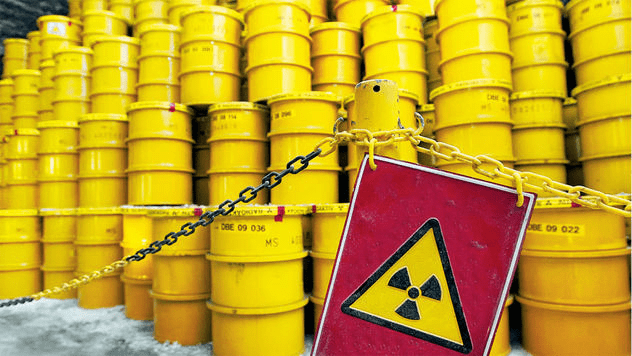
Photo credit: yandex
According to Mazhilis deputy Yedil Zhanbyrshin, one of the key provisions of the bill is the creation of a National Operator for Radioactive Waste Management, which would centralize responsibility for nuclear and radiation safety.
“International practice confirms the effectiveness of this model. The existence of a national operator allows for a unified, safe and economically efficient radioactive waste management system, eliminates fragmentation of functions and guarantees common safety standards,” Zhanbyrshin said.
Centralized system for radioactive waste management
Under the proposed legislation, the national operator would oversee the collection, transportation, processing and conditioning of radioactive waste, as well as the design, construction and operation of storage and disposal facilities.
The operator would also maintain a state registry of radioactive waste, participate in international projects and conduct long-term monitoring of burial sites. According to lawmakers, the institution is expected to become the central body responsible for the country’s radioactive waste management system and final disposal procedures.
The draft law also defines the legal framework governing radioactive waste management, including classifications of radioactive waste, sources of waste generation and the legal status of storage and burial facilities.
Kazakhstan to ban foreign radioactive waste imports
Another major provision of the bill is a direct ban on the import, placement and burial of foreign radioactive waste on Kazakhstan’s territory.
“This norm is aimed at protecting environmental sovereignty, national interests and state security,” Zhanbyrshin said.
The legislation would also introduce a unified state accounting and monitoring system for radioactive waste and clarify the responsibilities of government agencies involved in nuclear oversight.
Under the bill, the government would make decisions regarding the construction and closure of radioactive waste burial facilities, while the authorized state body would be responsible for licensing, supervision and regulatory control.
Questions over nuclear fuel disposal
The discussion also touched on the future management of spent nuclear fuel from Kazakhstan’s planned nuclear power plant.
Asset Makhambetov, deputy chairman of Kazakhstan’s Atomic Energy Agency, said the issue of spent fuel disposal has not yet been fully resolved and that authorities are continuing to study international practices.
“In Finland, they are building deep geological repositories. In the United States, despite having many nuclear reactors, spent nuclear fuel is still stored near power plants because not all uranium is burned during reactor operation and, with proper processing, some of it can be reused,” Makhambetov said.
The draft law envisions the creation of burial sites for radioactive waste, though final decisions regarding spent nuclear fuel management are still under consideration.
