
ANTALYA – The world produces enough food, but gaps in distribution, infrastructure and crisis response prevent it from reaching those most in need, said Berik Aryn, director-general of the Islamic Organization for Food Security (IOFS), addressing a panel at the Antalya Diplomacy Forum on April 17.
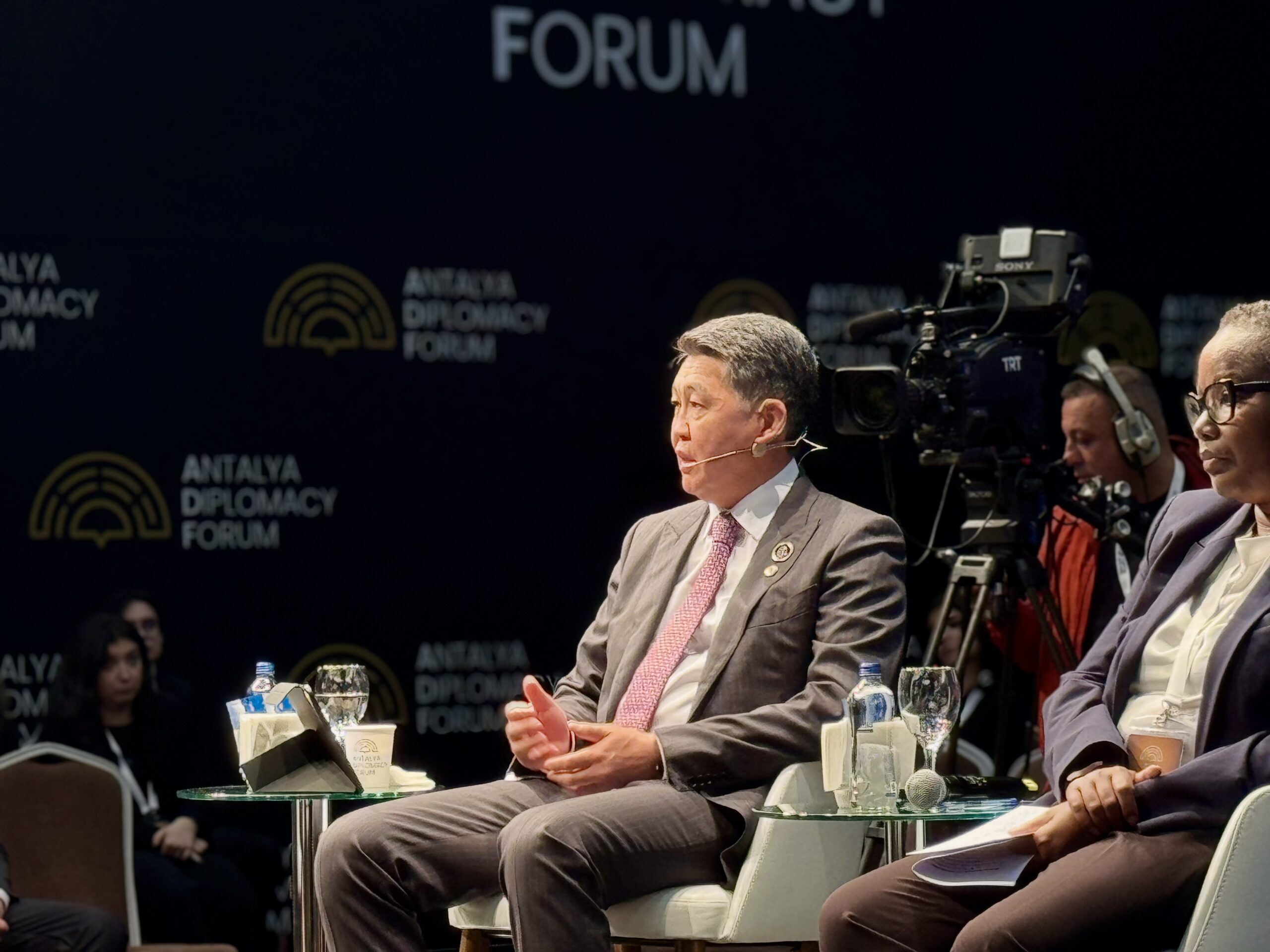
Berik Aryn. Photo credit: Assel Satubaldina/ The Astana Times
The Antalya Diplomacy Forum convened on April 17 and brought together leaders, diplomats, policymakers and media from nearly 150 countries. President of Kazakhstan Kassym-Jomart Tokayev addressed a high-level panel, calling for greater responsibility and pragmatism among global leaders and renewed efforts to reform the United Nations.
“What we are witnessing in fragile and conflict-affected settings is a stark reminder that today, food security is not only about production. The system fails when it comes to the distribution, the access and the protection in times of crisis,” Aryn said.
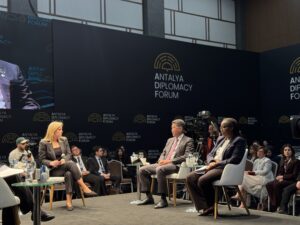
From L to R: moderator Nafisa Latic, Berik Aryn, and
Gerardine Mukeshimana, IFAD Vice President. Photo credit: Assel Satubaldina/ The Astana Times
Founded in 2018 with its headquarters in Astana, the IOFS seeks to strengthen cooperation among member states of the Organization of Islamic Cooperation (OIC) to ensure food security.
Continuing his remarks, Aryn pointed to the growing concentration of global food supply chains, which rely on a limited number of traders and suppliers. While efficient under stable conditions, he said, the system becomes highly fragile when disrupted by conflict or geopolitical tensions.
He stressed that access to food is increasingly shaped by non-market factors, including security conditions, political constraints and infrastructure gaps. “So this means that even when food is enough globally, it doesn’t reach the people in need,” he added.
“There is a disconnect between humanitarian response and long-term development planning. Too often, we respond to crises with humanitarian aid, but we don’t do sufficient investment in building local resilience. As a result, the same regions remain vulnerable cycle after cycle,” said Aryn.
Aryn mentioned the organization’s initiatives, such as strategic food security reserves, speed breeding technologies, and climate-smart agriculture. He also noted the critical importance of aligning food security strategies with climate priorities.
At the upcoming Regional Ecological Summit in Astana next week, Aryn said IOFS and Türkiye, which will host the United Nations Climate Change Conference in November, will organize a side event focusing on integrated climate action, land restoration and biodiversity.

Andrea Meza Murillo. Photo credit: ADF
Andrea Meza Murillo, deputy executive secretary of the United Nations Convention to Combat Desertification (UNCCD), agreed with Aryn on the importance of building resilience of global food supply chains.
“When we are talking about addressing the food system crisis, it is really about building resilience, especially for small-holder farmers around the world. If we really manage to guarantee that they can continue producing their food, that is transformational,” she said.
She also stressed that healthy soils and land are fundamental to food security, particularly for vulnerable communities. Fertile land, a basic condition needed for production, is often overlooked in discussions on food systems.
“Sometimes when we are talking about the food systems, we tend to forget that we need this good soil and good land to start producing, and especially for a lot of these small-holder farmers and for a lot of these vulnerable communities around the world,” she said.
Mehdi Eker, former minister of food, agriculture and livestock of Turkiye, described food security as an issue of national security.
“We know that the links between food security and peace it works on both sides,” he said. “Food insecurity leads to social unrest, leads to migration and displacement. On the other hand, when you have any armed conflicts, such as in Ukraine, in the Persian Gulf, or in other places of the world, then that problem leads to food insecurity. It works in two ways.”
He stressed that 733 million people suffer from hunger, while 1.4 billion face obesity and more than two billion are malnourished. “It is not the production issue; it is a coherence problem,” he added.
Eker said addressing these challenges requires stronger international coordination, noting that no single country can tackle global food security alone. He also highlighted Türkiye’s experience in humanitarian and food assistance, including its cooperation with international organizations such as the World Food Programme (WFP) and the Food and Agriculture Organization (FAO).
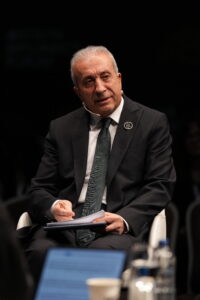
Mehdi Eker. Photo credit: ADF
Concerns about good security have been mounting since the start of the war in the Middle East. According to the FAO, disruptions in the Strait of Hormuz are triggering a major shock to global commodity flows, with far-reaching consequences for food security and agricultural production. The corridor carries around 20 million barrels of oil per day, one-fifth of global liquefied natural gas and up to 30% of internationally traded fertilizers.
“This is not only an energy shock. It is a systematic shock affecting agrifood systems globally,” said the organization’s chief economist Máximo Torero during a March 26 press briefing. The Gulf region supplies nearly half of the world’s sulfur, a key input in the production of phosphate fertilizers.
According to WFP estimates released on March 23 on the implications of the Middle East tensions for food security, in 53 countries with available data, the number of people facing acute food insecurity could increase by around 45 million if the crisis continues through the second quarter of the year. Overall, the organization projects that as many as 363 million people could face acute hunger in 2026, as higher prices further limit access to food for already vulnerable households.
