
ASTANA — Damir Torebai, a 28-year-old jeweler from Aktau, a city in western Kazakhstan on the Caspian Sea, is reinterpreting traditional Kazakh jewelry through contemporary design, blending heritage techniques with modern wearability.
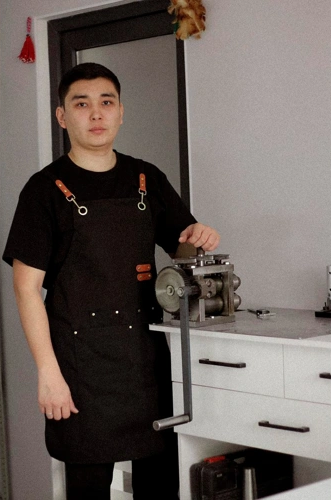
Damir Torebai in his workshop in Aktau. Photo credit: Damir Torebai’s personal archives
Torebai adapts national ornaments for daily use and preserves their authenticity.
His path into jewelry began with an early interest in art. He first studied drawing, then trained as a sculptor at the Mangystau College of Arts before continuing his education at the Zhurgenov Kazakh National Academy of Arts, where he specialized in jewelry-making.
“There I learned from professional mentors and more deeply mastered the subtleties of the craft. In 2020, I returned to Aktau and opened my own workshop,” said Torebai.
His work centers on national style jewelry, particularly using traditional techniques from western Kazakhstan such as granulation, which involves creating patterns from tiny metal beads, and filigree, a method of shaping fine silver wires into delicate ornamental designs.
“Earlier, jewelry was large in size. I adapt it to modernity. I reduce the size, making it comfortable for everyday wear, but at the same time try to preserve authentic elements,” he said.
Demand and production
Torebai’s most popular pieces include boitumar amulets, traditional protective pendants, as well as rings such as kudagi zhuzik, traditionally worn by kudagi, mothers of a bride and groom who become in-laws, and oimak zhuzik, a ring inspired by the shape of a thimble.
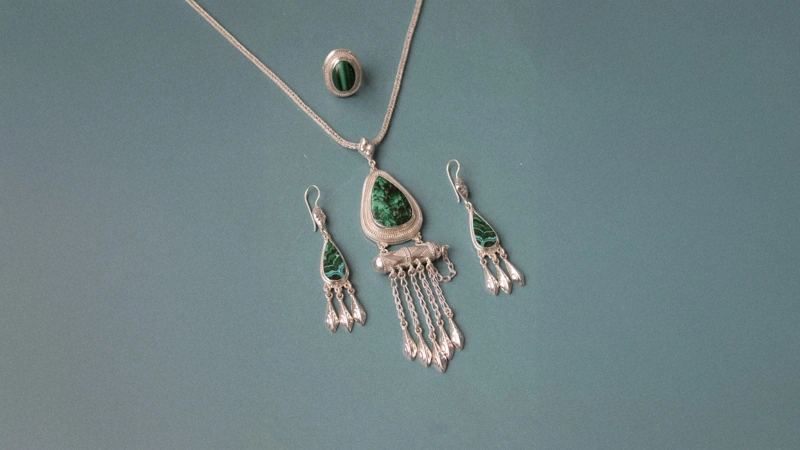
Silver jewelry set featuring traditional kazakh design elements. Photo credit: Damir Torebai’s personal archives
“For now, I work only with silver, but in the future I plan to also work with gold. (…) One ring takes approximately four to seven days. A full set – ring, earrings and necklace – is completed within 20 to 30 days,” he said.
Orders, Torebai said, now arrive from far beyond the Mangystau Region, with clients in Astana, Pavlodar and Semei seeking out his work. At his workshop, he has also opened a small storefront, offering ready-made pieces alongside custom orders.
Support, inspiration and challenges
After completing his studies, Torebai secured state support, including a grant through the Bastau Business program and a nonrepayable award under the regional Tauelsizdik Urpaktary (Independence Generation) initiative in Kazakhstan. The funding enabled him to fully equip his workshop; he now plans to expand and hire staff.
Torebai also studies historical jewelry and international design for greater inspiration.
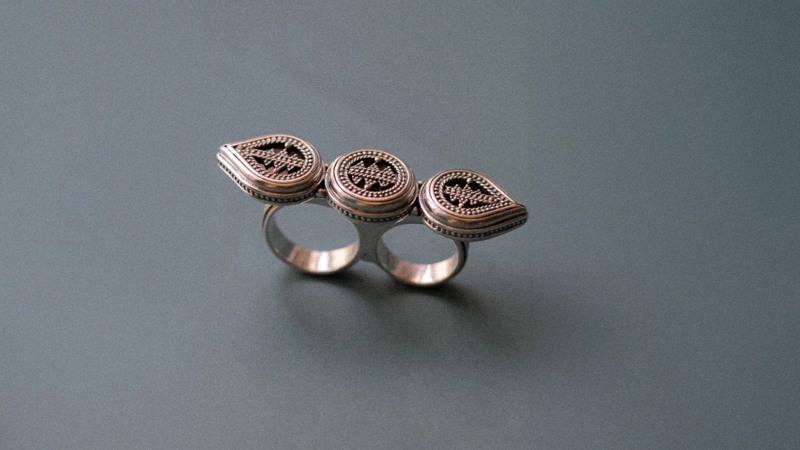
Double ring design with traditional ornamental patterns. Photo credit: Damir Torebai’s personal archives
“I often visit museums and study ancient jewelry. I also look at the works of foreign designers. This helps to develop national art in a modern direction,” he said.
He described patience and persistence as essential qualities for the profession, noting that strong drawing skills are equally important.
“The main difficulty is that high income does not come immediately. It is formed with experience and the trust of clients,” said Torebai.
The article was originally published on Kazinform.
