
ALMATY – An international festival Nomadic Art: Global Image of Steppe Culture, celebrating nomadic culture and traditional crafts, brought together artisans from across Kazakhstan in Almaty as part of the Nauryznama decade, offering visitors a rare opportunity to explore ancient techniques and cultural heritage, reported the city administration’s press service.
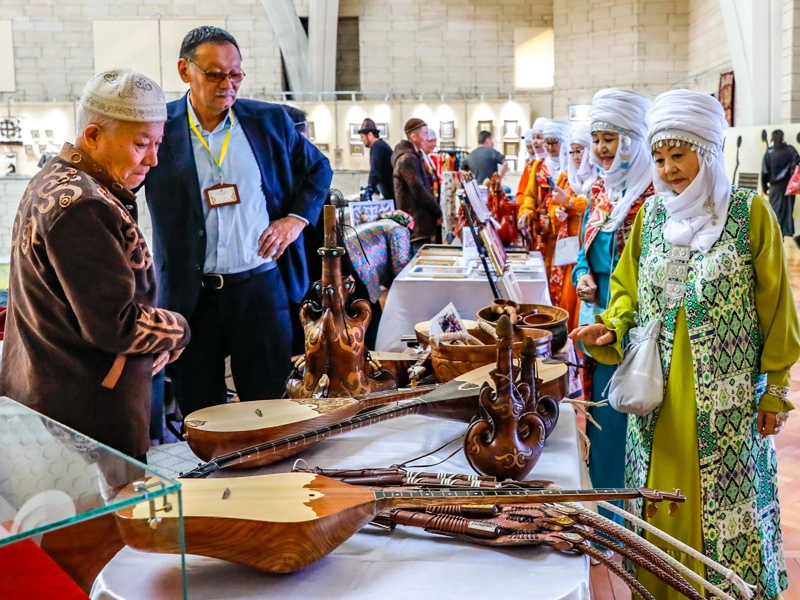
The festival was organized for the first time by the National Museum of Kazakhstan, together with the Almaty tourism department and the Union of Ethnodesigners. Photo credit: Alexander Pavsky/Kazinform.
The festival featured master classes, exhibitions and performances highlighting traditional decorative and applied arts, from felt-making and weaving to ceramics and jewelry.
Reviving traditional craftsmanship
At the festival, visitors viewed handcrafted works and learned traditional skills such as felt-making, spinning wool on a spindle, quilt-making, and embroidery. Artisans also demonstrated rare artistic techniques, including fumage, a form of painting using smoke.
Craftswoman Roza Uysinbayeva from the Kyzylorda Region shared insights into traditional Kazakh carpet weaving, explaining the difference between pile and pileless carpets to the Kazinform news agency.
She said creating a large carpet can take up to two months and requires significant materials, including up to 16 kilograms of patterned yarn and several kilograms of cotton base.
“The speed depends on the thickness of the thread. Thicker yarn allows faster work, while finer threads require more time,” she said.
Felt-making and natural materials
Artisans from Taraz presented both dry and wet felt-making techniques, explaining the differences and applications of each. While dry felting involves shaping wool with a needle, wet felting is a more labor-intensive process that requires teamwork and the use of water, soap, and natural dyes.
Craftswoman Raushan Imanali demonstrated how traditional ornaments are made with layered wool and natural dyes such as turmeric and onion skins.
“Only natural materials are used. After preparing the patterns, we fix them onto the base using warm soapy water and manual pressure,” she said.
Historically, felt played a key role in nomadic life, serving as material for yurt coverings, clothing, carpets and decorative wall hangings.
A platform for cultural exchange
The festival was organized for the first time by the National Museum of Kazakhstan, together with the Almaty tourism department and the Union of Ethnodesigners.
The program included a scientific conference, fashion shows featuring ethnic collections, and an international crafts fair.
Cities recognized as World Craft Cities also showcased their specialties, with Taraz showcasing felt-making traditions, Turkistan showcasing ceramics, and Almaty showcasing jewelry art.
Organizers said the festival aims to reinterpret national heritage in a modern context and promote Kazakhstan’s nomadic culture on the international stage.
Earlier, Kazakh jeweler artist Serzhan Bashirov told The Astana Times how he revives the lost nomadic material world, carrying memory and the weight of history through his craft.
Learn more about traditional Kazakh felt carpets, including the syrmak, a stitched felt rug widely used in Kazakh nomadic life, see Aiman Nakispekova’s article, available March 22.
