
ALMATY – At a time when many views of Turkic civilization are reduced to simplistic narratives, Kazakh researcher and writer Zira Nauryzbai invites a reassessment. At a public lecture on Feb. 18 in Almaty, she explored Turkic mythology, gender roles, and ancient belief systems, challenging conventional views of Turkic civilization and highlighting the deep symbolic role of women in the spiritual worldview of the steppe.
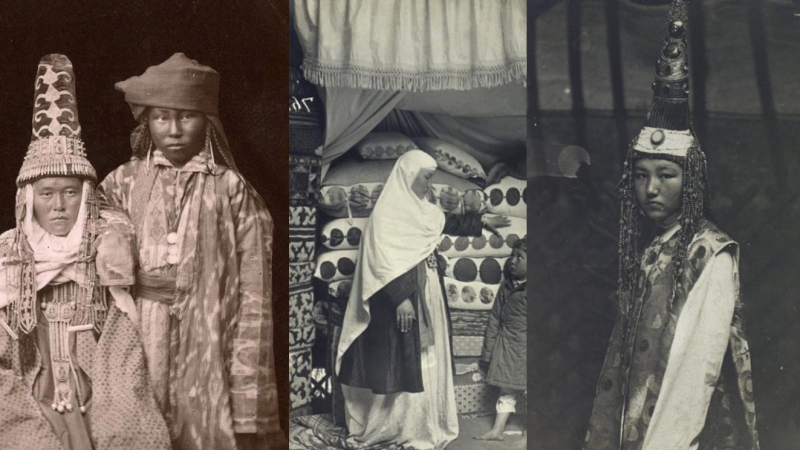
Nauryzbai discussed the changes of the women’s role in the society, connected also with the linguistic aspect. Photo credit: tengrinews.kz.
Turkic civilization: nomadic and martial, yet balanced
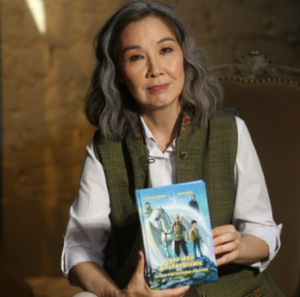
Kazakh mythology researcher and writer Zira Nauryzbai. Photo cresit: Nauryzbai’s personal archive.
Nauryzbai emphasized that the Turkic world should first be understood as a nomadic, pastoral civilization that was also fundamentally martial. Historically, Turkic peoples repeatedly conquered territories, established ruling dynasties, and elevated the cultural and architectural development of those regions before eventually assimilating into local societies.
“At first glance, such a society appears inherently patriarchal — a warrior and pastoral society by definition,” she said, addressing the public at the Almaty Management University. “Yet historians and travelers who visited the steppe were consistently struck by how significant the role of women was in this world.”
According to Nauryzbai, the roots of this paradox lie in ancient mythological consciousness. She noted that modern audiences often dismiss myths as fairy tales or fabrications, whereas traditional societies understood them as forms of ultimate truth.
“A myth is the highest truth for the society that believes in it — a truth expressed through imagery,” she said, referencing the work of Alexei Losev, an academician and philosopher who explored the philosophical nature of myth.
Rethinking the goddess Umai
One of the central figures that she discussed was the ancient Turkic goddess Umai, commonly portrayed as a fertility deity or earth goddess. Nauryzbai stressed that this interpretation reflects sedentary agricultural thinking rather than nomadic logic.
“When we call Umai a goddess of the earth, we are thinking like an agrarian civilization. For nomadic pastoralists, the worldview was structured differently,” she said.
She noted that in Turkic belief systems, land itself was personified separately as Zher-Su, a sacred earth-water entity, while Umai occupied a more complex role. Beyond protecting mothers and infants, Umai was also associated with warfare and valor.
“According to Turkic texts, Umai grants victory to warriors and gathers the souls of those who die bravely,” Nauryzbai said. “In this sense, she resembles a Valkyrie figure.”
Power, religion and the khagan–katyn model
Nauryzbai suggested that the divine pairing of Tengri, the supreme god of the sky, and Umai may have been politically constructed during the Turkic Khaganate to mirror the state’s ruling structure.
“Every powerful state creates a religion that suits it. This divine pair was likely designed to explain the dual authority of the khagan and the katyn,” she said.
While the khagan, the supreme ruler or emperor of a Turkic nomadic state, led during wartime, governance in peacetime was often exercised by male relatives of the katyn, translated from Kazakh as married woman, a term that symbolized the historical title of a female ruler.
She also noted that the term “katyn”, now perceived as a rude word in modern Kazakh, historically meant “queen” or “lady” and remains respectful in many Turkic languages.
Islam and the transformation of ancient deities
Nauryzbai stressed that with the adoption of Islam, particularly under the Karakhanid state, Umai gradually lost her divine status. By the 11th century, in Mahmud al-Kashgari’s dictionary, she appears only as a term related to childbirth.
Yet traces of her presence persisted. In Kazakh ethnography, the figure of Mai-ana survived into the mid-20th century, associated with oil, fire, childbirth and wedding rituals, as the Kazakh word ‘mai’ translates as oil.
“One ritual involved a groom pouring oil into the fire of his bride’s family home,” Nauryzbai said. “This act symbolized a request for protection and acceptance by the household fire.”
Nauryzbai also drew attention to ancient toponyms. Place names containing “mai” often indicate former sanctuaries dedicated to Umai. She cited the Maikudyk district in Karagandy, Central Asia, explaining that its name likely means “the well of Mother Umai,” rather than its modern literal interpretation, which is connected to the Kazakh translation as “oil pit.”
From goddesses to demons
A highlight of the lecture was the gradual transformation of ancient deities into negative or demonic figures as belief systems changed. Characters such as Mystan Kempir (a witch), Zheztyrnak (a vampire-like character with copper nails), and Albasty (a female spirit, the embodiment of diseases and nightmares), now portrayed as monstrous, once held divine or protective functions.
“In mythology, this pattern is universal. When a new religion emerges, former gods often become demons,” Nauryzbai said.
She referenced the concept of the “slain deity,” explored by mythologist Mircea Eliade. According to this idea, many mythological traditions begin with a supreme creator god who brings the world into existence and then withdraws or becomes distant.
In this sequence, she explained, a second generation of divine beings then comes to humanity, attempting to teach, guide, or enlighten people.
However, humans fail to understand this deity and ultimately sacrifice or kill it. From this act arise initiation rituals and sacred traditions, which symbolically reenact the death and renewal of the divine figure.
