
This year has been designated the International Year of Volunteers for Sustainable Development, recognizing the vital role volunteers play in addressing social challenges and strengthening communities worldwide. For Kazakhstan, this recognition reflects not only current civic engagement but also a long-standing tradition of mutual assistance deeply rooted in the country’s history.
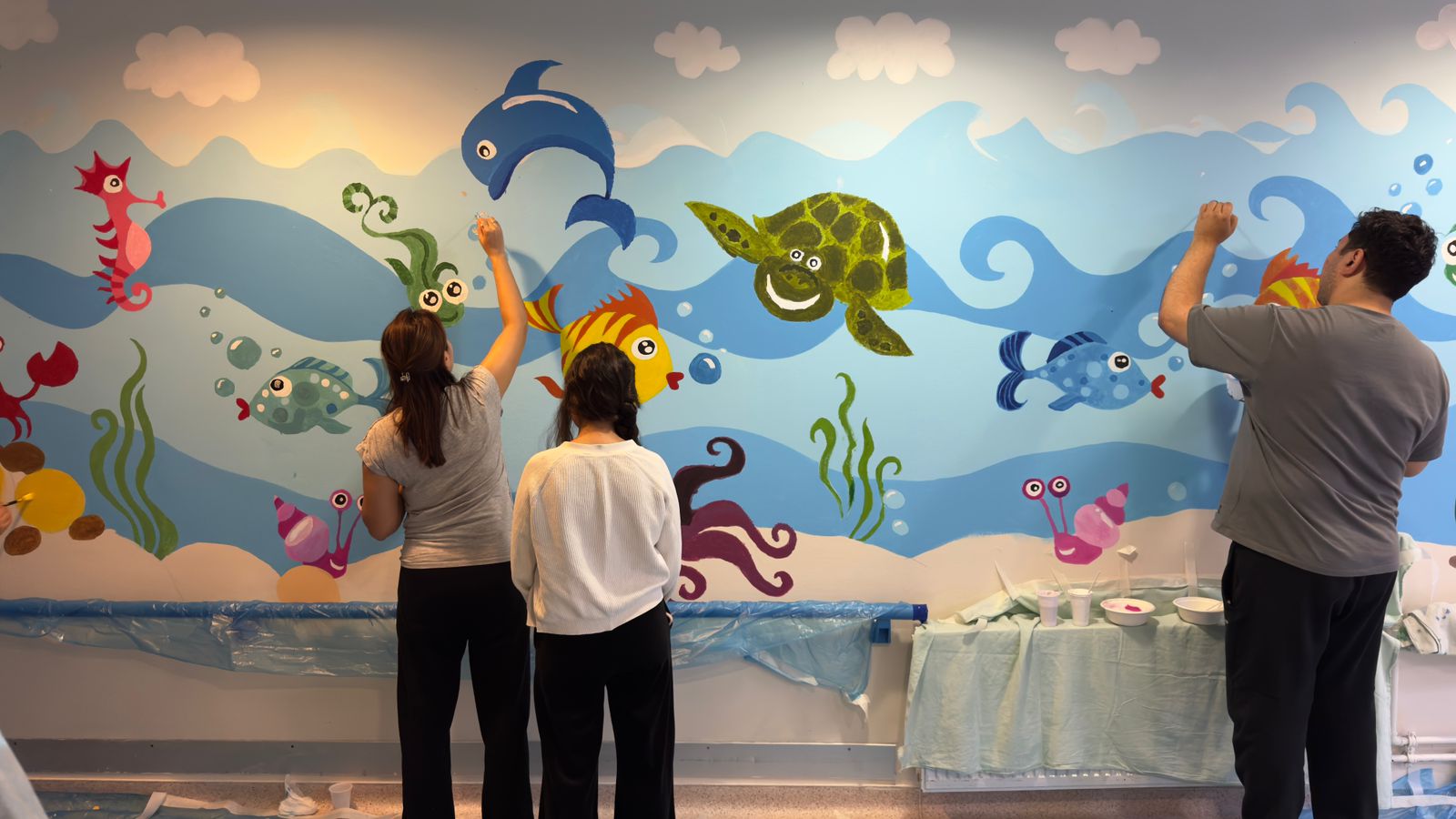
During a volunteer-led creative project at a children’s rehabilitation center in Astana. Photo credit: Nakispekova’s personal archieve
Kazakhstan’s modern volunteer movement received strong national recognition in 2020, when President Kassym-Jomart Tokayev declared it the Year of Volunteer. During the COVID-19 pandemic, volunteers emerged as a vital support network. With health systems and public services under extreme pressure, they delivered food and medicine, assisted vulnerable people and helped communities endure a period of deep uncertainty.
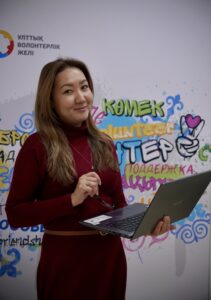
Aiman Nakispekova. Photo credit: Nakispekova’s personal archieve
My own journey into volunteering began during pandemic time, while I was living in the Kingdom of Saudi Arabia. At the time, I did not consider myself a volunteer. I simply responded to immediate needs, helping neighbors who were unable to leave their homes during lockdowns by delivering groceries and medication, and taking care of small but urgent needs.
Then we noticed something else, some pets were left behind as owners were stranded, hospitalized or displaced. We organized food, temporary care and adoption efforts. It was exhausting and emotionally heavy work, but it also revealed something fundamental: when people feel responsible for one another, even informal actions can have a real impact.
That experience reshaped my understanding of volunteering. What begins as spontaneous help can evolve into a lifelong commitment.
When I returned to Kazakhstan, volunteering became a structured part of my life. I joined the National Volunteer Network and began working on international cooperation, focusing on partnerships with volunteer organizations abroad and creating opportunities for Kazakh volunteers to participate in international events. Through this work, I met volunteers from various countries, cultures and backgrounds, people united not by language or nationality, but by a shared refusal to remain indifferent.
Roots in nomadic tradition
Volunteerism in Kazakhstan is not a recent phenomenon. It is closely tied to the country’s nomadic heritage and cultural values.
One of its earliest expressions is “asar,” a traditional form of collective, voluntary assistance practiced among nomadic communities. Similar traditions exist across Central Asia, known as “ashar” or “hashar.”
In nomadic life, survival depended on cooperation. Communities came together to rebuild homes destroyed by storms, cultivate land, restore lost livestock or help young families start independent lives. Assistance was voluntary, unpaid and collective. These practices emerged from the realities of life in harsh natural and climatic conditions, where cooperation was essential for survival.
Volunteers in times of crisis
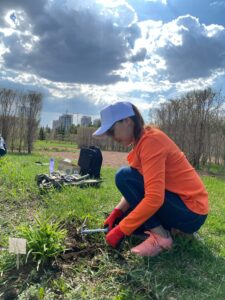
Volunteer initiative at the Botanical Garden in Astana. Photo credit: Nakispekova’s personal archieve
Modern volunteerism in Kazakhstan mirrors these principles, particularly during emergencies. Volunteers are often the first to mobilize during floods, fires and other natural disasters. They assist with evacuations, distribute humanitarian aid, provide psychological support and help restore basic services.
During devastating floods in 2024 in Kazakhstan, volunteers played a central role in response efforts. They organized collection points for essential supplies, helped affected families relocate and worked alongside emergency services in some of the most challenging conditions.
Kazakhstan’s volunteer community has also demonstrated strong international solidarity. After the earthquake in Türkiye, more than 500 tons of humanitarian aid and 150 yurts were sent from Kazakhstan. In meetings with Turkish partners afterward, the scale and sincerity of the support were repeatedly emphasized. It was a reminder that volunteerism does not stop at national borders.
A new generation of engagement
Environmental volunteering has become one of the most dynamic and emotionally resonant areas of civic engagement in Kazakhstan, particularly among young people and in regional communities.
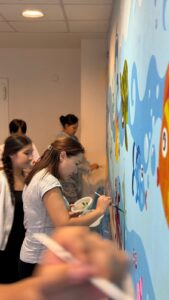
Wall painting at a children’s rehabilitation center in Astana. Photo credit: Nakispekova’s personal archieve
In the Zhambyl Region, volunteers have focused on environmental education at the earliest age. Preschool programs introduce children to the basics of ecology through games, storytelling and simple experiments. Volunteers explain why nature needs protection, how waste affects water and soil, and why small actions, such as turning off lights, saving water, not littering, matter. For many children, these lessons become their first conscious encounter with the environment.
School-based initiatives take this further. In the town of Talgar in the Almaty Region, a young volunteer launched a waste-sorting project that quickly grew into a community movement. Schoolchildren began collecting plastic bottles, cardboard, cans and other recyclable materials, bringing them to local collection points. Each contribution was weighed and converted into points that could later be exchanged for free educational courses at a local learning center.
What started as an environmental initiative soon became educational and social. Children began explaining waste sorting to their parents, correcting habits at home and encouraging neighbors to participate. For many families, it was the first time environmental responsibility became part of their daily routine rather than an abstract concept.
Another project in the same region was launched by a schoolteacher who introduced students to vermiculture, the use of red California worms to process organic waste into nutrient-rich compost. She set up a small laboratory in her school, where children learned how food waste could be transformed into valuable fertilizer. Students cared for the worms, observed the process and saw tangible results: improved soil quality, healthier plants and reduced waste.
Small actions, lasting change
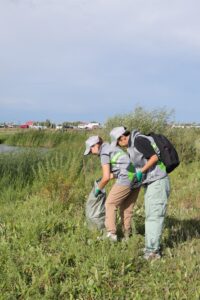
Environmental clean-up campaign near Talapker village in the Akmola Region. Photo credit: Nakispekova’s personal archieve
Some of the most touching volunteer stories come from the simplest acts. One of them is the 28 Loops project, where volunteers knit warm clothing for premature newborns. Each small sweater, hat or blanket helps fragile babies conserve energy and survive.
Many volunteers knit after long workdays, in the quiet hours of the evening. They meet occasionally, share stories and support one another. One of the youngest coordinators is a 12-year-old girl from the Akmola Region who teaches others how to knit.
Individual volunteers also play a crucial role. Rehabilitation specialist and volunteer Latif Parpiyev has spent several years providing free treatment and consultations to children with complex medical conditions, including cerebral palsy and post-stroke complications. He has developed and tested his own rehabilitation techniques and now shares educational content with parents through online platforms.
Volunteering as a family value
Volunteerism in Kazakhstan increasingly involves entire families. Parents bring their children to activities, passing on values of empathy and responsibility through action rather than instruction.
I experience this personally. I volunteer together with my 15-years-old eldest daughter. One of the most meaningful moments for us was participating in a creative project at a rehabilitation center for children in Astana. Alongside volunteers from the National Volunteer Network and Chevron Corporation, we painted a wall to brighten the daily environment for young patients. It was a small act, but one that stayed with both of us.
In a world often marked by division and conflict, volunteerism demonstrates the power of compassion and unity. Experience shows that many people who initially volunteer for practical reasons later undergo profound personal change. Through helping others, they gain new perspectives, values and connections.
