
ASTANA — The Trans-Caspian International Transport Route, widely known as the Middle Corridor, made its official debut at the 62nd Munich Security Conference (MSC 2026), as policymakers and experts gathered for the first-ever side event dedicated to its strategic and economic potential, the Caspian Policy Center (CPC) press service reported on Feb. 15.
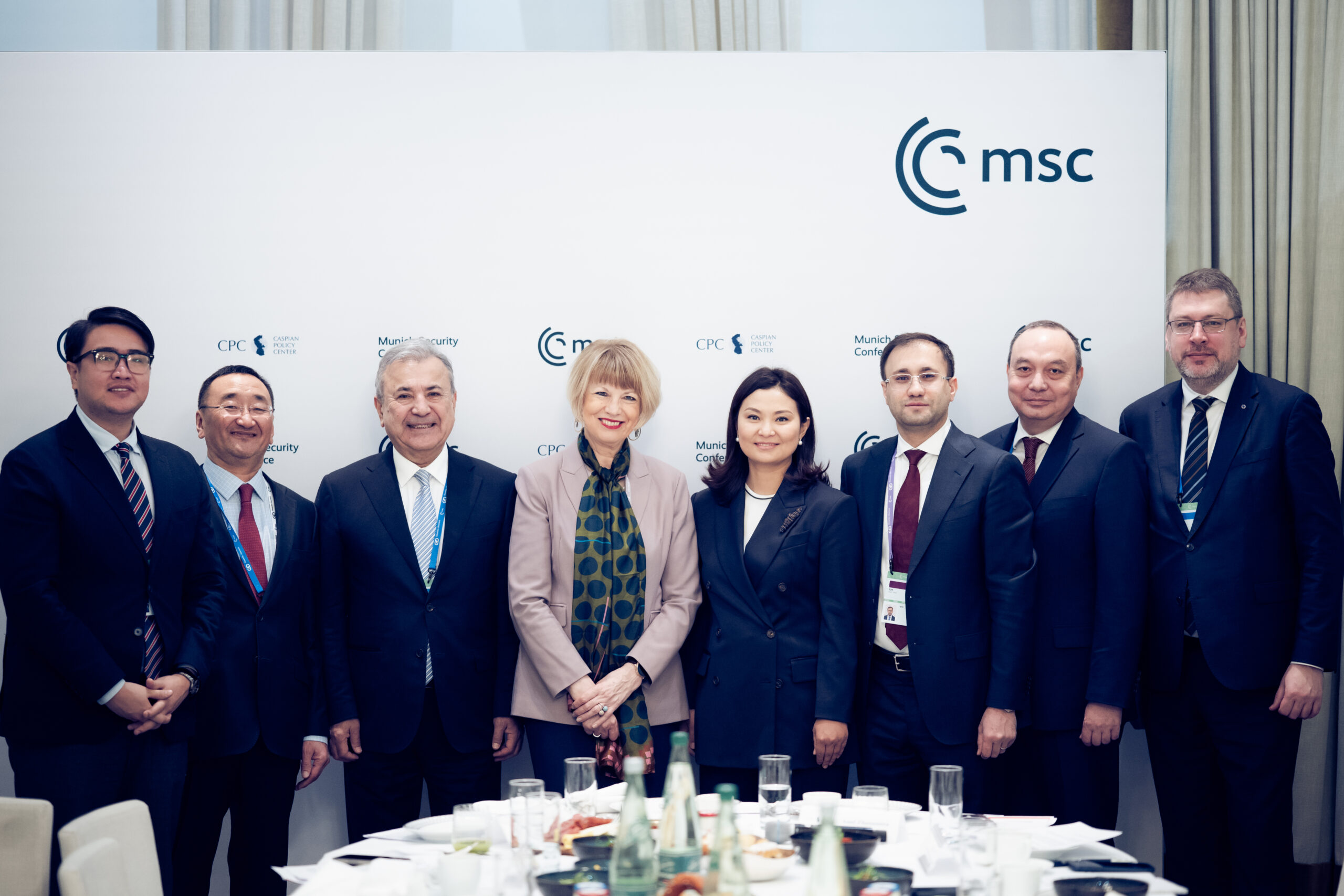
For the first time, an official side event dedicated to the development of the Middle Corridor was held at the Munich Security Conference on Feb. 15. Photo: MSC/Philipp Guelland
The discussion, titled The Golden Mean? Connectivity, Security and the Caspian Middle Corridor, was organized by the CPC in partnership with Kazakhstan’s intellectual platform CFive. Among the featured events of MSC 2026, the session highlighted growing international attention to the practical dimensions of Eurasian connectivity and the resilience of global supply chains.
Schmid, Vice President of the Munich Security Conference Foundation Council, highlighted the expanding role of the Middle Corridor in Europe’s security agenda on Feb. 15. Photo: MSC/Philipp Guelland
Helga Maria Schmid, former Secretary General of the Organization for Security and Co-operation in Europe (OSCE) and Vice President of the Munich Security Conference Foundation Council, highlighted in her opening remarks the expanding role of the Middle Corridor in Europe’s security agenda, strengthening economic resilience and diversifying international trade routes.
Held in the format of an in-person working breakfast, the event brought together representatives of government institutions, the diplomatic corps, think tanks and the international business community. Among the speakers were Assel Zhanassova, Deputy Head of the President’s Executive Office of Kazakhstan; Sodik Safoev, First Deputy Chairman of the Senate of the Oliy Majlis of Uzbekistan; Hikmet Hajiyev, Assistant to the President of Azerbaijan and Head of the Foreign Policy Affairs Department of the Presidential Administration; Iskander Akylbayev, Chairman of CFive; and Efgan Nifti, Chief Executive Officer of the Caspian Policy Center.

Zhanassova,Deputy Head of the President’s Executive Office of Kazakhstan, said the corridor’s further growth is directly tied to its economic viability and investment appeal. Photo: MSC/Philipp Guelland
In her remarks, Zhanassova stressed that the corridor’s further growth is directly tied to its economic viability and investment appeal. She noted that Kazakhstan plays a pivotal role in advancing the route as a strategic bridge between the Caspian region, Central Asia and European markets. According to her, priorities include coordinated regional policies, the introduction of digital solutions, the reduction of transaction costs and the creation of predictable conditions for international investors and businesses.
At the core of the discussion was a shared vision of the Middle Corridor as an emerging multilateral economic platform capable of ensuring sustainable trade, transit and investment links between Europe, the Caspian region, Central Asia and East Asian markets. Participants examined the ongoing transformation of global supply chains, new opportunities in trade, logistics and transit, and the role of digitalization and infrastructure modernization in improving the route’s reliability and efficiency.
The side event was held within the broader MSC 2026 program, which brought together around 70 heads of state and government, more than 65 foreign ministers and approximately 40 defense ministers. It featured over 500 bilateral meetings among political, business and expert leaders from across the globe.
