
ALMATY – The first meeting of the Board of Peace was held in Washington on Feb. 19, chaired by the United States (U.S.) President Donald Trump, bringing together representatives from a range of countries to discuss post-conflict reconstruction and emerging approaches to international peacebuilding. International media coverage of the meeting has outlined differing interpretations of the initiative’s mandate, governance structure, and broader implications for the evolving global order.
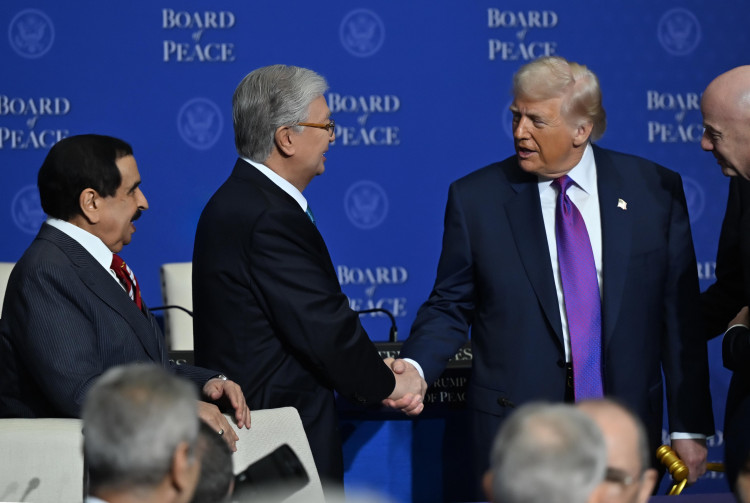
According to The Times of Central Asia, Tokayev’s engagement at the White House represents more than protocol or symbolism. Photo credit: Akorda.
Continuity and strategic discipline
According to The Times of Central Asia, Tokayev’s engagement at the White House represents more than protocol or symbolism. The outlet stressed that the visit signals continuity in Kazakhstan’s strategic posture amid heightened global uncertainty.
The article highlights Kazakhstan’s long-standing record as a Muslim-majority country that has institutionalized interfaith dialogue for more than two decades, served as a neutral venue for international negotiations, and consistently linked economic development with political stability.
“Kazakhstan’s experience managing internal diversity while maintaining constructive relations with competing global powers informs that outlook and shapes its contribution to initiatives such as the Board of Peace,” reads the article.
The Times of Central Asia notes that Kazakhstan’s participation in the Board of Peace aligns with this approach, framing it as the external expression of the country’s domestic model of pluralism and balanced engagement.
Against the backdrop of mixed international reactions, Kazakhstan’s engagement has largely been framed as consistent with its long-standing diplomatic philosophy. As the newspaper observes, Kazakhstan’s participation in the Board of Peace reflects a commitment to responsible statecraft, avoidance of ideological maximalism, and the pursuit of balanced relations across competing global power centers.
Rather than signaling a shift in alignment, international commentators largely interpret Tokayev’s Washington visit as an effort to reinforce predictable diplomacy and structured dialogue at a time when the architecture of global governance is increasingly contested.
Questions over mandate and governance
Other international outlets have taken a more cautious tone, focusing on the Board of Peace’s institutional structure. DW News reports that although the body originated as a Gaza-focused reconstruction mechanism, its mandate has since expanded and become less clearly defined.
DW notes that the founding charter, signed in Davos on Jan. 22, does not explicitly reference Gaza. It also points to criticism of the initiative’s governance, particularly following remarks by Trump, who chairs the organization.
“Besides obvious Trump allies such as leaders from Israel, Hungary and Argentina, there are also countries such as Pakistan seeking favor with the White House who have signed up to the board,” reads the article.
The outlet further emphasizes that the board operates under rules distinct from those of multilateral institutions, requiring member states to contribute $1 billion to extend membership beyond the initial two-year period, while leadership remains centralized under Trump’s chairmanship.
Global participation
Nikkei Asia has explored Asian perspectives, drawing attention to the absence of key U.S. treaty allies such as Thailand, the Philippines, and Malaysia. The publication emphasized that divergent responses across Southeast Asia reflect differing interpretations of Washington’s new platform and broader questions about whether the postwar, rules-based international order is in decline.
For emerging players such as Indonesia and Vietnam, Nikkei Asia suggests, participation offers greater access to the White House, though within a more transactional, power-centric international framework.
According to Al Jazeera, while some Western allies remained reserved, several Middle Eastern countries attended the first Board of Peace meeting.
“While the U.S. Western allies cautiously keep the board at arm’s length, some Middle Eastern nations are joining the first meet-up, which will take place at the U.S. Institute of Peace in Washington,” reads the article.
The European Union, despite lingering concerns about the initiative’s charter, is sending its Commissioner for the Mediterranean, Dubravka Šuica, as an observer. An EU spokesperson stated that Brussels remains open to working with Washington on implementing the Gaza peace plan, even as questions about governance persist.
