
ASTANA – Water flows through civilizations. It moves between continents, carries memory, and connects cultures. In Astana, Turkish watercolor artist Ahmet Öğreten uses that symbolism to trace a journey stretching from the Bosphorus to the great steppe.
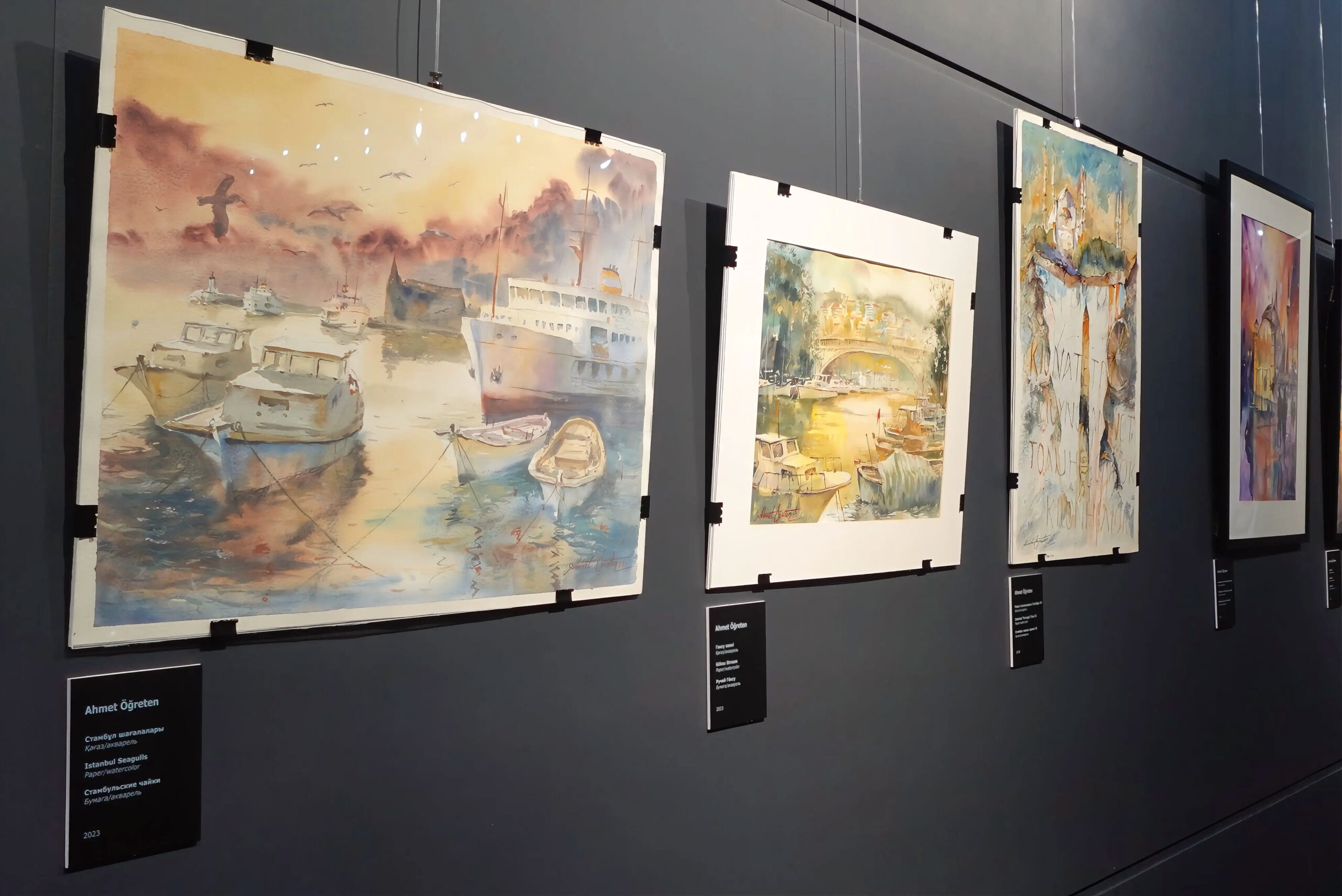
“Following the Water: From the Bosphorus to the Great Steppe” exhibition. Photo credit: The Astana Times/ Aida Temerkhan
His solo exhibition, “Following the Water: From the Bosphorus to the Great Steppe,” opened on Feb. 12 at the Palace of Peace and Reconciliation. The exhibition features 60 watercolor works. Arranged to take visitors from past to present, the pieces highlight the historical and cultural links between Central Asia and Anatolia.
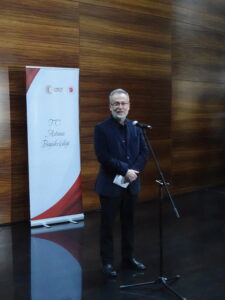
Turkish watercolor artist Ahmet Öğreten. Photo Credit: The Astana Times/ Aida Temerkhan
The project was organized by Kulanshi Art Group in partnership with the Embassy of Türkiye in Kazakhstan.
Through delicate layers of pigment and historical symbolism, Öğreten revisits the shared cultural roots of Turkic peoples.
“This exhibition was not only the result of artistic production, but also a journey toward our shared culture,” he told The Astana Times.
Invited by the Turkish Embassy, the artist immersed himself in researching nomadic life, ancient steppe traditions, patterns, motifs and objects used by early Turkic ancestors.
“As I learned more about how our ancestors lived on the steppe, it became impossible not to be amazed by the motifs, by the objects they used, by their respect for nature. I tried to reflect this harmony in my paintings,” he said.
Speaking with The Astana Times, Ambassador of Türkiye Mustafa Kapucu emphasized the historical dimension of the exhibition.
“This exhibition tells the story of a journey,” he said. “This land is the homeland of our ancestors, the place from which they came. Through this exhibition, we convey that message visually. How did our journey start? How did we travel from the steppe to the Bosphorus? It is a historical narrative expressed through art.”
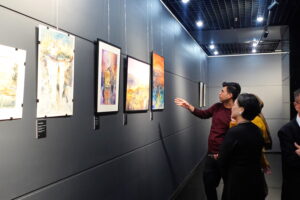
Öğreten works with soft washes and fine brushwork to capture landscapes and historical motifs. Photo Credit: The Astana Times/ Aida Temerkhan
The central metaphor of the exhibition is water. Öğreten explained that water symbolizes connection rather than division.
“When we think of water, we might imagine the flow of the Bosphorus, the silence of the great steppe, or the aesthetics of Seljuk and Ottoman art,” he said at the opening ceremony. “Water does not create distance between cultures. It brings them closer.”
Through this metaphor, the artist frames history not as a fragmented timeline but as a line that links lands and generations.
The exhibition remains open to the public through March 12, giving visitors the chance to explore the artworks and reflect on shared history and culture.
