
When you attend Abu Dhabi Sustainability Week, organized by Masdar, which I did this January, you expect discussions about clean energy, finance, technology, and the future of the planet. What you don’t necessarily expect is a sharp, intellectually uncomfortable conversation about soup, glue and the moral responsibility of museums.
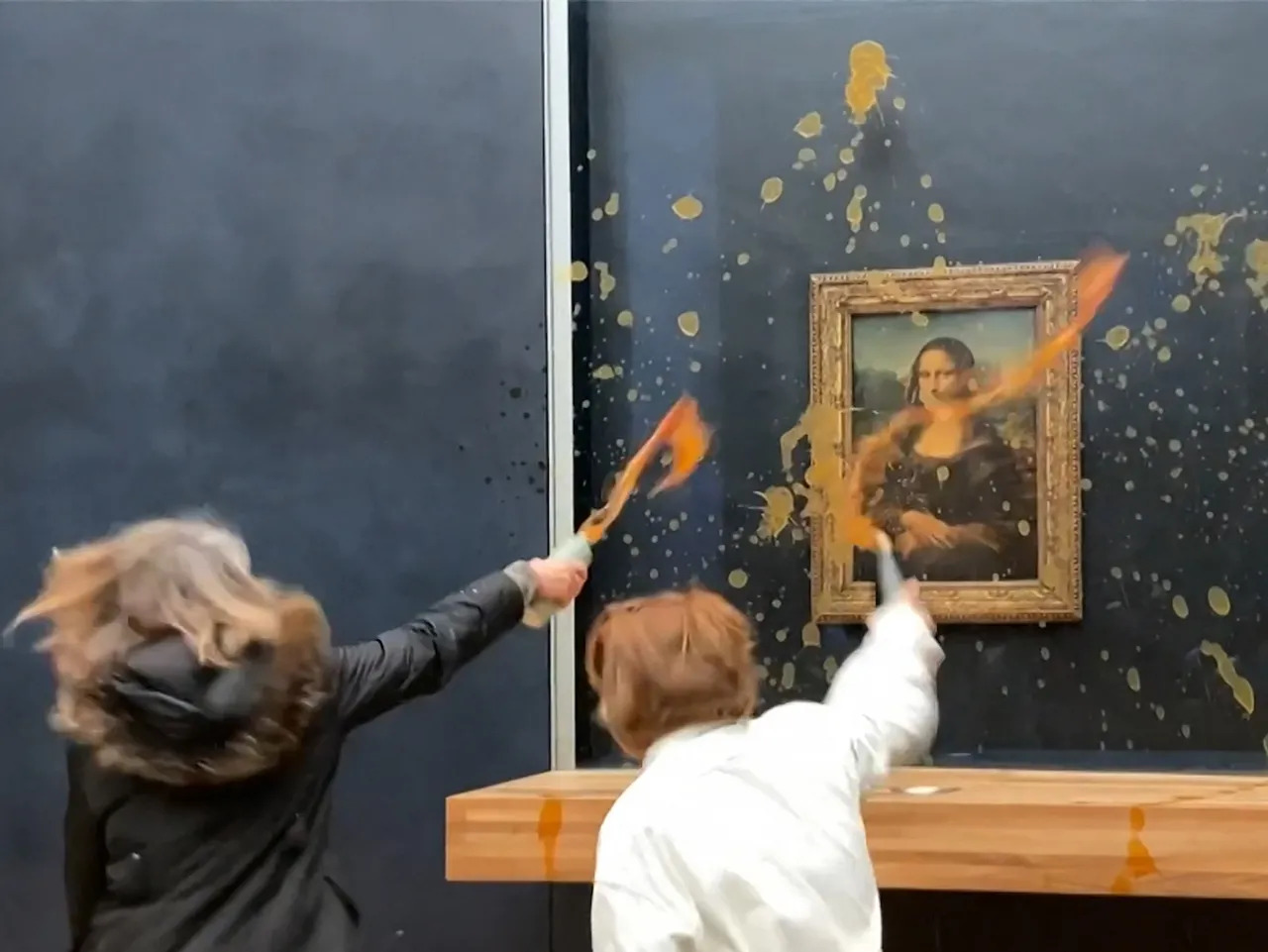
Protesters throw soup at the Mona Lisa’s protective glass covering at the Louvre on Jan.28, 2024. David Cantiniaux / AFPTV / AFP via Getty Images
Yet that was exactly what unfolded on Jan. 13 during a special address by Mariët Westermann, director of the Guggenheim Museum, who offered a thought-provoking reflection: why do climate activists keep targeting famous works of art, and why cannot museums simply dismiss such actions as vandalism?
“If we look at the situation today, there have been more than 40 such interventions involving famous paintings. Most resulted in no damage or very little damage, largely because the works were behind glass,” Westermann said.
Still, she acknowledged the disruption these actions cause. Museum visits are interrupted, galleries close temporarily, staff are mobilized, damage is assessed, and legal processes follow. “For most people, myself included, the immediate reaction is shock. Who on earth does such a thing?” she said.
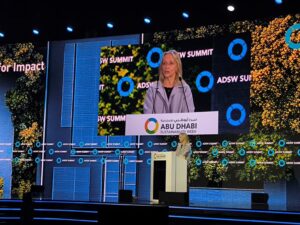
Mariët Westermann, director of the Guggenheim Museum, offered a thought-provoking reflection during ADSW 2026: why climate activists keep targeting famous works of art?
Photo credit: The Astana Times/Aida Haidar
It is a reaction many share. Art feels untouchable — priceless, irreplaceable, civilizational. As a museum director, Westermann made clear that she takes her responsibilities seriously. She supports holding perpetrators accountable through legal channels, as has happened in many countries. But what interested her more and what she urged the audience to consider was the why. “Why would someone risk their personal freedom by disturbing art that belongs, in a sense, to all of us?” she asked.
As she studied the phenomenon, Westermann realized that many of those involved are very young, the next generation, and that they are asking a question that unsettles traditional cultural logic. They are reframing “what is a world without art?” into something far more urgent: what is the value of art in a world that may soon become unlivable?
“Why spend billions preserving art if there may be no livable world left? Why do these objects matter if there may be no humans left to enjoy them?” she paraphrased their thinking.
Crucially, she noted, most activists are not trying to destroy art. On the contrary, their actions reveal a deep understanding of its value. According to her, it is no accident that these works have not been destroyed because that is not the goal. Paintings are targeted precisely because they are protected, behind glass, and because they carry immense symbolic weight. Soup is thrown. Protesters glue themselves to walls. She stresses that none of it is pleasant or acceptable, but it is deliberate and controlled. It is about maximum visibility.
To illustrate this logic, Westermann cited activists themselves. She quoted one of the leaders of Extinction Rebellion in New York, who said: “The function of art is to help people understand the world they live in and reflect on the human condition. That is why we are in museums: to tell people that we are in the middle of an emergency, and that now is the time to face it.”
Another perspective Westermann shared during her address came from the president of the Center for Cultural Power, who stated that protest is a form of theater—the creation of a shared narrative. Videos of soup attacks on the Mona Lisa or on Van Gogh’s Sunflowers at the National Gallery in London clearly reveal this performative dimension. The activists are prepared. The timing is precise. The cameras are ready, sometimes in visitors’ hands, sometimes in the hands of photographers alerted in advance. These moments are not spontaneous chaos. They are carefully staged.
“In other words, it is a kind of art,” Westermann said.
So why museums? Because art matters, and it draws attention. And because attacks on works by world-famous European male artists, housed in institutions like the Louvre, the National Gallery, or the Guggenheim, guarantee global visibility.
But activists’ critique goes further. They say that museums contribute to the climate crisis in two ways: by accepting donations linked to fossil fuel wealth, and by failing to make their own operations sufficiently sustainable.
Westermann deliberately set aside the donor debate to focus on what she called the more systemic issue: the environmental footprint of museum operations. She explained that world-class museums are energy-intensive by design. They require constant climate control to maintain narrow temperature and humidity standards. They depend on sophisticated lighting systems to protect and display art. They are deeply embedded in international air travel: drawing millions of tourists and transporting artworks across continents through complex, resource-heavy logistics. Exhibitions involve extensive shipping, installation, and travel, and they generate materials that are difficult to reuse or recycle.
Westermann bluntly agreed that this is true. She admitted that historically, museums, especially older ones, have been slow to adapt to a rapidly warming world. Climate activists, she argued, are calling on museum leaders, staff, and donors to act faster and do better.
“While I want these attacks on art to stop. I do not want us to ignore the message behind them,” she said.
At the Guggenheim, she noted, that message has already prompted action. When she joined the institution nearly two years ago, it had made a conscious decision “to run toward the noise, not away from it,” committing to comprehensive climate assessment, planning, and concrete changes aimed at reducing carbon emissions and waste.
Standing in Abu Dhabi, a city often associated with energy debates and future-forward ambition, Westermann offered an image that stayed with me. It was a reminder that climate action is not only about megawatts and markets. Sometimes it starts elsewhere in the quiet halls of museums with uncomfortable questions about practices that feel routine, familiar, and harmless, until you look closer.
