
ALMATY – Kazakhstan plans to fully cover its domestic electricity demand by early 2027 and move toward a stable power surplus by 2029 as the government accelerates large-scale energy projects worth more than 13 trillion tenge (US$27.7 billion), officials said during a Jan. 14 meeting chaired by Prime Minister Olzhas Bektenov.
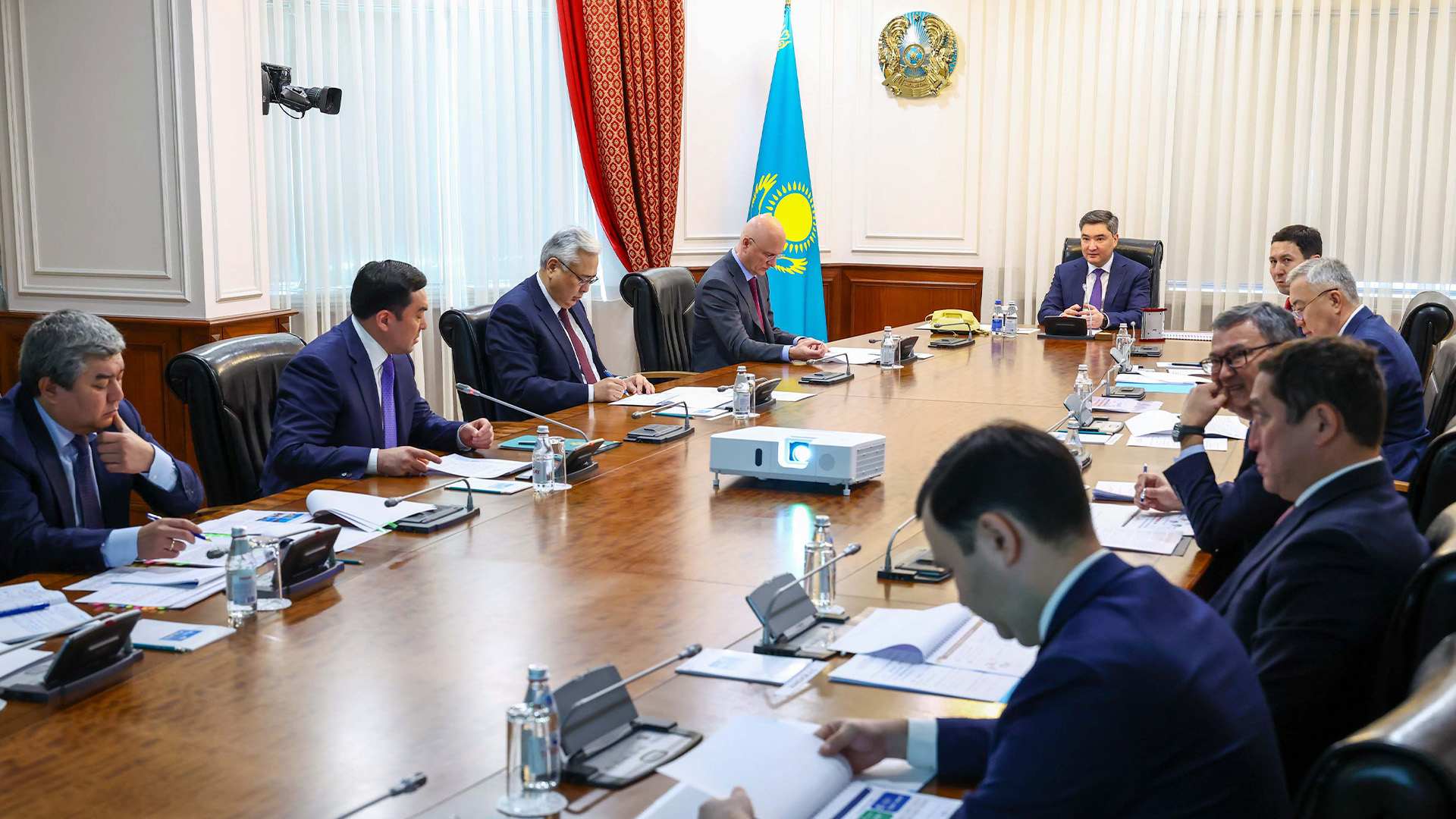
Prime Minister Olzhas Bektenov held a meeting on the development of the electric power industry on Jan. 14. Photo credit: Prime Minister’s press service.
According to the Ministry of Energy, work is underway on 81 power-generation projects with a combined capacity of 15.3 gigawatts. A significant share of these projects is being implemented through private investment attracted through the electricity capacity market mechanism.
Energy Minister Yerlan Akkenzhenov emphasized that most of the new facilities planned for commissioning over the next three years will belong to the maneuverable generation segment, aimed at addressing regulatory capacity shortages and increasing system flexibility.
“The commissioning of the project will make it possible to fully meet the economy’s electricity demand by the end of the first quarter of 2027 and remove Kazakhstan from the status of an energy-deficit country. By 2029, we expect to reach a stable surplus of both electricity and balancing capacity, creating conditions for expanding the country’s export potential,” he said.
Overall, Kazakhstan plans to introduce more than 26 gigawatts of additional generating capacity by 2035.
Power generation mix and grid expansion
According to the ministry ‘s data, electricity generation in 2025 reached 123.1 billion kilowatt-hours, while consumption totaled 124.6 billion kilowatt-hours. Installed capacity increased from 25.3 gigawatts to 26.7 gigawatts over the year.
Coal-fired power plants continue to form the backbone of the system, accounting for 51.4% of generation, while gas-fired plants make up 25.6% and renewable energy sources 13.5%, reflecting a gradual diversification of the energy mix.
Grid development was also a key topic of discussion. KEGOC, a national grid operator, is strengthening the southern power zone through the construction of a 475-kilometer 500-kilovolt transmission line between Shu, Zhambyl, and Shymkent. Another strategic project aims to connect western Kazakhstan’s energy system to the unified national grid via a 604-kilometer 500-kilovolt line between Ulke and Karabatan. Both projects are scheduled for completion in 2027.
By 2035, KEGOC plans to commission 6,659 kilometers of new high-voltage lines and modernize more than 10,500 kilometers of existing infrastructure.
Samruk Energo and clean coal projects
The portfolio of Samruk Energo energy holding includes plans to add 7.4 gigawatts of new capacity by 2035. Key projects include the modernization of Almaty Combined Heat and Power Plant-2, expected to be completed in October 2026, and the expansion of Ekibastuz Power Plant-2, with new units scheduled for 2028 and 2030.
The government also reviewed progress on coal-based generation using clean coal technologies. Strategic projects include Ekibastuz Power Plant-3 with a capacity of 2,640 megawatts, a new 700-megawatt plant in Kurchatov, and combined heat and power plants in Kokshetau, Semei, and Oskemen.
Bektenov criticized delays in project implementation and warned that missed deadlines would not be tolerated.
“All planned projects must be delivered on time. There must be no failures or postponements. The minister and the heads of Samruk-Energo and KEGOC bear personal responsibility for each facility. Your place of work is not in offices, but at construction sites,” he said.
