
ABU DHABI – Transforming global energy systems will require more than breakthrough technologies, according to a new report by the International Renewable Energy Agency (IRENA), released on Jan. 12 during a ministerial dialogue on the role of artificial intelligence at IRENA’s Assembly.
Photo credit: IRENA
According to the report Innovation Landscape for Sustainable Development Powered by Renewables, progress depends on systemic innovation that combines technology with policy, regulation, market design and new business models. The report highlights that there is no “one-size-fits-all” solution for the energy transition. Rather, durable change comes when innovations are integrated across entire energy systems.
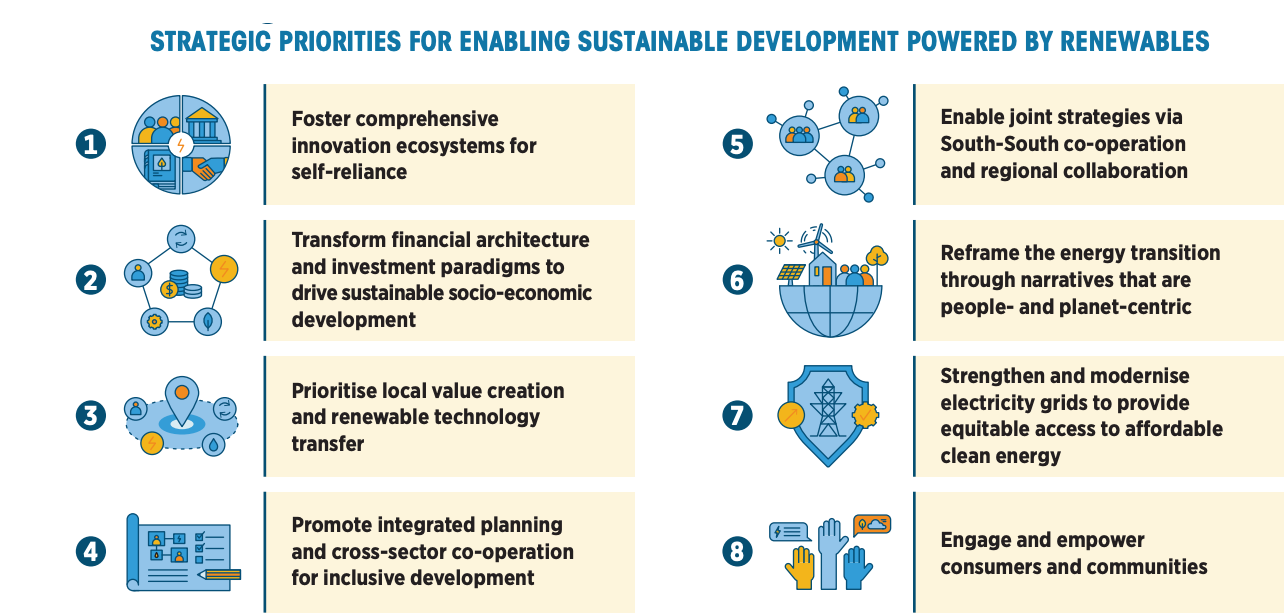
IRENA maps what it really takes to scale renewables: eight priorities, one message — without the right policies, finance, skills and institutions, innovation stays on paper. Photo credit: IRENA
The report identifies 40 emerging innovations, ranging from AI and digital tools to smarter grid planning, off-grid solutions and new market approaches. It concludes that only a holistic, system-wide strategy can deliver resilient power systems, expand energy access, keep costs affordable and unlock the full potential of renewables.
“The question isn’t whether we can transform our energy system. It’s whether we will seize the moment to do it in a holistic way, leaving no one behind,” said Francesco La Camera, director-general of IRENA. He stressed that the energy transition is not only about deploying technology, but also about ensuring social justice and inclusive development.
Renewable energy technologies are now the cheapest source of electricity in most regions, the report notes. Their falling costs and decentralized nature are opening new opportunities for universal electricity access and more resilient power systems, particularly in emerging markets and developing economies. However, the report underlines that successful implementation depends on national and local conditions, including grid characteristics, economic structure, available resources and social and cultural factors. What works in one country may not work in another. The report provided no specific examples from Kazakhstan or Central Asia.
However, case studies highlighted in the publication show how tailored approaches are already delivering results in other parts of the world. In Tanzania, Kenya, Colombia and Malaysia, energy communities collectively own and benefit from local renewable projects. West Africa’s regional power pool enables 15 countries to share renewable resources across borders. In Malaysia, dynamic line rating has increased transmission capacity by 10–50% using real-time weather data. Battery-swapping stations in Uganda and Rwanda are expanding access to electric mobility, while pay-as-you-go models have provided affordable electricity to more than 500,000 people in Sierra Leone and Liberia.
To help policymakers translate these ideas into action, IRENA groups the 40 innovations into four strategic toolkits: grid modernisation, decentralised solutions, inclusive local development, and energy access. The report calls for coordinated action at all levels – from multilateral institutions and regional platforms to national governments and local communities – to design solutions that reflect specific technical, economic and socio-cultural realities.
The findings were presented during the 16th IRENA Assembly, which marked the opening of the Abu Dhabi Sustainability Week 2026, held from Jan. 11–15 in the UAE capital. The event brings together heads of state, ministers and global experts under the patronage of Masdar, Abu Dhabi’s state-backed clean energy champion.
