
ALMATY — Kazakhstan has significantly upgraded its nuclear fuel production capabilities as the Ulba Metallurgical Plant (UMP) in Ust-Kamenogorsk, East Kazakhstan, launches a new automated inspection line for uranium fuel pellets and expands output of fuel assemblies for nuclear power plants (NPPs).
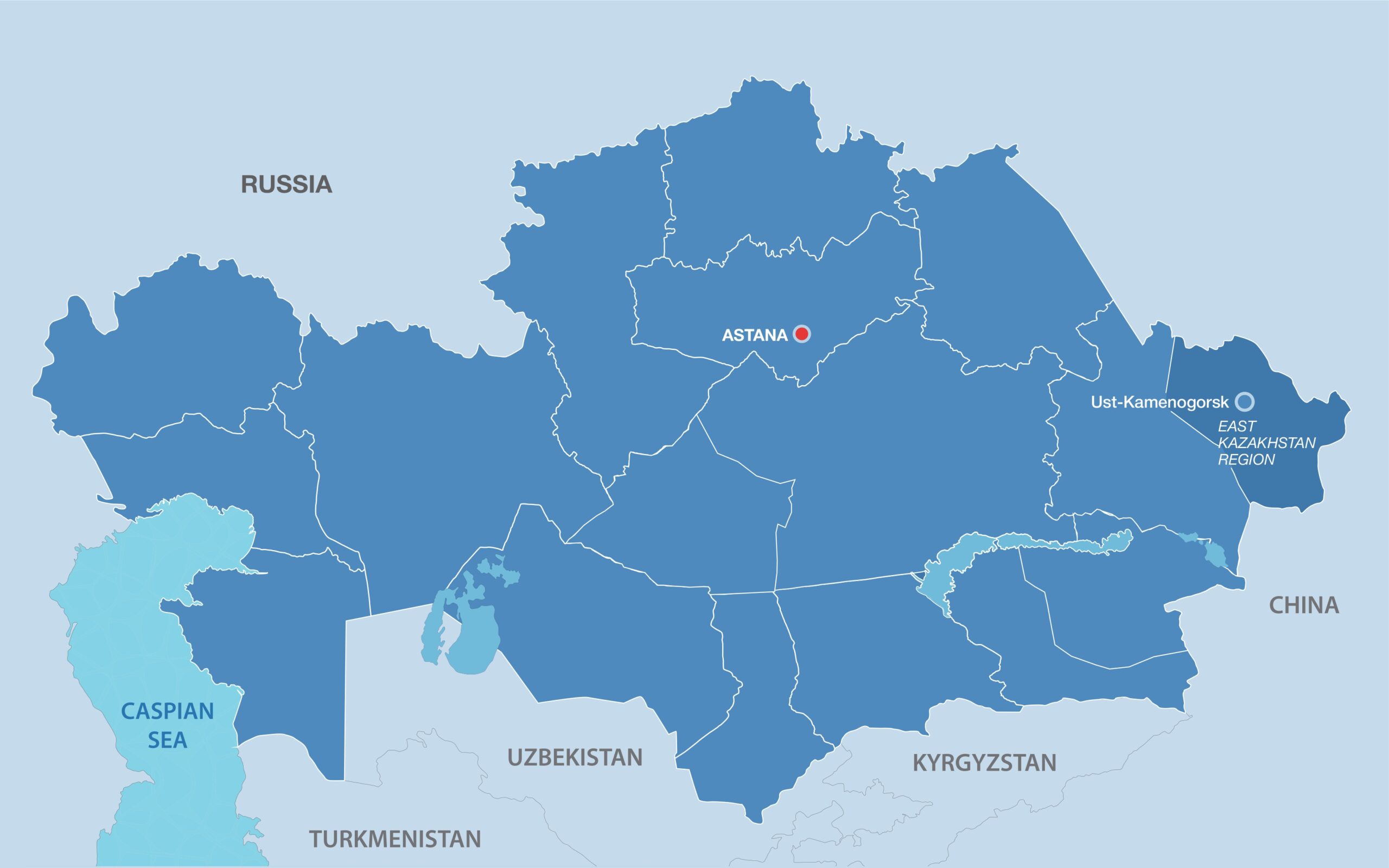
The Ulba Metallurgical Plant (UMP) in Ust-Kamenogorsk, East Kazakhstan, launches a new automated inspection line for uranium fuel pellets. Photo credit: ulba.kz Click to see the map in full size. The map is designed by The Astana Times.
The upgraded system now inspects three fuel pellets per second, using micrometer-level precision to ensure consistent dimensions and energy output.
Each pellet, weighing just 7.7 grams, generates as much energy as 700 kilograms of high-grade coal, making it an essential component of modern low-carbon energy systems, reported the plant’s press service.
Ramping up fuel assembly production
The plant has also increased annual production of fuel assemblies, the core energy-generating components of NPPs, to 300 tonnes per year, reflecting growing demand for nuclear fuel on international markets and Kazakhstan’s ambition to build its own nuclear power plant.
“We plan to maintain the current production volumes to ensure a stable supply of fuel pellets for Ulba-TVS,” said Konstantin Kuzmin, director of UMP’s uranium production division.
The factory’s facility Ulba-TVS, which produces complete reactor fuel assemblies, has reached its design output of 200 tonnes of uranium per year, placing Kazakhstan among the small group of countries capable of manufacturing nuclear fuel.
Building Kazakhstan’s full nuclear fuel cycle
Kazatomprom, the national nuclear company, noted that integrating high-tech fuel production enhances Kazakhstan’s role in the global nuclear industry.
“We are building a full, high-tech value chain and strengthening Kazakhstan’s position as a reliable partner in the nuclear sector,” said Meirzhan Yusupov, chair of the board of Kazatomprom.
Experts at the Ulba plant say they are ready to supply fuel components for the first Kazakh nuclear power plant, expected to be launched in 2035–2036, depending on the final technology choice.
“We have extensive experience, including producing pellets for French and Chinese nuclear assemblies. If it is economically viable, we can manufacture the fuel assemblies for Kazakhstan’s future NPP,” noted Vladimir Vakhnenko, first deputy chairman of the board and chief engineer at UMP.
A new stage in industrial innovation
The modernization of fuel pellet production and the commissioning of the Ulba-TVS plant mark an important stage in Kazakhstan’s development of a complete nuclear fuel cycle.
Ust-Kamenogorsk is rapidly becoming a national hub for advanced nuclear technologies, enabling the country not only to export raw uranium but to supply value-added, high-tech reactor fuel to global markets.
Earlier, Kazakhstan had started preliminary activities for the planned NPP in the village of Ulken, Zhambyl district, Almaty Region, on Aug. 8 with Rosatom leading the international consortium. The State Commission on the Atomic Industry had also identified a second prospective site for construction.
