
ASTANA – International youth voices brought fresh urgency to a Nov. 27 roundtable in Vienna on the humanitarian consequences of nuclear testing, underscoring the lived legacy of Semipalatinsk and the need for inclusive disarmament.
Photo credit: icanw.org
They joined community leaders, researchers and practitioners to examine what the Treaty on the Prohibition of Nuclear Weapons (TPNW) can deliver today and what steps are required to secure justice for affected communities.
Hosted by Dialogbüro Vienna, the Steppe Organization for Peace (STOP) and Friedrich-Ebert-Stiftung (FES) Kazakhstan, the discussion centered on recognition, remediation and amplifying the role of youth in shaping the future of disarmament.
The panel explored how youth, feminist, Indigenous and environmental perspectives reshape disarmament.
Moderated by Zhibek Toktash, a program and communications officer at the FES Kazakhstan and STOP co-founder, the discussion underscored the need for intersectional and bottom-up approaches.
“We strongly believe in bottom-up approaches. Listening to survivors, to their voices, to local leaders and young activists on the ground and letting their experiences guide. By embracing intersectionality, we can see nuclear weapons and security issues more holistically,” said Toktash.
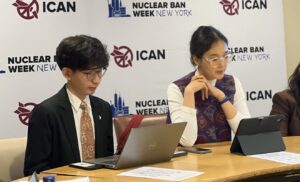
STOP founding members Alisher Khassengaliyev (on the left) and Adiya Akhmer (on the right). Photo credit: Nagima Abuova / The Astana Times
Adiya Akhmer, a founding member of STOP, highlighted that meaningful youth involvement requires moving beyond visibility-driven participation. She said symbolic participation places youth in public-facing roles without influence, while substantive participation involves youth in agenda-setting, policy development, long-term research, and work with affected communities.
“We may be young, but we are not youth experts. We are experts, and that’s it,” said Akhmer.
She added that youth advocacy should confront the lived realities of survivors — including health consequences, environmental degradation, socioeconomic marginalization and long-term emotional trauma, and that youth contributions should “amplify survivors but not overshadow them.”
“This is our commitment to continue building evidence, to stand alongside affected communities and to make sure that youth engagement and nuclear justice are not just visible but also meaningful,” she said.
Nazerke Kanatbekova, a researcher and PhD candidate at the University of Vienna, highlighted how academic research grounded in lived experience can expose gaps in state reporting and reveal complexities of intergenerational harm. She said narratives from affected communities should not be treated as anecdotal but recognized as analytical tools for shaping policy.
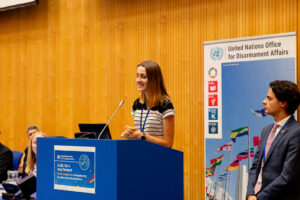
Vanda Proskova. Photo credit: Ms.Ana Moruja Nigro / Flickr
“We are not playing there with whoever has the saddest story, or whoever has the incredible story about radiation. It all has practical implications. Lived experience should be seen as analytical, because it can reveal gaps in state reporting. It can expose contradictions in official narratives. It can also identify what this community-centered approach we are talking about should look like,” said Kanatbekova.
Echoing the view, sustainable security consultant Vanda Proskova said peace and security cannot be separated from gender, environmental, or socioeconomic dimensions.
“Peace and security are incredibly intersectional. We cannot be talking about disarmament and forget about the environment. We cannot be talking about disarmament and forget about gender injustice,” said Proskova.
She added that institutions must distinguish genuine youth engagement from tokenism, emphasizing that success should be measured not by the number of youth events or social media metrics, but by whether young people meaningfully shape decisions.
“Atomic Secrets”
The program also featured the screening of “Atomic Secrets” by Zhanana Kurmasheva and The Guardian, spotlighting Ukrainian scientist Dmitry Kalmykov, who has spent his career confronting environmental disasters, including the Chornobyl and Semipalatinsk nuclear disasters. He now teaches schoolchildren how nuclear tests were conducted and why communities are still uncovering the full extent of radiation’s harm decades after the site’s closure.
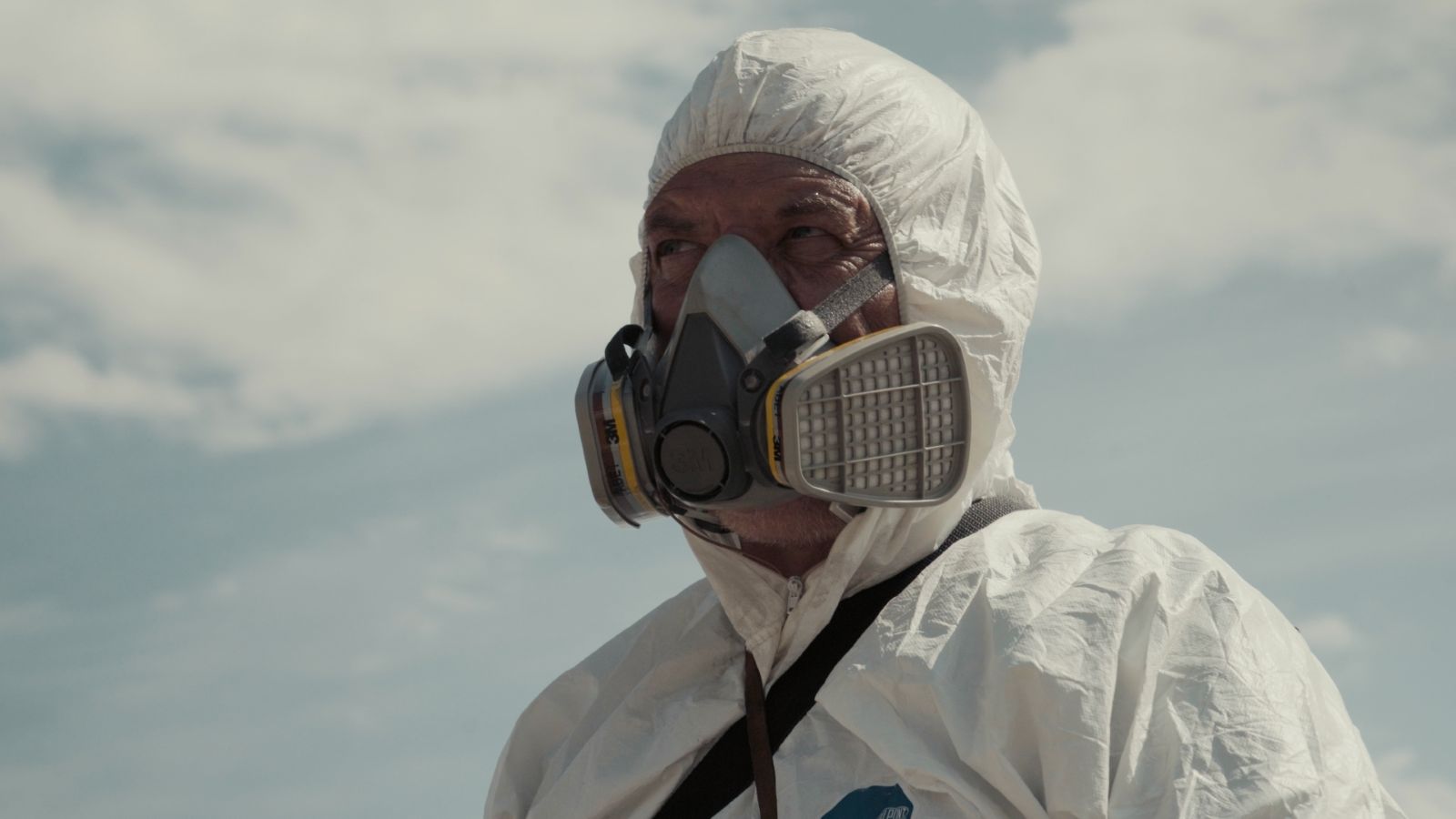
Scene from the “Atomic Secrets” by Zhanana Kurmasheva and The Guardian, spotlighting Ukrainian scientist Dmitry Kalmykov. Photo credit: povmagazine.com
“It is hard to quantify how radiation affects people. The correlation between radiation exposure and its health effects is indirect and non-linear. Radiation works statistically: if you receive a dose, it will mean that your probability of developing a serious disease increases,” said Kalmykov in the documentary.
“Nobody knows where that cow has been grazing – the same cow whose milk a mother may give to her children in the evening – how much contaminated soil or remnants of a nuclear bomb might it have come across while wandering the steppe,” he added.
