
ASTANA – Kazakhstan is participating in the United Nations Climate Change Conference in Belém, Brazil, on Nov. 10-21. Minister of Ecology and Natural Resources Yerlan Nyssanbayev leads the country’s delegation.
COP30 will run through Nov. 21. Photo credit: UN Climate Change : Lara Murillo
The UN Climate Change Conferences, known as COPs, are held annually and serve as the world’s sole multilateral platform where nearly all nations come together to make decisions on climate action.
Leaders’ Summit
World leaders, ministers, and senior officials gathered on Nov. 6 for the Leaders’ Summit to address looming climate threats and outline new commitments. Minister Nyssanbayev addressed the opening session, reaffirming Kazakhstan’s adherence to the global climate agenda and informing the international community about the country’s climate actions and measures.
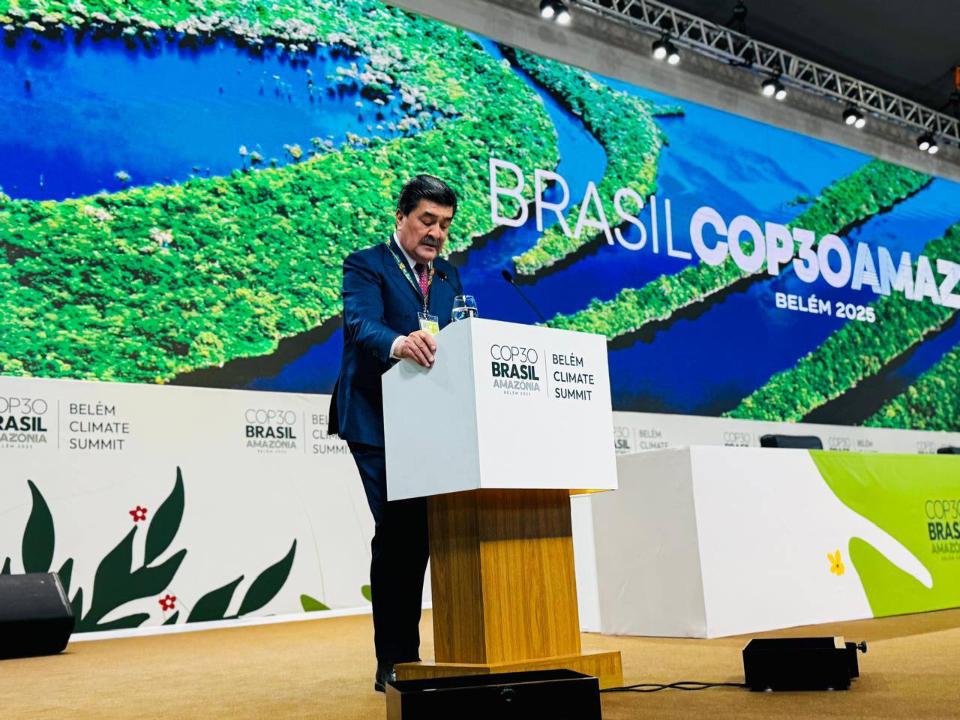
Minister Nyssanbayev addressed the Leaders’ Summit. Photo credit: Kazakh Ministry of Ecology and Natural Resources
Minister Nyssanbayev addressed the Leaders’ Summit. Photo credit: Kazakh Ministry of Ecology and Natural Resources
“It is crucial for us to consistently work toward achieving climate goals – for this reason, we have developed a Revised Nationally Determined Contribution [NDC 3.0] and a National Adaptation Plan, which include more ambitious targets for reducing emissions and adapting to climate change,” said Nyssanbayev.
“In this context, the implementation of the New Collective Climate Finance Goal aimed at mobilizing significantly increased climate funding and adopting the Baku-Belém Roadmap 1.3T, which envisages attracting up to $.3 trillion annually by 2035, gains great importance for developing countries,” said the minister.
Nyssanbayev also invited delegates to attend the Regional Environmental Summit to be held in Kazakhstan in 2026.
The Leaders’ Summit in Belém has raised $5.5 billion for the Tropical Forests Forever Facility, a fund that rewards rainforest protection. Delegates also pledged to strengthen indigenous land rights, scale up sustainable fuel production fourfold, and tie climate action more directly to efforts to combat hunger, poverty, and environmental racism.
Opening of COP30
The conference kicked off its work on Nov. 10 under Brazil’s presidency this year.
“This is the moment to match opportunity with urgency,” said Brazil’s President Luiz Inácio Lula da Silva, urging the world to reject climate denial and accelerate efforts to keep the 1.5 degrees Celsius target within reach.
COP30 President and Ambassador Andre Correa do Lago said the world gathered in Belém to “try to change things.” “I deeply believe that the human being is essentially good, but we also know that he is capable of terrible things, such as war, which, unfortunately, has again come close to so many people. But human beings have done and continue to do extraordinary things, and the thought that we can improve people’s lives is what inspires us,” he said at the opening of the conference.
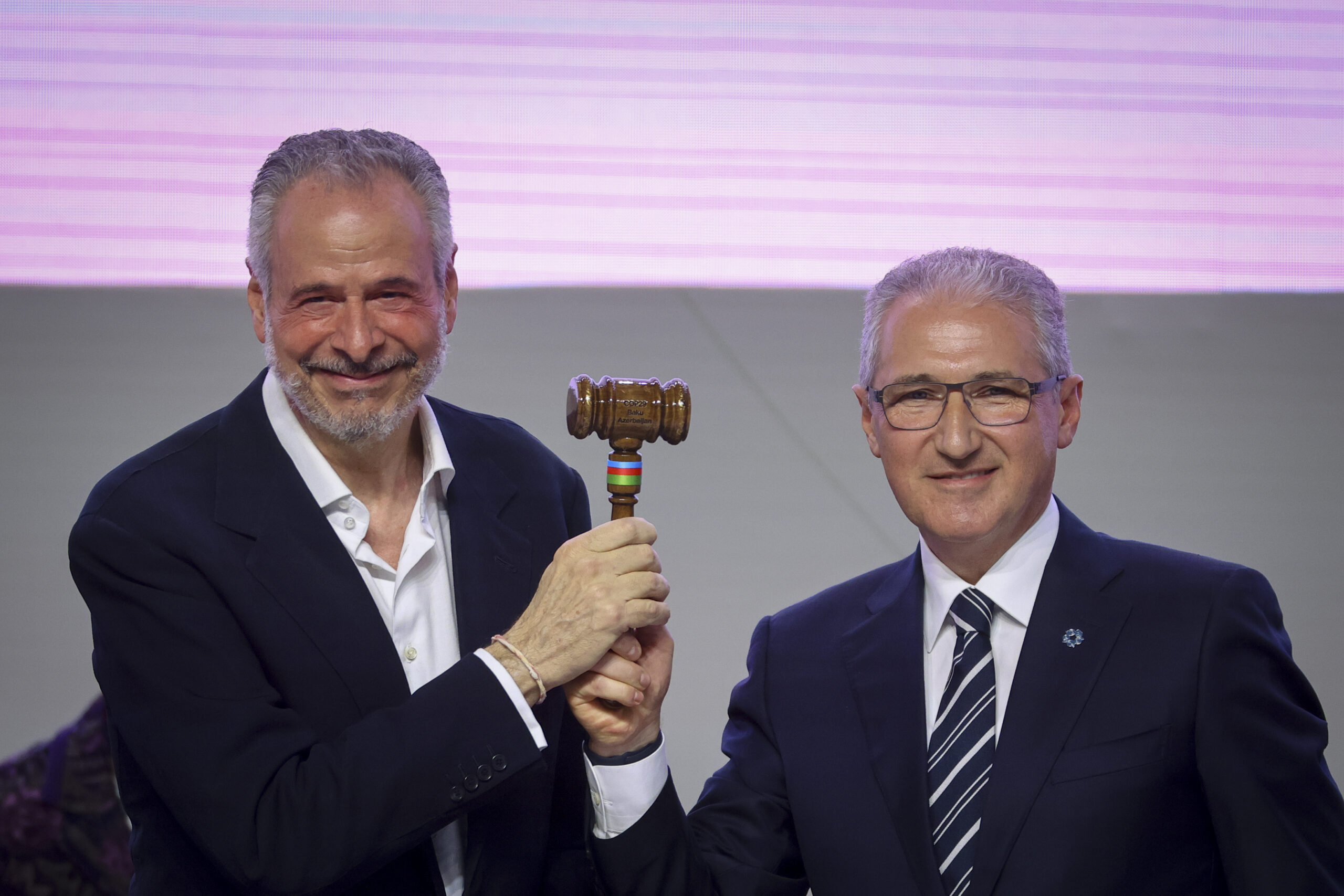
Ambassador Andre Correa do Lago, president of COP 30 greets Mukhtar Babayev, presidente da COP 29 during the opening ceremony of the 30th Conference of the Parties (COP30). Photo by Ueslei Marcelino:COP30
“Science, education, and culture are the path that we must follow. And, for combating climate change, multilateralism is definitely the way,” he added.
Correa do Lago stressed that the Paris Agreement was adopted a decade ago, when the world was on track for more than 4 degrees Celsius of warming. While projections have fallen sharply since then, Correa do Lago noted the world still falls far short of what is needed.
“This is, therefore, a moment of several celebrations, but we must receive them with humility and realism, because there are still many things missing,” he added.
On Nov. 5, Andre Correa do Lago and COP29 President Mukhtar Babayev presented the Baku to Belém Roadmap, aimed at mobilizing at least $1.3 trillion annually in climate finance for developing countries by 2035. They said this target is within reach, but will require greater effort, including the development of innovative financial mechanisms.
“We need to act and the time is now. The 2030 and 2035 climate commitments give us a rare chance to turn promises into real, sustainable development—protecting the planet while creating jobs, strengthening communities, and ensuring prosperity for all,” said Babayev, who spoke to The Astana Times in June on the key takeaways from COP29 in Baku in November 2024.
The document identified five priority action fronts through 2035. They include boosting grant and concessional financing, easing fiscal pressures and improving debt sustainability, mobilizing private capital, strengthening capacity and coordination to scale climate portfolios and reforming systems to ensure fairer, more equitable capital flows.
Addressing the opening of COP30, UN Climate Change Executive Secretary Simon Stiell highlighted the urgency of stronger international cooperation.
“We don’t need to wait for late NDCs to slowly trickle in, to spot the gap and design the innovations necessary to tackle it. Not one single nation among you can afford this, as climate disasters rip double-digits off GDP,” Stiell said.
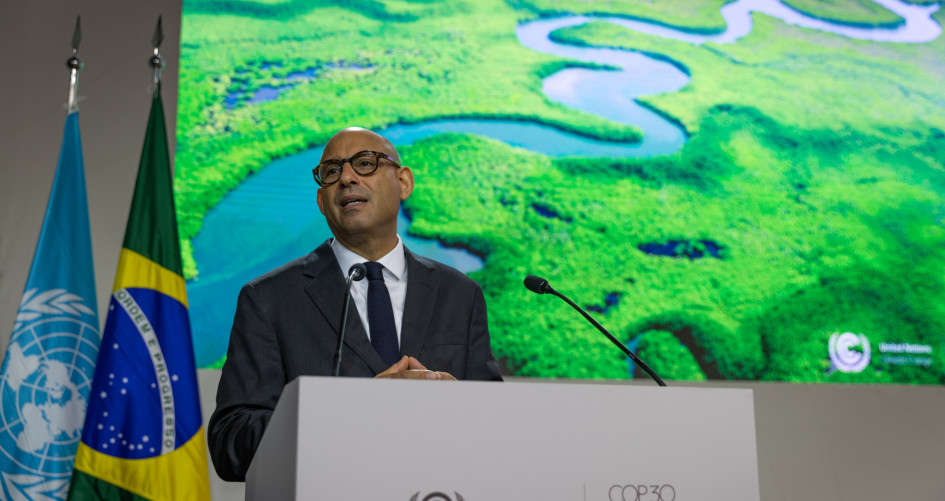
UN Climate Change Executive Secretary Simon Stiell at the opening plenary of COP30. Photo credit: Kiara Worth | UN Climate Change
He stressed several milestones that need further action. The transition from fossil fuels should be done fairly and orderly, “focusing on which deals to strike, to accelerate the tripling of renewables and doubling energy efficiency.”
The same enthusiasm should be applied to pledges to deliver at least $300 billion in climate finance and start moving towards $1.3 trillion, as per the Baku-Belém roadmap.
Among other priorities, he underscored tripling global renewable energy capacity and doubling energy-efficiency gains, adopting a global set of adaptation indicators, and pushing forward the Just Transition Work Program and the Technology Implementation Program.
Because COP negotiations are often contentious, Stiell reminded the delegates that their job is “not to fight one another.”
“Your job here is to fight this climate crisis, together,” he added.
Off track
This year is particularly symbolic as it marks 10 years since the adoption of the Paris Agreement. Yet the world is on the brink of failing to meet the targets.
Last year was reported to be the hottest year on record. The latest Emissions Gap Report from the UN Environmental Program indicates that the world remains far off track from the Paris goal of keeping temperatures well below 2 degrees Celsius, while striving to limit warming to 1.5 degrees.
According to the report, just 60 parties, representing 63% of global emission, had submitted or announced updated Nationally Determined Contributions by Sept. 30, underscoring the slow pace of new pledges.
It also warns that countries are not on course to meet their existing 2030 commitments, widening an already significant implementation gap well before 2035 targets come into play.
“Nations have had three attempts to deliver promises made under the Paris Agreement, and each time they have landed off target,” said UNEP Executive Director Inger Andersen. “While national climate plans have delivered some progress, it is nowhere near fast enough, which is why we still need unprecedented emissions cuts in an increasingly tight window, with an increasingly challenging geopolitical backdrop.”
“But it is still possible – just. Proven solutions already exist. From the rapid growth in cheap renewable energy to tackling methane emissions, we know what needs to be done. Now is the time for countries to go all in and invest in their future with ambitious climate action – action that delivers faster economic growth, better human health, more jobs, energy security and resilience,” she explained.
Pushing for information integrity in climate action
Among the key highlights of the conference was the Declaration on Information Integrity on Climate Change unveiled by the Global Initiative for Information Integrity on Climate Change on Nov. 12.
The declaration urges governments, businesses, civil society, academia and donors to step up efforts against the rise of disinformation, denialism and targeted attacks on environmental journalists, activists, scientists and researchers that erode climate action and pose risks to broader social stability.
“We must fight mis- and disinformation, online harassment, and greenwashing,” said UN Secretary-General António Guterres.
“Through the Global Initiative for Information Integrity on Climate Change, governments and organizations are working together to fund research and action promoting information integrity on climate issues. Scientists and researchers should never fear telling the truth,”he said.
In more concrete priorities, the declaration is aimed at promoting integrity of information in climate change per international human rights laws, support a diverse and resilient media ecosystem to ensure accurate and reliable coverage, foster “informed and inclusive” climate action by advancing equitable access to accurate, evidence-based information for all. With global resources falling far short, governments are encouraged to fund research on climate information integrity, particularly in developing nations.
Officials express hope for climate multilaterism delivering progress, though not at a pace desired by many. Some milestones in efforts to scale up renewable energy were underlined by the delegates. Notably, last year, global clean energy investment surpassed $2 trillion, and nearly 90% of all new power capacity came from renewables.
