
ASTANA – Kazakhstan’s push for investment and continued subsidized lending through state-owned enterprises is keeping the broader public sector on an expansionary path, offsetting budget tightening and fueling demand, a key reason inflation is expected to remain elevated, said Ali Al-Eyd, head of the International Monetary Fund (IMF) mission to Kazakhstan, at a Nov. 19 press conference in Astana on the Article IV consultations with the country.
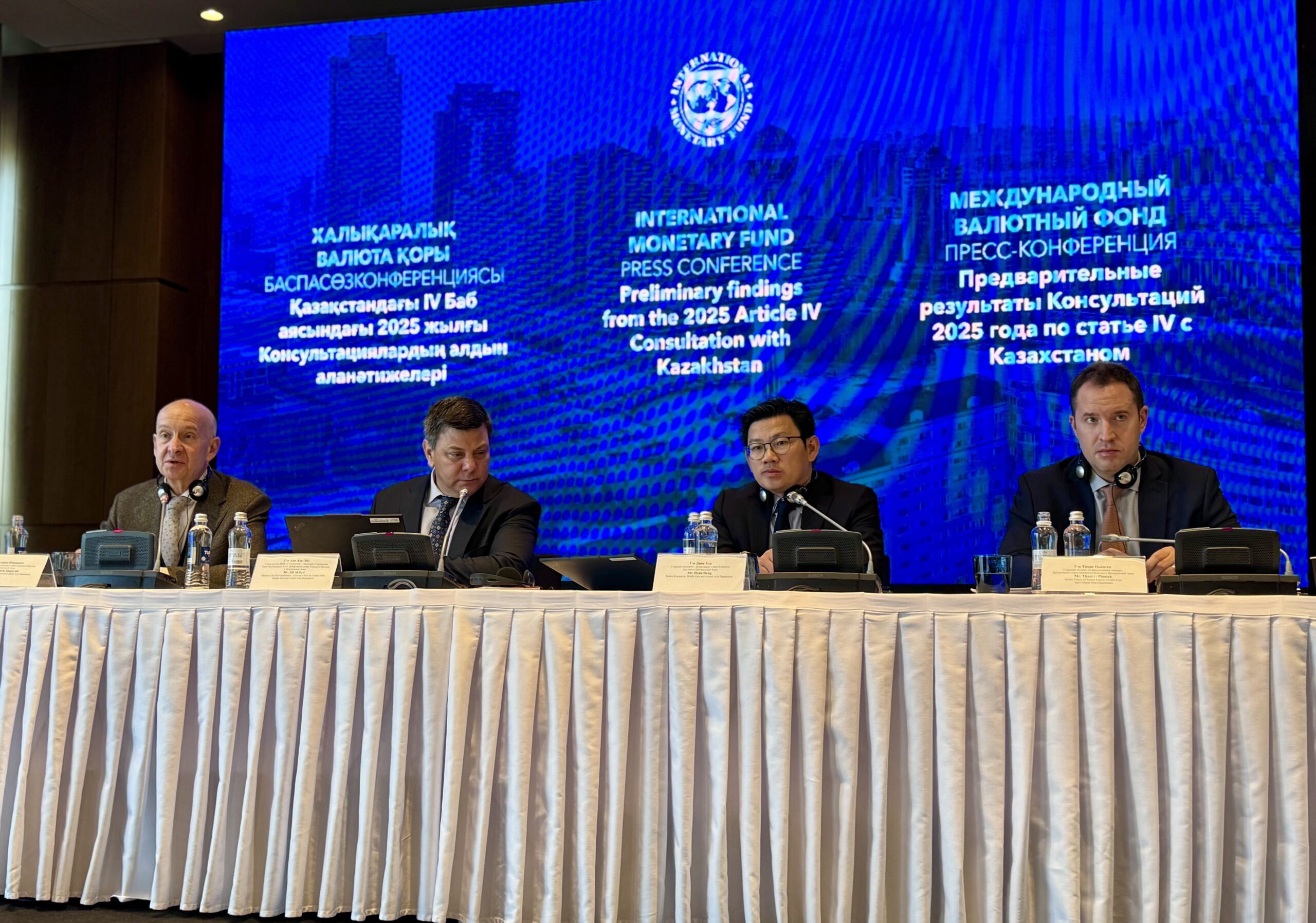
From L to R: Gregorio Impavido, Ali Al-Eyd, Dyna Heng and Thomas Piontek. Photo credit: Assel Satubaldina/ The Astana Times
“Currently, we see very strong growth in Kazakhstan. We project real GDP growth in 2025 to be just over 6% and we expect growth to remain strong next year at around 4.5%,” said Ali Al-Eyd, who took on this role in February.
“This picture reflects continued strong output in the oil sector, as well as strong domestic demand, which is driven by a number of factors, including consumer spending, manufacturing, transport and investment, and, of course, loose fiscal stance and public sector spending, particularly driven by state-owned enterprises,” he said.
IMF expects inflation to be close to 13% by the year’s end and narrow down to 11% by the end of 2026. “We see that inflation pressures come from several sources, including strong domestic demand, which I have mentioned, higher prices for imported goods, and temporary factors such as utility price increases and planned tax reforms in the next year,” he said.
Al-Eyd stressed that tighter monetary policy should be matched by stricter fiscal discipline to cool demand. The current fiscal stance remains loose, he added.
“This will result in a non-oil fiscal deficit of just over 8% of GDP in 2025, and we project this deficit to narrow slightly in 2026, including as a result of the planned tax reforms and the broader consolidation measures that the government has announced, which we, of course, support and expect to lift non-oil revenue sources,” he said.
“Given the strong overall demand in the economy, we expect the current account deficit to remain large, increasing to around 4% of GDP in 2025, and to decline only slightly in 2026,” he added.
Tight policy of the central bank
IMF welcomed the recent decision of the National Bank to raise the base rate to 18%.
“We encourage this stance to remain tight until inflation comes back down towards the target. And the central bank should remain ready to tighten rates further if inflation increases again, because this is its job, and it needs to do this to bring inflation down,” Al-Eyd said.
Rapid growth in consumer debt
IMF officials raised concerns about rising consumer debt. “We know that consumer credit growth is quite rapid here in Kazakhstan, and this poses challenges and risks for household indebtedness. This also contributes to demand in the economy and demand for imports. This, of course, contributes to the current account deficit as well,” said Al-Eyd.
Latest figures from the National Bank of Kazakhstan indicate that loans to the economy reached 48.6 trillion tenge (US$93.4 billion) as of Oct. 1, 2025, up 23.9% from a year earlier. Businesses accounted for 22.7 trillion tenge (US$43.6 billion), or 46.8% of total lending, while household loans reached 25.9 trillion tenge (US$49.8 billion), or 53.2%.
The IMF chief said the fund welcomes a three-year package of measures prepared by the Kazakh government, the National Bank, and the Agency for Regulation and Development of the Financial Market aimed at macroeconomic stabilization and improving public welfare.
The document, presented at a Nov. 19 government meeting, outlines measures aimed at supporting household incomes, ensuring higher-quality growth, boosting non-resource exports, advancing digitalization and AI, improving investment and tariff policies, curbing inflation and reducing the state’s share in the economy.
Al-Eyd expressed hope these measures will help bring down the consumer credit levels and “ease some of those demand pressures in the economy and ensure that household indebtedness does not become too much to bear.”
“This is also a key component of the overall policy mix when I discuss tight monetary policy, restricted fiscal policy, and targeted and gradual spending by state-owned enterprises. This is another component that can help cool the economy down and reduce inflation pressures. But I would like to stress that such prudential measures should not be used to replace the need for higher interest rates to cool inflation. That is the main tool that the central bank has and should use. And these prudential measures should be focused on ensuring financial stability,” he explained.
Government debt

Dyna Heng. Photo credit: Assel Satubaldina/ The Astana Times
According to Dyna Heng, senior economist for the Middle East and Central Asia, Kazakhstan’s government debt remains low. “It looks sustainable given the current level of about 25% of GDP. We don’t have a concern on that front,” he told journalists.
He, however, cautioned that government borrowing should be efficient.
“The borrowed money should be used efficiently, and that means the government should spend on the right thing, in the right way, in the right time, given the inflationary environment and in the right amount,” Heng said.
“What matters the most is your ability to produce efficiently and how you put capital and your population in the right way so that you can have a higher potential growth in the future,” he added.
Policy recommendations
Moving to policy recommendations, the IMF chief reiterated the further focus on structural reforms.
“We see the implementation of these as critical to raising the economy’s trend growth level. This means the ability of the economy to grow at higher levels, but with lower inflation,” said Al-Eyd.
IMF urged Kazakhstan to focus on reforms to boost productivity, including further investments in health, education, digitalization, and infrastructure, as well as additional efforts to strengthen the private sector and reduce the state’s role in the economy.
“In the medium term and long term, these are the factors that are key to delivering the country’s higher growth and higher living standards,” he said.
Reiterating the importance of monetary and fiscal policies pulling in the same direction, Al-Eyd said it is a “crucial step to ensuring a more sustainable growth path for the economy.”
Tax reforms
IMF also supported the country’s tax reforms.
“In fact, it is necessary for the government to increase its sources of revenue from non-oil sectors, because this is important for Kazakhstan’s long-term fiscal sustainability. In the near term, as these reforms come into shape, they have to be as effective as possible. That means reducing the number of exemptions that can be counted against the taxes,” Al-Eyd said.
“Currently, the plans are for VAT [value-added tax] to go from 12% to 16%. But within that, there will be a number of deductions for certain businesses, certain activities. What we are saying is we should reduce the amount of deductions and exemptions in order to make the reforms most effective,” he said.
Dyna Heng went on to say that those tax exemptions were initially designed to attract foreign direct investment. Over the years, the list has grown to nearly 1,000 items.
“With the new Tax Code from next year, we see that the government is making efforts to reduce tax exemptions by about one-third of that,” he said, adding that they cover capital expenditures and corporate income tax breaks in selected industries.
Heng expects that, as the business climate improves, Kazakhstan will no longer need to rely on tax exemptions to attract investors.
Digital assets
Joining his colleagues, Thomas Piontek, a senior financial sector expert, welcomed Kazakhstan’s efforts to scale measures to develop digital assets.
“We welcome efforts across all agencies, specifically the regulators, and also the AIFC [Astana International Financial Centre] on coordination around the opening up of these products across the country itself – the digital tenge efforts, stable coins, tokenized assets that are all being introduced and brought to a broader population,” Piontek said.
He warned that regulation should keep pace with the rapid adoption of these assets. That requires coordinated work across all agencies. onshore and within the AIFC, as well as with national regulators and other jurisdictions.
“Building this regulatory framework will help protect consumers, avoid fraud, and help sort of the gradual adoption of these assets and be implemented both in the economy and the financial system and be safe for use across the country,” he added.
The full report with key findings is expected to be published in February 2026. Al-Eyd said Kazakhstan is in a “fortunate position” as it is capable of “withstanding headwinds in the global economy.”
“Because it has a strong balance sheet, but our overall message is to make sure that both monetary policy, fiscal policy, and quasi-fiscal policy are working together,” he added.
In early November, The Astana Times journalist Aida Haidar spoke with Jihad Azour, director of the IMF’s Middle East and Central Asia Department, about the region’s economic prospects.
