
ROME — Kazakhstan presented its second national trade-facilitation report on Nov. 11, outlining reforms for 2023-2025 to digitize foreign trade and modernize the Trans-Caspian International Transport Route (TITR), also known as the Middle Corridor. The report, prepared by the Ministry of Trade and Integration and QazTrade, details the country’s progress in digitalization, customs automation and cross-border connectivity.
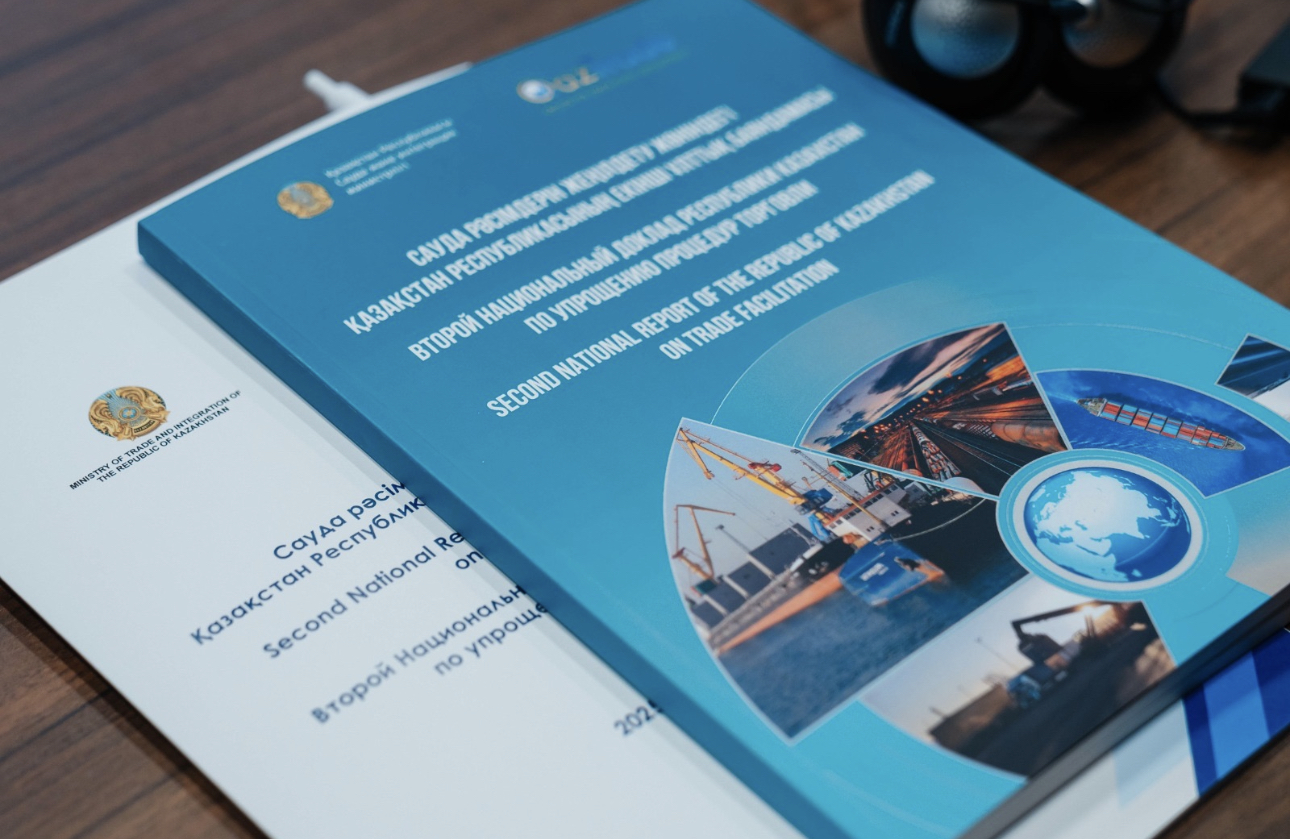
Second national report of Kazakhstan on trade-facilitation, with special emphasis on the TITR. Photo credit: QazTrade
The document reviews efforts to simplify procedures, deploy advanced digital tools and strengthen supply-chain sustainability along routes connecting Asia and Europe. It positions Kazakhstan as an emerging leader in building a transparent, predictable and environmentally responsible trade environment.
Digital progress and institutional reforms
Vice Minister of Trade and Integration Zhanel Kushukova said that according to the United Nations survey, Kazakhstan’s overall trade-facilitation score rose to 76.34% in 2025, up from 70.97% in 2021 and 36.56% in 2015, reflecting steady improvements in business predictability.
“The deepening of economic fragmentation, the escalation of trade wars, and the rise of protectionist rhetoric among major economies is shaping a new geo-economic reality. (…) The development of the Trans-Caspian Corridor is viewed not merely as a transport initiative but as a cornerstone for building the region’s strategic autonomy amid the realities of a new trade era,” wrote Kushukova in the report’s preface.
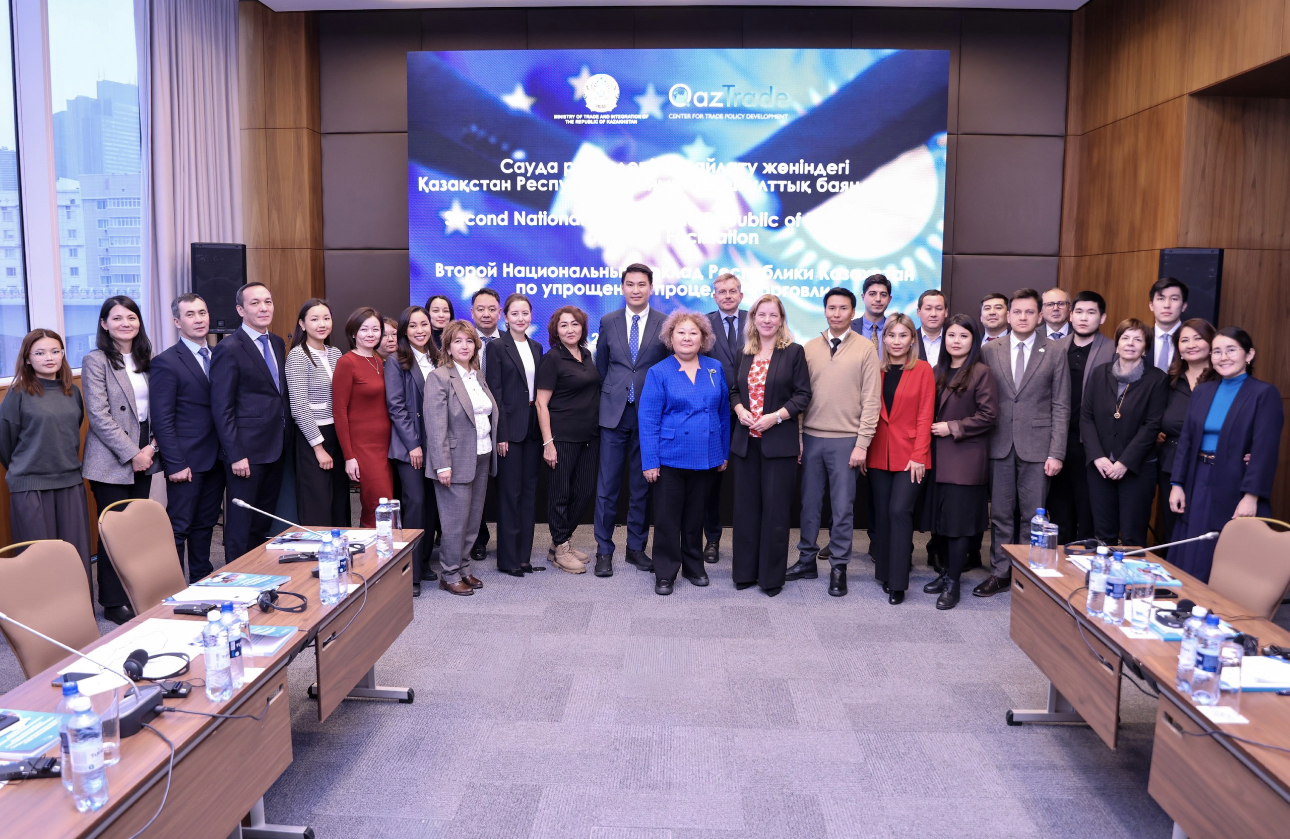
The report, prepared by the Ministry of Trade and Integration and QazTrade, outlines recent progress in digitalization, customs automation and cross-border connectivity. Photo credit:Qaztrade
UN data also show advances in digitalization. Paperless trade implementation increased from 29.6% in 2015 to 66.7% in 2025, and cross-border paperless procedures rose from 11% to 61.1% over the same period.
European Union Ambassador Aleška Simkić underscored Kazakhstan’s growing regional role.
“This corridor is more than a trade route. It is a pathway for digital, green, and sustainable connectivity,” she said.
Digital by Default model: KEDEN and CART.IS
QazTrade Deputy Director General Nurlan Kulbatyrov presented the CART.IS (Cartography of Information Systems) initiative, developed with the International Trade Center (ITC).

QazTrade Deputy Director General Nurlan Kulbatyrov during the presentation in Astana on Nov.11. Photo credit: Qaztrade
The system maps all government IT platforms involved in trade, identifies inefficiencies and supports the creation of a unified digital architecture for faster, more transparent cross-border operations.
Mapping revealed 27 government services tied to export, import, and transit procedures, 81% of which are electronic, and 15 state information systems requiring deeper integration. Digital cartography identified duplicate data flows and gaps in system compatibility between customs, food-safety and agricultural inspection services, and transport agencies.
“Trade facilitation and the development of the Middle Corridor are systemic strategies, not one-off initiatives. Kazakhstan is betting on digital integration, infrastructure development, and international partnerships so that the TITR becomes a full-fledged platform for regional integration and green growth,” said Kulbatyrov.
Under the Digital by Default principle, Kazakhstan is overhauling customs through the KEDEN national integrated platform, which automates declarations, connects government databases and minimizes human involvement. Since launch, KEDEN has processed more than 446,000 transit notifications and 397,000 declarations.
Its AI-based modules automatically classify goods. At the moment, the system includes 1,100 registered customs operators and more than 6,200 active users. Digital inspection reports, electronic permits, automated security guarantees, and other tools now used through the KEDEN system have eliminated the need for paper inside customs offices.
Kazakhstan is also digitizing CT-1 and CT-3 certificates, which confirm product origin under regional trade agreements, and ATA carnets, so-called international passports for temporarily imported goods. These documents are being integrated into the national e-permit and customs systems for full electronic issuance, verification and exchange.
The country is advancing cross-border paperless exchange with regional partners through pilot projects such as electronic phytosanitary certificates (ePhyto) with Uzbekistan and electronic certificates of origin (e-CO) with Tajikistan.
Faster transit, smarter borders
Kazakhstan’s border-management system, CarGoRuqsat (cargo permit), now provides electronic queuing for trucks, eliminating manual scheduling. Combined with smart customs monitoring, average processing times at checkpoints were reduced to 15 minutes for transit shipments and under an hour for imports.
The platform has 96,294 registered users, has processed more than 1.27 million bookings, and integrates 17 state systems across 34 border-crossing points.
Modernization of the Aktau and Kuryk ports on the Caspian Sea and the expansion of dry port hubs have boosted TITR’s capacity. Delivery times along the corridor fell from 38-53 days in 2022 to 12-18 days in 2024, and as short as nine days on specific sections such as the China-Kazakhstan-Caspian Sea route.
According to the State Revenue Committee of the Ministry of Finance, Kazakhstan processed 23,800 digital railway transit declarations on the Altynkol-Saryagash route and 6,700 on the Altynkol-seaport route. Processing time for a single container has dropped from three hours to five minutes. In the first half of 2025, more than 59,000 railway transit declarations were processed digitally, reducing errors and railcar idle time.
Green logistics and integration into global value chains
Kazakhstan is embedding green standards across transport and logistics by upgrading port equipment, expanding rail-sea transport and introducing digital tools for emission tracking. These steps support Kazakhstan’s strategy for carbon neutrality by 2060 and help exporters prepare for the EU carbon border adjustment mechanism (CBAM), which applies carbon-based tariffs to certain imports.
These efforts are reinforced through partnerships with international organizations, which help introduce alternative fuels, improve energy efficiency and apply eco-standards across supply chains. Together, they strengthen the Middle Corridor’s reputation as a green route.
Kazakhstan continues to expand its cooperation with international organizations, including the Organisation for Economic Co-operation and Development (OECD), the United Nations Economic and Social Commission for Asia and the Pacific (ESCAP), the Asian Development Bank (ADB), and the Central Asia Regional Economic Cooperation (CAREC) program.
Through the Ready4Trade Central Asia and GIZ programs, Kazakhstan and its neighbors are piloting electronic certificates and strengthening shared digital standards to improve regional cross-border trade.
