
ASTANA – European officials say Central Asia’s transport expansion should go hand in hand with workforce development, as both areas are emerging as key pillars in Central Asia’s growing engagement with the European Union.
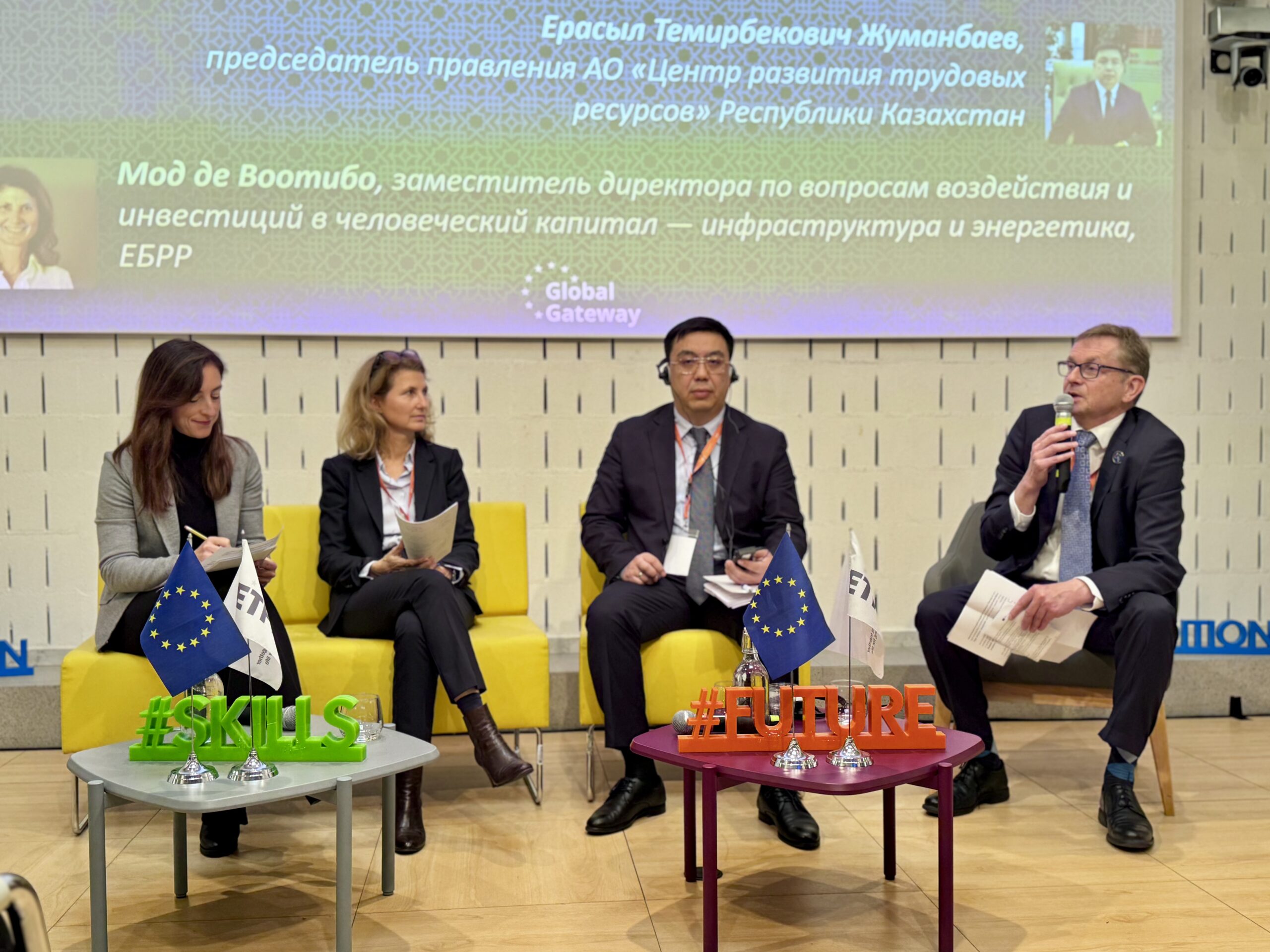
From L to R: Donatella di Vozzo from ETF; Maud de Vautibault; Yerassyl Zhumanbayev, chairman of Kazakhstan’s Workforce Development Center; Johannes Baur. Photo credit: Assel Satubaldina/ The Astana Times
Transport has become one of the core priorities in Central Asia – EU cooperation, a focus reaffirmed at the first EU–Central Asia Summit in April in Samarkand.
“Why is this? Of course, we need to link each other, the European Union, and Central Asia better, to increase and to exploit our economic potential. For that, we need a functioning transport corridor. Therefore, the Trans-Caspian transport corridor has been decided by the leaders of the European Union and by the leaders in Central Asia as one of the key priorities,” said Johannes Baur, head of cooperation at the EU Delegation to Kazakhstan, as he addressed a panel session as part of the high-level meeting of the DARYA project in Turin in October.
Baur explained that Central Asia’s historical role in global transport has been limited, with low containerization levels, a landlocked position, and a legacy of Soviet-era infrastructure weakening its integration into global markets. Strengthening connections with the EU, he added, requires addressing these structural gaps.
A second driver is geopolitical. “Most of the land transport from Asia to Europe has been going through what we call the Northern Corridor from China through Kazakhstan, via Russia to Europe. Following the geopolitical events, this corridor cannot be used by anyone, in particular, by European companies who need to be careful with the sanction regime,” he said.
That has pushed Brussels to accelerate work on an alternative route via the Trans-Caspian corridor, an important part of the EU’s efforts in the region under its flagship Global Gateway program.
In June last year, the EU launched a coordination platform to support the corridor’s development. The goal is to create a sustained, long-term framework for dialogue.
Baur stressed that skills development is central to this effort. European companies investing in the region will rely on local labour rather than imported workers, creating demand for new qualifications in transport, logistics, and digital systems. “The third aspect is for the skill system itself. They have to be flexible,” Baur added.
With rapid changes driven by digitization and artificial intelligence, the region’s technical and vocational education systems must become far more adaptable, he said, describing this as a challenge not only for Central Asia but for Europe itself.
EBRD’s ongoing investments
Maud de Vautibault, associate director for Impact & Human Capital Investing at the European Bank for Reconstruction and Development (EBRD), said human capital is becoming central to the bank’s investments in Central Asia, particularly as the region’s transport and logistics sectors expand. She noted that the bank invested 2.26 billion euros across 121 infrastructure and energy projects in Central Asia in 2024, underscoring its long-standing footprint in the region.
Looking forward, EBRD expects major skills needs across the region’s green transition, including hydrogen, renewables and battery value chains.
Human capital, Vautibault said, is one of the bank’s core strategic pillars. When approaching new investments, whether with national railway companies, transport ministries, or private logistics operators, the bank evaluates how skills development can be built into the project.
Vautibault also highlighted several ongoing initiatives aimed at widening access to skills.
“We do a lot of cooperation with academia in Central Asia, for example, with specific technical skills for women. (…) We also support entrepreneurship and access to skills through SME finance, under the flagship program of EBRD, Women in Business, Youth in Business,” she explained.
Digital skills are another priority. “We also equip workers with needed skills for the future in the digital economies, and one example is a mechatronics training at Karaganda Technical University in Kazakhstan,” she added.
She mentioned EBRD’s $40 million loan to Eastcomtrans, the country’s largest private rolling-stock operator, in December 2023. “EBRD developed a technical assistance to upgrade training programs and logistics in partnership with two TVET colleges and promote STEM education and career opportunities in transport and logistics for women, and develop and upgrade national occupational skills for two professions and introduce equal opportunity policies and processes,” she explained.
Vautibault also mentioned the bank’s recent investments in the Kambarata-1 hydropower project. “On the back of this project, just to give you one insight, is that the World Bank, a leading financier, changed its procurement rule, and now there will be an obligation that 30% of the workforce to build this new infrastructure will have to be a local labor workforce,” she said.
Local companies, she noted, may not become main contractors, but they will need the capacity to supply goods and services further down the value chain.
