
ASTANA – Kazakhstan has seen positive improvements in its education system, according to the latest Teaching and Learning International Survey (TALIS) by the Organization for Economic Cooperation and Development (OECD), published on Oct. 7.
Photo credit: gov.kz
The survey assessed the educational environment, teachers’ working conditions, professional development, teaching practices and professional beliefs. More than 7,000 teachers and 369 school principals across Kazakhstan participated in the study.
Teachers’ profiles and skills
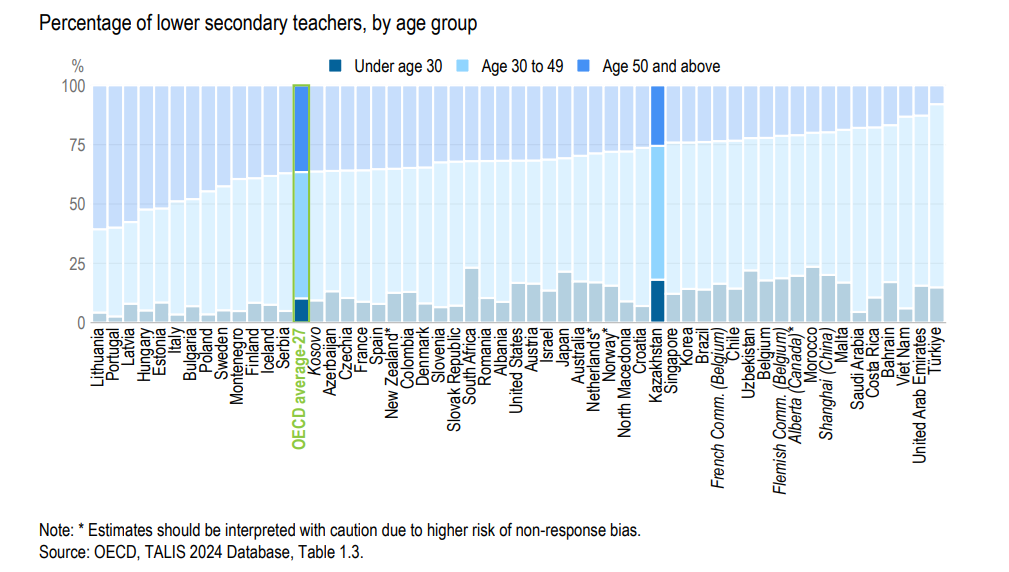
In Kazakhstan, the average teacher is 41 years old, younger than the average age of teachers across OECD countries and territories with available data. Approximately 25% of teachers are 50 years old or older, while 18% are under 30 years old. Women make up 78% of teachers, compared to the OECD average of 70%.
Teachers’ professional outcomes. Photo credit: oecd.org
Social and emotional skills play an important role in student success. The survey highlights that 78% of Kazakh teachers feel confident supporting students’ social and emotional learning, and 84% are comfortable teaching these skills.
The share of teachers who said they frequently or always help students understand their own emotions reached 86%, well above the OECD average of 68%. Meanwhile, 91% said they help students develop empathy for others, compared to the OECD average of 82%.
Use of artificial intelligence in education
Kazakh teachers are also ahead in using artificial intelligence in their work, with 59% reporting the use of AI tools compared to the OECD average of 36%.
Teachers’ age Photo credit: oecd.org
Teachers primarily use AI to learn and summarize topics (87%), design lesson plans and activities (79%), and assist students in practicing new skills (76%). Less frequent uses include analyzing student performance data (66%), supporting students with special education needs (65%), and generating feedback or communicating with parents (59%).
Among those who did not use AI, 51% reported a lack of skills, which is lower than the OECD average of 75%. Additionally, 61% stated that their schools lacked the necessary infrastructure, a figure higher than the OECD average of 37%.
Quality of teacher training and development
According to the survey, 90% of new teachers in Kazakhstan, who completed initial training within the past five years, rated their education as high quality, exceeding the OECD average of 75%.
Among new teachers, 69% said their training prepared them well in subject content, 76% in general pedagogy, 49% in teaching in multilingual environments, 72% in using digital tools, and 74% in supporting students’ social and emotional development.
Around 64% of all teachers reported that professional learning activities over the past year had a positive impact on their teaching, which is higher than the OECD average of 55%. The most common areas where teachers want more training include curriculum knowledge (49%), integrating digital resources (47%), and improving technical digital skills (47%).
The main barriers to professional learning were cost (40%), lack of time due to other commitments (34%), and conflicts between professional learning and work schedules (26%).
Teacher satisfaction and workload
An overwhelming 97% of teachers reported that students and teachers get along well, which is slightly above the OECD average. Around 76% of respondents reported that teachers are valued by students, which is higher than the OECD average of 71%.
According to Zhuldyz Suleimenova, Kazakh Minister of Education, TALIS is the only large-scale international study focused on improving learning environments and teacher conditions.
“Compared to 2018, Kazakh teachers now spend less time on administrative tasks and more time teaching and interacting with parents. Teacher satisfaction with their profession and working conditions has also risen significantly,” she said.
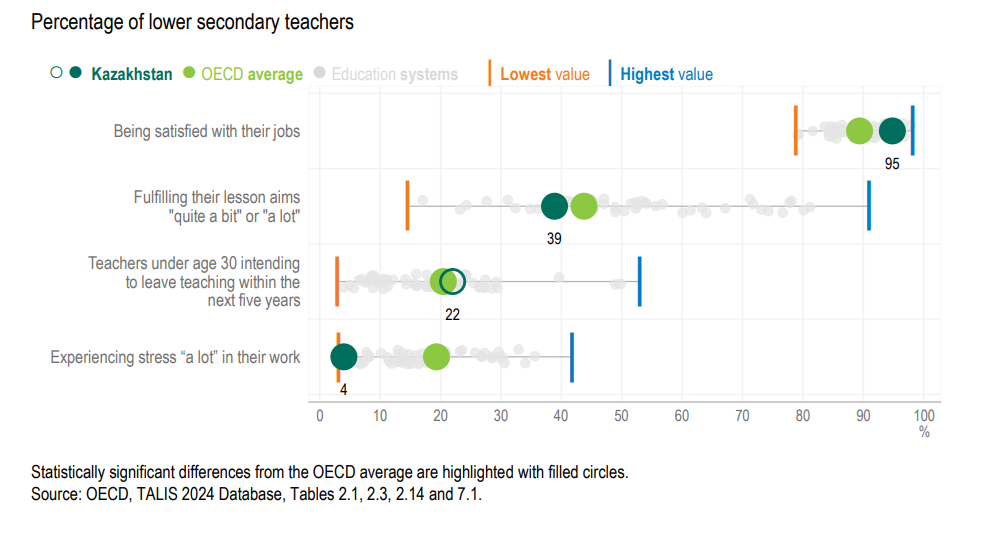
The average weekly workload for Kazakh teachers is now 36 hours, down from 50 hours in 2018, one of the sharpest reductions among OECD countries.
Teachers also report higher satisfaction levels: 95% said they are satisfied with their job, and 80% would choose the teaching profession again.
