
ASTANA – Kazakhstan’s TrustExam.ai transforms how the world takes exams with its advanced AI supervision technology. The independent startup, which has grown without outside investment, recently won a $25,000 prize at the Astana Hub Battle for its innovative approach to secure online testing.
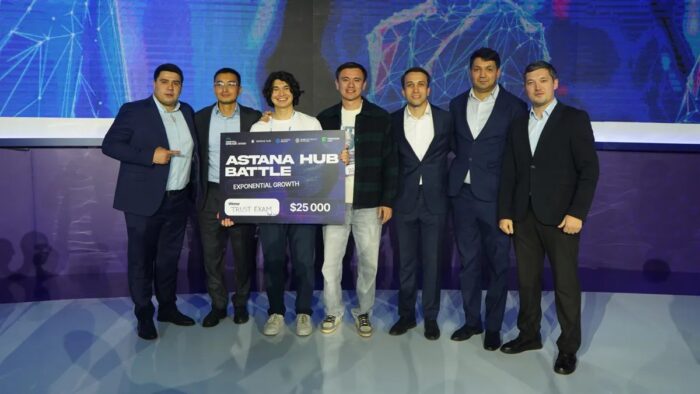
Kazakhstan’s TrustExam.ai startup recently won a $25,000 prize at the Astana Hub Battle for its innovative approach to secure online testing. Photo credit: Astana Hub
In an interview with The Astana Times, TrustExam.ai CEO and co-founder Nurali Sarbakysh shared insights about the company’s journey, the role of AI in exam supervision, and the challenges young tech companies face in Kazakhstan.
AI that sees what humans miss
Sarbakysh said the idea was born in 2020 during the COVID-19 pandemic, when universities and government institutions urgently needed to move exams online.
“There was a massive demand for secure AI proctoring solutions, and we immediately identified that gap in the market. What started as a small solution to help universities hold fair online exams quickly evolved into a large-scale system used by national testing centers, corporations, and government agencies,” he said.
The company’s proprietary AI, trained on over 1.2 million real exam sessions, detects hidden devices, subtle behaviors, and even AI-assisted cheating, such as the use of generative AI.
“Our system blocks remote desktop access, suspicious software, and screen sharing in real time. The AI continuously analyzes a user’s environment, movement, and voice patterns to detect violations automatically,” Sarbakysh said.
The platform uses computer vision and machine learning to monitor test-takers’ behavior, gaze, and presence, while emotion recognition models assess engagement, emotional levels, and authenticity of responses during oral assessments.
Sarbakysh emphasized that AI complements rather than replaces human supervision.
“The human factor will always matter. Our goal isn’t to replace people but to scale their capacity. For example, an institution that once needed 100 supervisors can now operate with five supervisors overseeing thousands of candidates through our system. AI handles routine monitoring, and humans focus on decision-making. It’s AI empowering humans,” he said.
Driving forward with impact beyond profit
Sarbakysh acknowledged that entering foreign markets was a challenge, particularly competing with established global players.
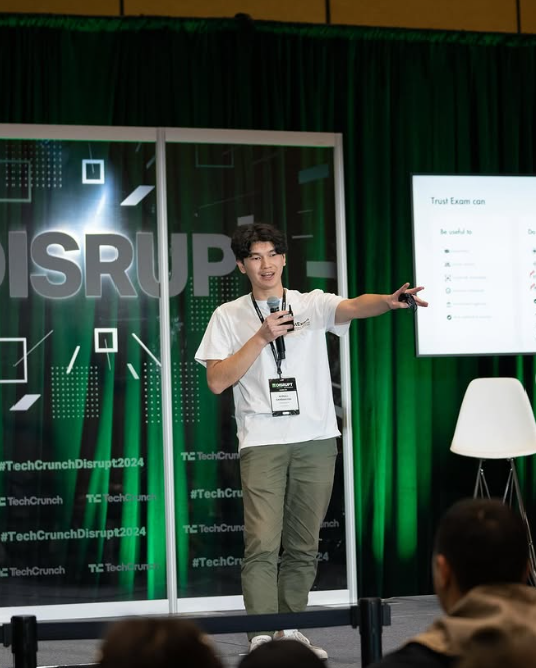
TrustExam.ai CEO and co-founder Nurali Sarbakysh. Photo credit: Sarbakysh’s Instagram page
“Five years ago, we launched in Kazakhstan, and now we power the country’s two largest national exams, serving millions of citizens every year. Later, we expanded to Silicon Valley, where we joined Stanford University’s StartX accelerator. That gave us not only validation but also access to mentors, investors, and a global network,” he said.
To date, more than four million users have taken exams through the platform, with another two million expected this year.
TrustExam.ai is now focused on the United States, Canada, and the United Kingdom, where certification exams have major financial and safety implications.
At London Tech Week 2025, TrustExam.ai established a strategic partnership with the U.K.’s Driving Instructors Association to modernize theoretical driver exams. The AI-powered solution aims to make testing faster, fairer, and more accessible.
“In the U.K., our joint venture is now certifying taxi and bus drivers, and the goal is to scale nationally to support four million exams annually,” Sarbakysh said.
According to Sarbakysh, the startup is also expanding beyond education. A new version of the system supports HR departments and professional training organizations, verifying skills and conducting secure remote interviews.
“In fact, we’re seeing a big shift. Companies are starting to treat recruitment and upskilling with the same seriousness as formal exams, and that’s where we come into play,” he said.
Sarbakysh highlighted that ethics and compliance remain a top priority while adapting to international markets.
“It’s not just legal, it’s cultural. In some regions, people are more sensitive to camera monitoring or data collection. We provide transparent privacy policies, data localization options, and fully anonymized analytics to ensure institutions feel confident in using our tools. We also partner primarily with local educational bodies to ensure our standards align with their assessment frameworks. The technology is global, but the implementation is always local and depends on the customer,” he said.
Beyond business, the company has delivered over 120,000 free exams for underprivileged students.
“One of my favorite stories is about rural kids from the Kazakh Competitive Programming Federation who got to compete fairly in national coding contests thanks to our platform. That is the impact,” he said.
Global credibility
Sarbakysh believes Kazakhstan’s EdTech sector is rapidly developing, though still young compared to fintech.
“We have promising startups such as CodiPlay and a growing number of startups exploring AI and gamified learning. The potential is huge, especially as digital education becomes more accessible and the government invests in the modernization of testing and certification,” he said.
However, he noted that many startups struggle with international credibility.
“Many startups have strong products, but when entering foreign markets, they face skepticism: ‘Are you reliable? Can you live up to the expectations? Are you compliance-tested?’ Joining Stanford’s StartX accelerator solved that for us – it opened doors, validated our work, and made conversations with global clients much smoother. But for many young companies, that bridge between local success and global trust is still missing,” Sarbakysh said.
“For us, success means both scale and impact. If one day our platform powers national certification systems in the U.K., U.S., and Canada, serving tens of millions annually, that will mean we’ve truly succeeded,” he added.
