
ASTANA – Central Asia’s vibrant youth population could become the region’s greatest asset or its greatest risk, hinging on coordinated policy action, said Fabio Losa, regional demographic resilience and policy adviser at the Regional Office for Eastern Europe and Central Asia of the United Nations Population Fund.
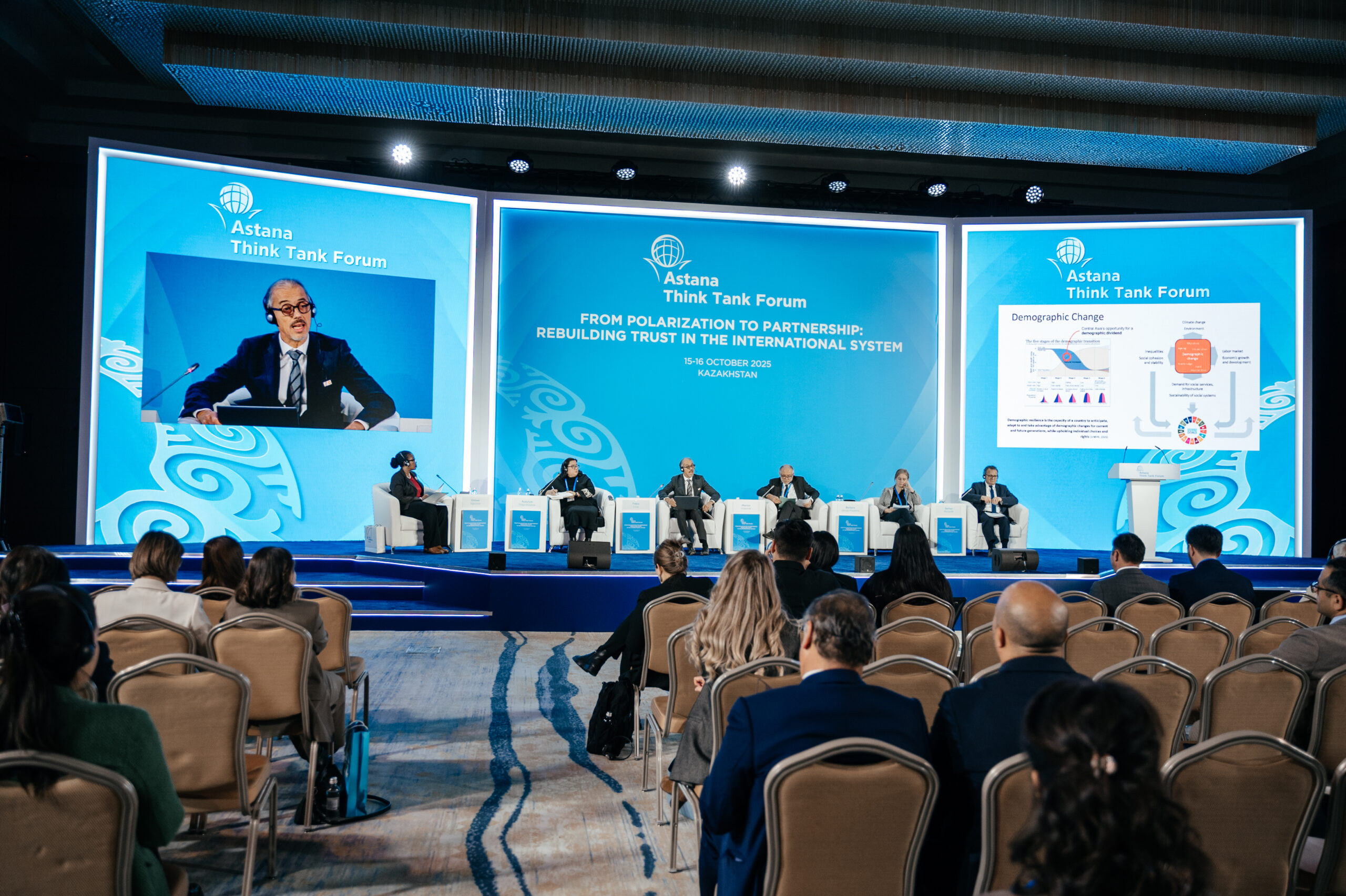
Fabio Losa, regional demographic resilience and policy adviser at the Regional Office for Eastern Europe and Central Asia of the United Nations Population Fund, addresses the session at the Astana Think Tank Forum on Oct. 16. Photo credit: KazISS
Losa warned that without strategic investment in education, jobs, and health, the region’s demographic advantage could quickly transform into a social and economic burden.
“Demographic change is about changes in population size, distribution, and, of course, composition. These changes are affecting phenomena like aging, rural depopulation, migrations, and many others. These, of course, are not just development outcomes, but they are also drivers of development,” said Losa in his remarks to the Astana Think Tank forum in the Kazakh capital on Oct. 16.
Demographic shifts should be integrated into countries’ strategic planning to strengthen demographic resilience, which Losa describes as the capacity to “anticipate, adapt to, and harness demographic shifts for the current and future generations.”
In the case of European countries that have completed their demographic transition and now face low fertility rates, the challenge lies in addressing aging populations, brain drain, labor shortages, and rural depopulation. In Central Asia, it is a totally different picture.
“You still have high fertility rates, which means that you have a youth population. And this is for the coming decades. The working age population in Central Asia is projected to rise from 50 million to 71 million by 2050. This means more than 20 million Central Asian individuals are ready to contribute to their country’s development process,” Losa said.
‘Time-bound window’
For Central Asian countries, the current demographic situation presents a unique opportunity for economic growth. With a favorable age structure and a large share of working-age population, the region faces a “time-bound window” known as the demographic dividend, a period when the labor force can drive an exceptional surge in GDP growth.
“But one important issue is that the demographic dividend is not given; it is not automatic. It depends on a precise and strategic policy framework,” he said.
Addressing demographic change demands targeted investments in healthcare systems, education, gender equality, and labor markets. Strengthening reproductive health services, empowering women and youth, and modernizing social protection systems are all essential to harness demographic dividends. At the same time, investment in data and demographic analytics is vital for evidence-based policy.
Three key conditions
Losa put forward three main conditions for this effort to become sustained.
“The first one is that these 21 million young women and men entering the productive age in Central Asia need to be prepared, educated, and skilled. Investment in human capital, education, and vocational training, in line with the Fourth Industrial Revolution, and health, are key,” he said.
He cited the World Bank’s Human Capital Index, indicating that children born in the region today will be only 50–60% as productive as they could be if they enjoyed full education and health, highlighting the scale of the challenge.
“The second condition is about an economic model and system able to create employment and entrepreneurship opportunities. Economic diversification with a focus also on labor-intensive specialization of high value and the creation of a favorable business environment will be key to absorbing these 21 million new women and men coming to their working age and boost economic growth,” Losa said.
Yet, a significant skills mismatch persists between workforce qualifications and employer demands, an issue that calls for comprehensive upskilling, reskilling, and lifelong learning programs.
Coming to the third condition, Losa underscored the importance of policies to be people-centered, inclusive, and grounded in human rights.
“Evidence shows clearly that combining economic principles with human rights, in particular gender equality and women’s empowerment, leaving no one behind, is key to long-term well-being. If these conditions are not met, if investments are not adequately thought through, the demographic dividend can transform into a demographic time bomb. A large youth cohort facing indecent or informal unemployment or inactivity represents a profound economic loss and can foster frustration, thereby increasing the likelihood of social unrest and instability,” Losa explained.
Kazakhstan’s demographic picture
Ayaulym Sagynbaeva, a national demographic expert, echoed this sentiment.
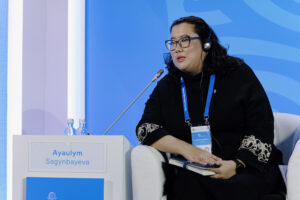
Ayaulym Sagynbaeva. Photo credit: KazISS
“During the COVID-19 pandemic, we witnessed a lower number of births, a lower number of marriages, and higher divorce rates, then in Kazakhstan, it was a totally different picture. The country experienced a demographic surge when the fertility rate reached an average of 3.3 births per woman of reproductive age. Since then, Kazakhstan has returned to its pre-pandemic demographic levels, with the current fertility rate standing at 2.8 births per woman,” said Sagynbaeva.
This is a very high indicator, according to the expert. There are, however, specific regional differences.
“We see that in the north and eastern regions of our country, there is a decrease in the population, while in the western and southern regions, we see a high growth, where the total fertility rate reaches up to four births,” Sagynbaeva said.
The average life expectancy is 75 years. “The average life expectancy of men is 71 years, and of women is 79 years. And this gap of eight years continues for a long time. This is also one of the most important aspects of analyzing the demographic process in our country,” she added.
Despite being the world’s ninth-largest country in terms of territory, population density in Kazakhstan is not high.
“Population density is 7.4 people per square kilometer. I would like to note that, at first glance, the demographic picture of Kazakhstan seems to be homogeneous and positive. But when we look at the deeper processes, we see that they are different. The processes that last hundreds of years in the world, Kazakhstan has been achieving in a few years,” Sagynbaeva said.
She also underlined the looming impact of climate change on the demographic landscape of the region. According to the expert, given its relatively favorable environmental conditions, Kazakhstan could become a kind of “climate oasis” in Central Asia, attracting people from neighboring countries in the coming decades.
