
When President Kassym-Jomart Tokayev flew into the Esenboğa international airport in Ankara, he was greeted there by President of Türkiye Recep Tayyip Erdoğan, a move full of symbolism, but also a rare one. The smiles and the long handshake that proceeded further and were captured nicely in photos speak a lot about the nature of relations between Kazakhstan and Türkiye.
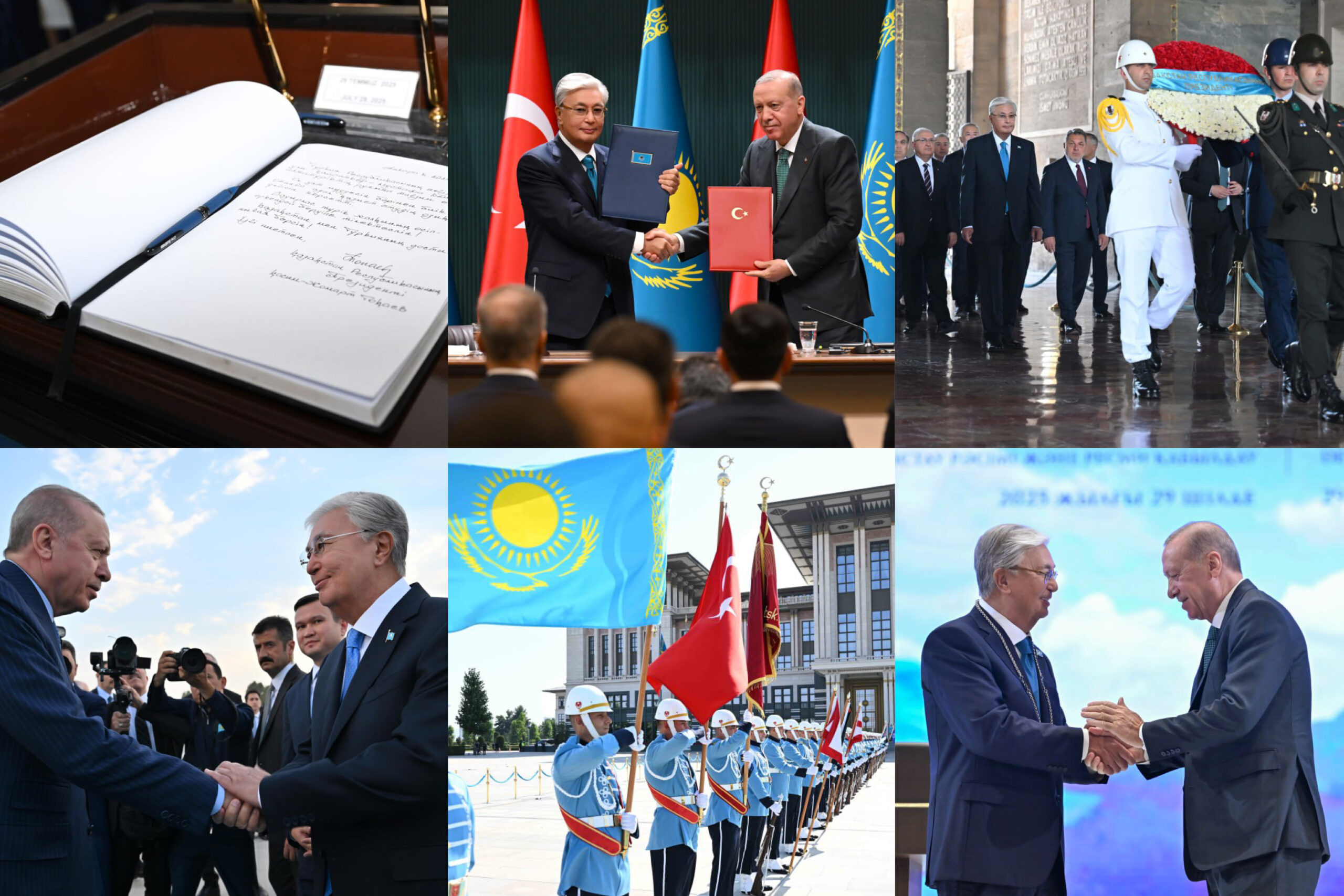
Photo credit: Akorda
Türkiye was the first country to recognize the independence of Kazakhstan in 1991. Their airlines were the first to enter the then-developing Kazakh market.
Since then, the rhetoric of brotherhood has always been present in official statements, declarations and communiques, and multiple times during Tokayev’s latest visit. Symbolism ran deep when this time Erdoğan welcomed Tokayev and his delegation to the “second home,” or when he addressed Tokayev as “kardeş,” which translates as brother in Turkish, but has a much deeper meaning in the Turkish language.

Assel Satubaldina. Photo credit: personal archive
Tokayev also accepted Türkiye’s highest state award, called Devlet Nişanı Order, from Erdoğan. I found myself thinking, Tokayev, a president who has made principled decisions to turn down foreign honors, made an exception this time, which makes it clear how deeply Kazakhstan values its bond with Türkiye.
Speaking at a ceremony, he acknowledged that this award strengthens the main asset of the two nations: the ties of friendship and brotherhood passed down from generation to generation. It is also a symbol of what Erdoğan calls an “unshakable brotherhood,” one that was proven during dark days for Türkiye in a devastating earthquake two years ago. Brothers and sisters are those we want to rely on in difficult times. And in a turbulent world we are seeing now – ripe with sanctions, conflicts, and full of uncertainty – feeling of brotherhood brings a much-wanted sense of stability and certainty.
When it comes to real politics, Kazakhstan and Türkiye are middle powers with global ambitions. Türkiye is a NATO member with a foot in both continents of Europe and Asia. Kazakhstan navigates its own multi-vector foreign policy under which it manages to keep good ties with Beijing, Moscow, Brussels, and Washington, while increasingly looking to fellow Turkic states and the Islamic world, a pragmatic policy that my colleague Aida Haidar breaks down well in her latest YouTube episode.
Beyond these ceremonial exchanges lies some good economic substance. Kazakhstan and Türkiye elevated their strategic partnership sealed in 2009 to the level of an enhanced strategic partnership three years ago. Trade between the two countries hit nearly $5 billion in 2024, and Erdoğan said clearly that the two leaders target $15 billion.
According to Tokayev, some 4,000 Turkish companies operate in Kazakhstan, implementing projects worth more than $6 billion across industries from energy and transport along the so-called Middle Corridor linking China to Europe via Central Asia to medicine and agriculture. Kazakhstan’s investments in Türkiye now exceed $2.5 billion. Add to that the 18 agreements signed during this visit, and it becomes clear how strong ties translate into hard commitments.
The partnership is also visible in the movement of people. Nearly 800,000 Kazakh citizens visited Türkiye last year, and not only for holidays. More than 12,000 Kazakh students study in the country. The recent decision of Kazakhstan to extend the visa-free stay in Kazakhstan for Turkish nationals to 90 days makes it even easier for them to travel to Kazakhstan, and I am sure each of these travels will make our ties even stronger.
For me, these ties have always been deeply personal. I grew up watching Turkish TV dramas every evening with my grandmother, when the internet was not even a thing. From “Binbir Gece” and “Kurtlar Vadisi” to “Haziran Gecesi,” Turkish culture has been deeply ingrained in my mind since childhood.
I continued watching Turkish TV series as an adult, and at some point, I realized I had picked up the language by accident. Similarity with my mother tongue, the Kazakh language, was very helpful.
The flow of the language, the characters, the humor, the non-verbal gestures, and the music. All of it made Türkiye feel less like a foreign country and more like a relative. That is why, when President Erdoğan greeted President Tokayev with the words “Welcome to your second home,” it was personal. Perhaps, my love for the country is a product of soft power, but in many ways, Türkiye does feel like a second home.
