
ASTANA – Artificial intelligence should become the driving force behind the development of all industries, said President Kassym-Jomart Tokayev during an Aug. 11 meeting on AI development, underscoring its role as a strategic priority for Kazakhstan.
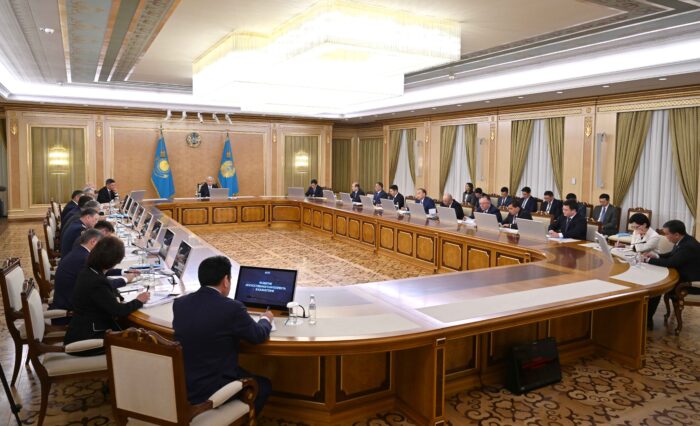
Photo credits: Akorda
The meeting was attended by Prime Minister Olzhas Bektenov, Head of the Presidential Administration Aibek Dadebay, members of the government, and heads of central government agencies, reported Akorda.
AI as a driver of national growth and independence
Tokayev emphasized that without the adoption and advancement of AI, it is impossible to remain competitive in today’s global landscape. According to forecasts from the United Nations Conference on Trade and Development (UNCTAD), the global AI market is expected to reach $4.8 trillion by 2033, with its share of the tech industry projected to rise from 7% to 29%.
President Tokayev stated that while Kazakhstan has made some progress in AI, the current pace is insufficient. He called for intensified work in this strategic area and reaffirmed that AI must become a key element of national independence and a core engine of economic growth.
Global trends and Kazakhstan’s strategic course
Referring to international developments, he pointed to the United States’ recent adoption of America’s AI Action Plan and China’s initiative to establish the global AI cooperation organization. He instructed Kazakh specialists to study these international strategies and supported Kazakhstan’s participation in the preparatory work for the proposed multilateral body, underscoring the need for the country to become a digital hub in Eurasia.
Tokayev reiterated the importance of transitioning to a unified national digital ecosystem. Despite earlier instructions on preparing necessary infrastructure, legal frameworks, and AI implementation mechanisms, he expressed dissatisfaction with the slow pace of progress.
Comprehensive national AI strategy required
To systematize the country’s efforts, the President tasked the government, in collaboration with the Agency for Strategic Planning and Reforms, to develop a comprehensive program for AI development and digital transformation. He emphasized that the document must be pragmatic, involve international experts, and outline concrete steps for integrating AI across various sectors of the economy and public administration. The strategy should also focus on labor market adaptation through large-scale training and skills development.
Nine strategic areas for AI implementation
Tokayev identified nine key areas that should form the foundation of Kazakhstan’s AI policy. These include the application of AI in the real sector to drive economic modernization and productivity, digitalization of government processes, and the implementation of AI in healthcare to enable accurate diagnostics and treatment planning.
He also emphasized the need to improve the regulatory framework for AI, drawing on international best practices, and to accelerate the development of digital infrastructure. Referring to the recent launch of Central Asia’s largest supercomputer cluster, Tokayev underlined the importance of ensuring its full and equal accessibility for practical use. He instructed that all components of the national digital ecosystem, including state and quasi-state systems, be migrated to a sovereign digital platform.
Strengthening cybersecurity and secure communications
President Tokayev addressed the growing cybersecurity challenges posed by AI technologies, such as biometric identity theft and misinformation through deepfake content. He noted that over 40 significant data leaks have occurred in Kazakhstan since the start of the year, with the largest incident in June, and stated that the state must take full responsibility for national digital security.
Tokayev also raised concerns over the use of international messengers for transmitting personal data, which often violates data protection laws. He proposed shifting to secure domestic platforms, such as the Aitu messenger, for all official and personal data communications.
Human capital and education in AI
In line with ensuring long-term sustainability, Tokayev emphasized the need to cultivate AI proficiency among the younger generation. He mentioned the ongoing AI-Sana training initiative, aimed at equipping students with foundational AI skills, and called for its expansion. He also emphasized the need for teacher upskilling in AI, assigning this responsibility to the relevant ministry.
Fostering innovation, startups, and investment
Touching on the global investment climate, President Tokayev noted that in 2024, nearly $100 billion was invested in AI startups worldwide, representing over one-third of global venture capital. With competition for talent and funding intensifying, he stressed the importance of creating a favorable ecosystem in Kazakhstan that can attract both.
He praised promising Kazakhstan’s AI startups, some of which he said have the potential to become unicorns, and called for targeted state support for young talent. The President instructed the government to introduce export support measures for local AI startups and to revive the digital ambassador initiative to promote Kazakhstan’s digital innovations abroad.
Concluding the meeting, Tokayev reaffirmed that building a strong national AI sector is of strategic importance for the country’s future. He underscored that Kazakhstan must become an advanced digital state and that the development of artificial intelligence will remain under his personal supervision.
