
ASTANA – Kazakhstan’s proposal to expand exports to Canada across 45 product categories worth approximately $255 million comes as global trade relationships are being reshaped by growing geopolitical and economic uncertainty. Financial analyst Andrei Chebotaryov told The Astana Times that while the proposed figure is relatively modest, Kazakhstan’s initiative could lay the groundwork for a broader trading relationship.
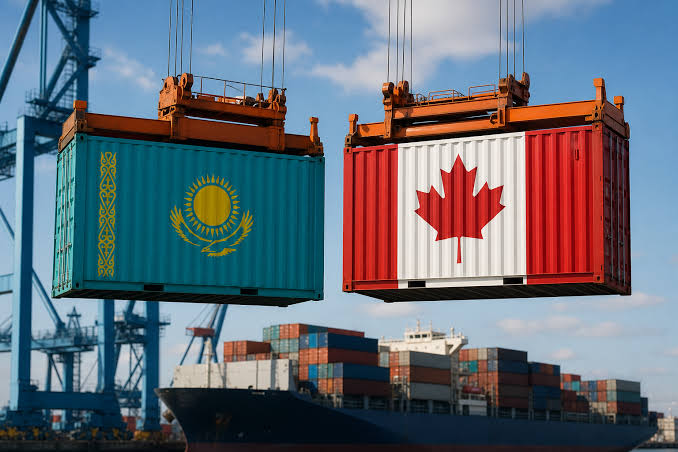
Photo credit: Ai generated image/ Atameken Business
“$255 million is modest, but the amount is not the important part. This initiative creates a precedent and infrastructure for relations that can be scaled up,” Chebotaryov said.
A small market opportunity with wider implications
During a Sept. 17 telephone conversation, Kazakhstan’s Minister of Trade and Integration, Arman Shakkaliyev and Canada’s Minister of International Trade, Maninder Sidhu, discussed expanding trade and investment cooperation. Kazakhstan presented a list of potential exports to Canada covering 45 product categories and valued at about $255 million. The two officials also agreed to work toward a joint economic action plan focused on trade facilitation, investment and sectoral cooperation.
The proposal comes against a backdrop of already growing bilateral trade. According to Canada’s Global Affairs department, merchandise trade between the two countries reached $727.9 million in 2025, up 53.2% from 2024. More than 160 joint ventures with Canadian capital currently operate in Kazakhstan.
The figures suggest that the relationship is developing, but also indicate room for further expansion.
Trade diversification gains urgency
The timing is significant. Canada has been seeking to broaden its international economic relationships amid tensions with its largest trading partner, the United States. Recent measures affecting Canadian and U.S. trade have increased pressure on businesses to assess supply-chain and market concentration risks.
An analysis published by Canadian writer Kevin Boucher argues that Ottawa’s broader strategy is not simply about shifting toward China, but about reducing dependence on any single trading partner by building a wider network of economic relationships. Boucher points to Canada’s efforts to strengthen ties with Europe and Asia alongside its relationship with China.
For Kazakhstan, this creates a potential opening.
“Right now, we are seeing a global restructuring of trade chains, which opens windows of opportunity for medium-sized economies,” Chebotaryov said. He noted that Kazakhstan’s position between major economic centers allows it to pursue commercial ties with different markets rather than relying exclusively on one partner.
From raw materials to higher-value exports
The more important question, however, is what Kazakhstan ultimately exports. The bilateral discussions identified critical minerals and mining, nuclear energy, agriculture, aerospace and transport as potential areas of cooperation. Canada also proposed sharing experience in small modular reactors and CANDU technology, while the two officials discussed Canadian agricultural technologies and cooperation in the mining sector.
For Kazakhstan, the challenge is to ensure that greater access to the Canadian market does not simply increase shipments of unprocessed commodities.
“The risk is significant: we could remain a supplier of primary raw materials and fail to move toward processing. $255 million in raw materials is a good start, but hopefully not the end of the story,” Chebotaryov said.
This question is particularly relevant to the critical minerals agenda. Both countries have substantial mining experience, but Kazakhstan has increasingly emphasized shifting from extraction to processing and higher-value products.
What to watch next
The $255 million export proposal is only a first step. Its success will depend on whether Kazakh products enter the Canadian market and whether planned cooperation leads to new investments and projects.
Shakkaliyev and Sidhu also discussed using the Trans-Caspian International Transport Route, or Middle Corridor, to diversify trade routes. For Kazakhstan, this could create another channel to expand trade with Canada and connect Canadian businesses with markets in Central Asia and beyond.
The broader goal is to use new markets not only to increase exports, but also to attract investment and develop higher-value production.
