
ALMATY – Trade between Kazakhstan and Uzbekistan reached $2.8 billion in the first half of 2026, making Kazakhstan Uzbekistan’s third-largest trading partner and highlighting a relationship that is moving beyond traditional commodity exchanges toward manufacturing, agricultural trade and integrated production chains.
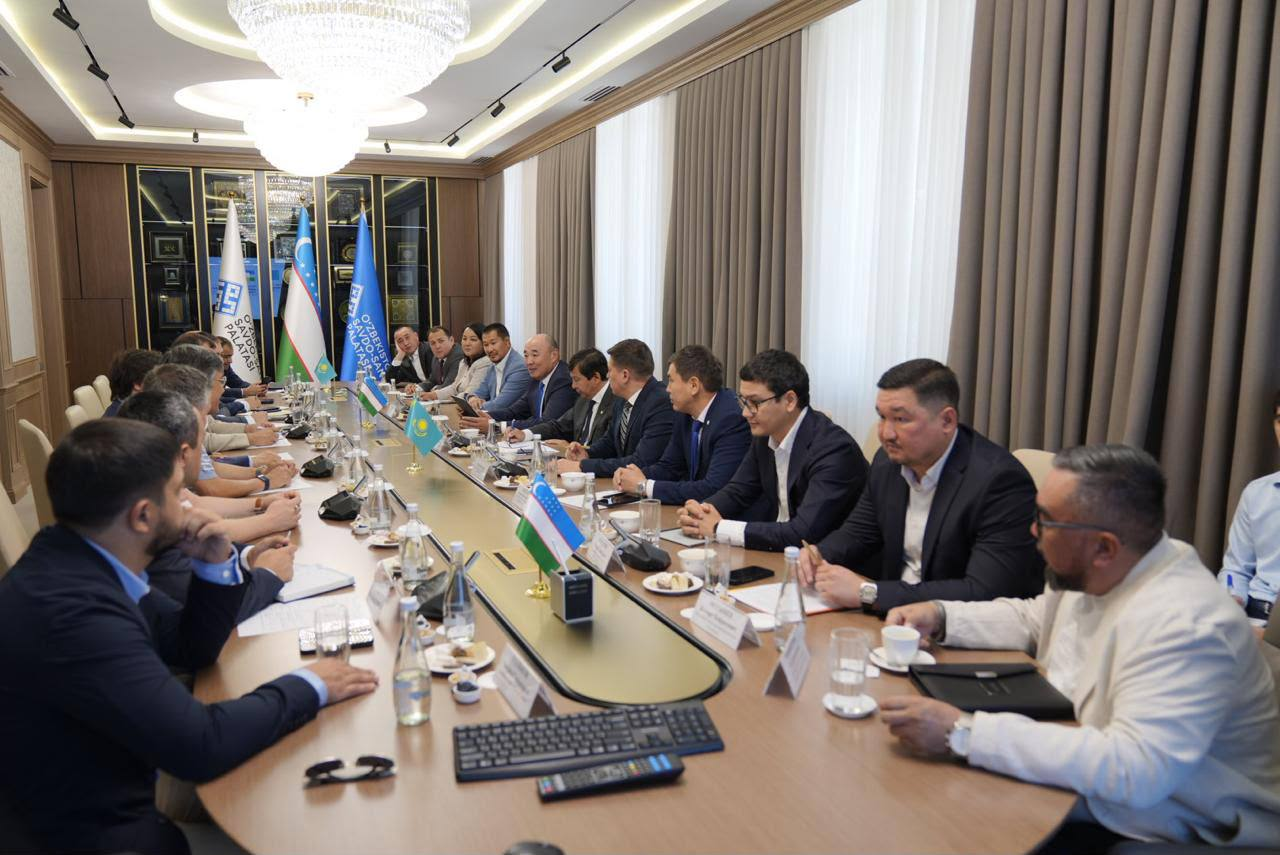
The 7th Meeting of the Uzbekistan–Kazakhstan Business Council was held in Tashkent on Aug. 6, where officials discussed how to transform the strong momentum in bilateral trade into new investment projects. Photo credit: Chamber of International Commerce of Kazakhstan.
According to Uzbekistan’s National Statistics Committee, Kazakhstan accounted for the third-largest share of Uzbekistan’s foreign trade in January-June, behind China with $9.5 billion and Russia with $7 billion. Türkiye ranked fourth with $1.4 billion.
The latest figures come as businesses and governments on both sides seek to turn rapidly expanding trade into longer-term investment and production cooperation. In 2025, bilateral trade reached $4.8 billion, up 16.2% year on year. The first months of 2026 suggest that momentum has continued.
According to data presented by the Atameken National Chamber of Entrepreneurs on Aug. 6, trade between the two countries reached $2.3 billion in January-May, 37.2% higher than in the same period of 2025. Kazakhstan’s exports increased particularly rapidly, while imports from Uzbekistan also continued to grow, reported the Chamber of International Commerce of Kazakhstan.
The figures point to a relationship that is becoming important for both countries as they seek to strengthen regional value chains and reduce dependence on distant markets.
From trade growth to deeper economic integration
The headline increase in trade is significant, but its composition may be more important than the total value itself. Kazakhstan’s trade turnover with Uzbekistan grew by 34.7% year on year to $2.8 billion in January-June. Uzbekistan has moved from eighth to sixth place among Kazakhstan’s trading partners over the past year, while its share of Kazakhstan’s total trade increased from 3.1% to 3.9%.
The strongest growth has come from Kazakhstan’s exports, which rose 39.5% to nearly $2.1 billion. Wheat accounted for almost 27% of Kazakhstan’s exports to Uzbekistan, reaching $571.6 million. Wheat exports nearly doubled over the year. Other significant increases were recorded in sunflower oil, beef, lamb and metal products.
The trend is notable because Kazakhstan has traditionally been associated with commodity exports. Yet the structure of its exports to Uzbekistan has been changing.
In 2017, raw materials and products classified as “near-raw materials” accounted for 65.3% of Kazakhstan’s exports to Uzbekistan. By 2025, their share had fallen to 35.5%, while semi-finished products increased from 29% to 40.2% and finished goods, excluding re-exports, rose from 3.4% to 20.5%. The first half of 2026, however, shows that this transition is not yet linear. Raw materials accounted for 39.9% of exports, semi-finished products for 38.2% and finished goods for 17.9%.
This longer-term shift reflects a broader challenge for Kazakhstan: increasing the value generated from its existing resource base rather than relying primarily on higher volumes of commodity exports.
“Metal products, for example, can be different. You can simply export ore or some initial products of processing, or you can already export rolled metal and metal products. They may fall under approximately the same export category, but each time this actually implies an increasingly higher level of processing of the same raw material,” said Farkhad Kassenov, head of the A+ Analytics research center, political scientist and international relations expert.
He said diversification has become increasingly important because Kazakhstan cannot rely indefinitely on expanding raw-material exports.
“Diversification is extremely important, and recent efforts have been aimed exclusively at this, because it is impossible to increase GDP only through a mechanical increase in raw material exports,” he said.
The data on trade with Uzbekistan show both progress and limitations. The share of finished goods in Kazakhstan’s exports to the Uzbek market has increased significantly since 2017, but the first half of 2026 also saw the share of raw materials rise again. In other words, the transition toward higher-value exports is visible over the longer term, but it is not yet firmly established.
Uzbekistan becomes part of Kazakhstan’s production chains
Around $162 million, or 24% of Kazakhstan’s imports from Uzbekistan, consisted of vehicles, parts and components. Among the largest individual categories were passenger-car bodies, worth $81.6 million, and engines, worth $51.8 million.
Kazakhstan’s broader push toward higher-value production could make such cross-border industrial links increasingly important. Kassen highlights that the country’s next stage of economic development should involve bringing foreign partners into domestic technological and production chains rather than relying on a simple exchange of raw materials for investment.
This is particularly relevant to Kazakhstan’s automotive industry, where Uzbek-made components could become inputs into domestic production.
Investment cooperation is already beginning to develop alongside trade. Kazakhstan and Uzbekistan are currently implementing 80 joint projects worth approximately $1.8 billion. At a recent Uzbekistan-Kazakhstan Business Council meeting in Tashkent, representatives of the two countries discussed moving from trade growth toward joint production, localization and the development of shared value chains.
The next challenge: turning trade into production
At the seventh meeting of the Uzbekistan-Kazakhstan Business Council, participants also proposed creating a unified list of joint projects with designated responsible parties and implementation timelines. The objective is to track whether agreements actually progress into investment and production.
They also identified customs procedures, technical regulation, phytosanitary controls, access to raw materials, logistics, cross-border payments and mutual recognition of permits as barriers that businesses continue to face. The proposed response is a more permanent mechanism for collecting business requests and bringing the most significant problems to the level of the intergovernmental commission.
The $2.8 billion trade figure therefore represents more than another annual increase in bilateral commerce. It points to an economic relationship that is becoming broader and more interconnected. For Kazakhstan and Uzbekistan, the opportunity is to move from trading across a border to producing across it.
